Reducing Solvents in Sole Bonding
This article details a survey about solvents and solvent reduction in cleaner, primer, adhesives, and hardeners.
For several years there has been a tendency to eliminate solvent or to reduce VOCs in the sport-shoe industry, especially in outsole bonding. However, there is really no VOC, so what can realistically be achieved?
The following article is a survey about solvents and solvent reduction in cleaner, primer, adhesives, and hardeners.
The results for rubber outsoles depend not on the addition of any cleaning agent; only some acids help to reduce the blooming. For EVA, almost no additives are used; therefore in ultrasonic cleaning no solvents are used.
Some countries are still running their lines without ultrasonic cleaning with good bonding results. The real purpose of the cleaning is to remove the release agent. However, GC still shows a lot of contamination.
So how are the parts really cleaned? The rubber outsole is not cleaned again in the line because a primer with reduced solvent content is doing two jobs: cleaning and priming. So, for pylon, MEK is still used in the line or as a primer with 50% water, MEK and IPA, resulting in an actual VOC reduction of 50%. Cleaners with less solvent (25%) are being tested.
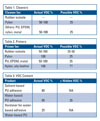
Additionally, the parts of PU, EPDM, metal and nylon are cleaned in the same way. Table 1 shows that VOCs of cleaners can be reduced to 25%.
For rubber outsoles, the biggest step is achieved with a reduction of 50-75%. However, the stability of the primer is still the best with 100%. With 50% VOC, the shelf life is reduced, and with 75% it is still very short. The best results are with 50% VOC. However, testing of new and improved primers is still being conducted.
Pylon soles are still primed with a solvent-based UV-curing primer. Here VOC content is 95%. For some materials and models, a solvent-free primer (PU-primer) is used. This currently represents only 5% of the market and offers great potential. However, the residues of the release agent reduce the adhesion of any water-based primer. Other options include a better cleaning process to remove the release agent, which is currently being tested.
For all other materials like PU and leather, water-based PU primer can be used. However, there are also VOCs that are “hidden” during the production of the PU raw material. For nylon and EPDM, material solvent-based primers are still required.
In total, we still have 35% VOC during production. However, the solvent (VOC) problem changed from the shoe factories to the raw-material suppliers. This is the “hidden” VOC.
The change from solvent-based adhesives to water-based adhesive results in only around 45% VOC reduction. This is also true for the PU raw materials used for primers.
Also, to achieve better distribution and wetting, the hardener contains 25% solvent (VOC). If 5% hardener is added to the PU adhesive, the mixture contains 1% VOC in total. So zero VOC does not always equal zero VOC.
A small amount of solvent is still necessary for better wetting and penetration. Most sport-shoe factories understand this and allow small amounts of non-hazardous solvents.
For more information contact Tack Service, phone 49-2801-705939, fax 49-2801-3600, e-mail TACKSERVICE@aol.com or tack-service@t-online.de, or visit www.tack-service.com.
For several years there has been a tendency to eliminate solvent or to reduce VOCs in the sport-shoe industry, especially in outsole bonding. However, there is really no VOC, so what can realistically be achieved?
The following article is a survey about solvents and solvent reduction in cleaner, primer, adhesives, and hardeners.
Tables 1-3.
Cleaner
In sole bonding, the most-cleaned parts are rubber outsoles and the midsoles of pylon (EVA thermo molded and injected and reacted in mold). This is a solvent-free process in an ultrasonic line with or without additives.The results for rubber outsoles depend not on the addition of any cleaning agent; only some acids help to reduce the blooming. For EVA, almost no additives are used; therefore in ultrasonic cleaning no solvents are used.
Some countries are still running their lines without ultrasonic cleaning with good bonding results. The real purpose of the cleaning is to remove the release agent. However, GC still shows a lot of contamination.
So how are the parts really cleaned? The rubber outsole is not cleaned again in the line because a primer with reduced solvent content is doing two jobs: cleaning and priming. So, for pylon, MEK is still used in the line or as a primer with 50% water, MEK and IPA, resulting in an actual VOC reduction of 50%. Cleaners with less solvent (25%) are being tested.
Additionally, the parts of PU, EPDM, metal and nylon are cleaned in the same way. Table 1 shows that VOCs of cleaners can be reduced to 25%.
Primer
All materials, like rubber outsole, pylon, EPDM, PU, metal, and leather, need primer before any adhesives are applied. All products still contain solvents like acetone, MEK, ethyl acetate or IPA, or mixtures, either alone or as a mix with water.For rubber outsoles, the biggest step is achieved with a reduction of 50-75%. However, the stability of the primer is still the best with 100%. With 50% VOC, the shelf life is reduced, and with 75% it is still very short. The best results are with 50% VOC. However, testing of new and improved primers is still being conducted.
Pylon soles are still primed with a solvent-based UV-curing primer. Here VOC content is 95%. For some materials and models, a solvent-free primer (PU-primer) is used. This currently represents only 5% of the market and offers great potential. However, the residues of the release agent reduce the adhesion of any water-based primer. Other options include a better cleaning process to remove the release agent, which is currently being tested.
For all other materials like PU and leather, water-based PU primer can be used. However, there are also VOCs that are “hidden” during the production of the PU raw material. For nylon and EPDM, material solvent-based primers are still required.
Adhesives
Most VOC reduction was achieved in the switch from solvent-based PU adhesives to water-based PU adhesives. However, while the VOC reduction changed in the shoe factories, solvents (acetone) are still being used in the production of any PU raw materials: 3-5% are used for the cleaning of the reactor, and another 30% are used for the production of the PU emulsion. Acetone is so contaminated with catalyst and water it must be incinerated.In total, we still have 35% VOC during production. However, the solvent (VOC) problem changed from the shoe factories to the raw-material suppliers. This is the “hidden” VOC.
The change from solvent-based adhesives to water-based adhesive results in only around 45% VOC reduction. This is also true for the PU raw materials used for primers.
Also, to achieve better distribution and wetting, the hardener contains 25% solvent (VOC). If 5% hardener is added to the PU adhesive, the mixture contains 1% VOC in total. So zero VOC does not always equal zero VOC.
A small amount of solvent is still necessary for better wetting and penetration. Most sport-shoe factories understand this and allow small amounts of non-hazardous solvents.
Summary
The sport shoe industry is on its way to solvent-free, but still has a ways to go. In 1996, my lab manager told me: “Tomorrow we work with water based.” It seems tomorrow has yet to come.For more information contact Tack Service, phone 49-2801-705939, fax 49-2801-3600, e-mail TACKSERVICE@aol.com or tack-service@t-online.de, or visit www.tack-service.com.
Links
Looking for a reprint of this article?
From high-res PDFs to custom plaques, order your copy today!