New Technology
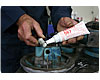
Early anaerobic threadlockers were effective at maximum continuous operating temperatures of 300°F and were unreliable in high-temperature applications. Current anaerobic adhesives have been formulated to withstand temperatures up to 650°F without degrading.New high-temperature/high-strength anaerobics thrive in demanding applications and environments, including industrial ovens and boiler rooms, as well as heat-treating operations in refineries, paper mills, metal-fabrication plants, and glass-manufacturing facilities. Despite their high heat resistance, these new threadlockers can be removed with standard hand tools after the fastener is heated to 700-750°F for about five minutes.
Regardless of their physical form, all anaerobic adhesives facilitate fastener assembly by providing lubrication as the fastener is tightened. This lubrication allows applied torque to be converted into high clamp load instead of dissipating as friction or heat. On bolts that are 7/8-inch in diameter or larger, friction between the threads reduces potential clamp load. Recently developed high-lubricity threadlockers more effectively control friction and reliably convert torque energy into clamp load.
The odor of traditional anaerobic adhesives can be a concern when the materials are used in confined space applications. New anaerobic products are available with greatly reduced odor, allowing users to work in close proximity to the liquid with less exposure to chemical fumes.
For more information, contact Henkel Corp., One Henkel Way, Rocky Hill, CT 06067, or visit www.henkelna.com/loctite.

SIDEBAR: Anaerobic Glossary
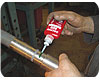
Threadlocking adhesives.These adhesives fill the grooves of threads and cure to a hard thermoset plastic that locks threads together, preventing unwanted movement or loosening and leakage or corrosion. These adhesives offer high shear strength, good temperature resistance, rapid cure, easy dispensing and excellent vibration resistance. They can reliably and inexpensively ensure that a threaded assembly will remain locked and leakproof for its entire service life.Thread sealants.These easy-to-apply products block the naturally occurring leak path located where the crest and the root of a pipe thread meet. Once cured, these materials seal and lock threads. During assembly, they act as a lubricant to promote tightening while ensuring consistent assembly torque.
These materials provide instant low-pressure (500 psi) seals, and many formulations will seal to pressures of 10,000 psi after cure. Thread sealants can seal pipe unions and compression fittings, and provide exceptional fluid compatibility and sealing ability.
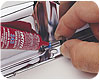
Retaining compounds.Anaerobic retaining compounds are applied to the inside and outside diameter of parts and enable rigid cylindrical assemblies to be bonded with adhesives rather than by mechanical means, such as press fits or shrink fits. Once cured, retaining compounds offer high adhesion to metal surfaces through mechanical interlocking and chemical bonding. Retaining compounds are used to assemble clearance, slip and interference fits. They also fill imperfections and augment fits on worn shafts and slip fits.
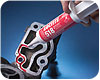
Formed-in-place anaerobic gaskets and flange sealants.These materials produce leakproof seals between mating flanges, preventing the release of moisture, gasses, fluids, or contaminants. Formed-in-place gaskets and sealants fill the surface roughness between mating metal parts and add structural strength to an assembly. In their uncured state, anaerobic gaskets and flange sealants flow into the microscopic surface irregularities on metal substrates and fill the voids between flange faces. When cured, they unitize the assembly, withstand thermal expansion of the mated parts, and resist a range of chemicals. These materials can be applied to any size flange, minimizing cut gasket inventories.