The 2013 May Adhesives and Sealants Industry Magazine includes articles about PPG and Bostik, as well as a Q&A about polyurethane. Check it out today!
"Environmentally friendly” can mean many different things. For Emerald Performance Materials—a mid-sized specialty chemicals company with four business groups, eight manufacturing operations and sales to more than 70 countries across the globe—it has meant making a concerted effort to reduce emissions and consider ways to improve the chemical composition and volatile organic compound (VOC) levels of products.
Graco Inc. recently announced its new InvisiPac™ Tank-Free™ hot-melt delivery system for case and carton sealing applications is available through distributors.
A VIP list of political, business and economic development leaders helped Bostik celebrate the grand opening of its expanded business and technology center in Wauwatosa, Wis., late last year.
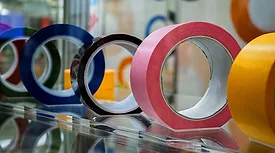
The Pressure Sensitive Tape Council’s Tape Summit 2013 will be held May 13-17 at the Sheraton New Orleans Hotel in New Orleans, La. Industry professionals will benefit from a variety of focused learning opportunities, including Tape University, TECH 36, and the Exhibitor and Technical Poster events.
Acrylic polymers are widely used in pressure-sensitive adhesive (PSA) applications in the form of emulsion, solvent or radiation-cured systems. They combine good UV resistance, transparency, tailored tack, and stiffness due to a large choice of acrylic and methacrylic comonomers.
Today’s hot-melt formulators face many challenges, including variations in the availability of raw material supply and the pressure to reduce formulation costs. High-efficiency polymers can help formulators by reducing formulation viscosity or increasing formulation flexibility, which allows for the exchange of resin or oil for polymers.
Mussels can be a delicious meal, but the chemistry that lets mussels stick to underwater surfaces may also provide a highly adhesive wound closure and more effective healing from surgery.
Almost two-thirds of adhesives produced each year in the U.S. are from non-renewable petroleum resources. However, each year brings added pressure to search for alternatives to petroleum-based adhesives, as oil prices rise and concerns over pollution released during the manufacture of these products grow.
Carbon nanotubes (CNTs) are nanometer-scale tubular structures consisting entirely of carbon atoms (see Figure 1). They represent a newly discovered elemental form of carbon and have remarkable properties in terms of mechanical strength, thermal conductance and electrical conductivity.
PPG Industries’ Protective and Marine Coatings (PMC) business recently received the 2013 Military Coatings Project Award of Excellence from The Society for Protective Coatings (SSPC) during the SSPC 2013 event held January 14-17 in San Antonio, Texas.
QUESTION: We are looking for adhesives with high electrical conductivity for several assembly operations. What alternatives do we have?
I’m writing this column one day after the horrific terror attacks in Boston. Authorities are unsure whether the origination was domestic or foreign, and we’ve all got more questions than answers. The thoughts and prayers of all of us at ASI are with those affected by the attacks.
For many years, we have been hearing about green adhesives, paints, household cleaners and buildings—basically, green everything.
Over the past couple of years, the concept of alternative assessment (AA) has become much more common in the regulatory environment.
I would like to achieve the high performance of a two-component polyurethane coating, but my application process is only able to handle a one-component system. Can any existing formulations help me make this performance leap?
Edward Gotch, president of Emerald Kalama Chemical, talks about embracing sustainability with Susan Sutton, editor-in-chief.
The 2013 May Adhesives and Sealants Industry Magazine includes articles about PPG and Bostik, as well as a Q&A about polyurethane. Check it out today!
The Handbook of Sealant Technology provides an in-depth examination of sealants, reviewing their historical developments and fundamentals, adhesion theories and properties, and today’s wide range of applications.
|
|
With access to over one million professionals and more than 60 industry-specific publications, Clear Seas Research offers relevant insights from those who know your industry best. Let us customize a market research solution that exceeds your marketing goals.