How Spatter Application Adhesives Expand Coverage and Efficiency
Spatter application of adhesives demonstrates how methods are evolving to simplify installation while ensuring reliable performance.
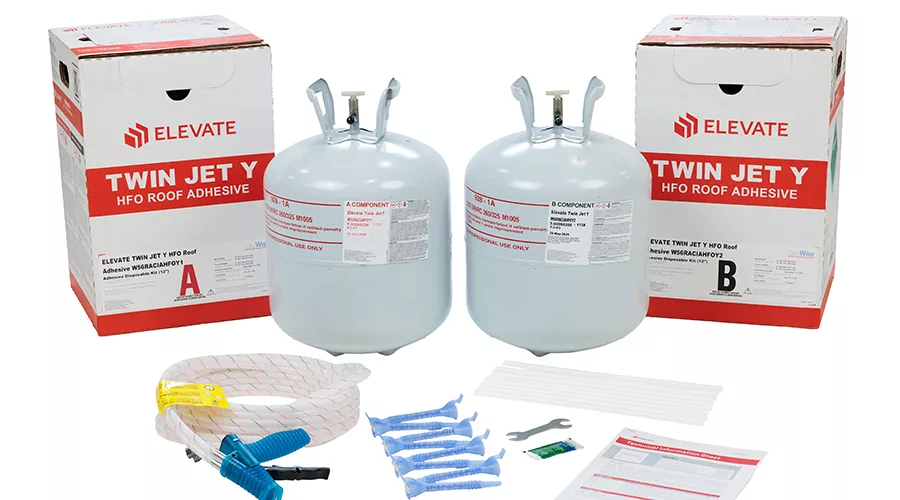
Elevate Twin Jet Y is the first FM-approved spatter-applied adhesive in a canister.
For many commercial roofing projects, low-rise foam adhesives are widely used for insulation and membrane attachment because they drive installation speed, reliable adhesion, and adaptability across climates. Contractors expect adhesives to deliver strong bond strength, fast application, cold-weather usability, and safety/environmental compliance. Installers should weigh these needs against the building requirements to determine how different spray methods, such as bead or spatter application, could affect efficiency and finished roof performance. Adhesives play a vital role in roofing assemblies by delivering resilience and efficiency, helping systems withstand wind forces, maintain a smooth, uniform appearance, and adapt to uneven surfaces. The adoption of the spatter application builds on these fundamentals, showing how application methods are evolving to simplify installation while ensuring reliable performance.
Adhesive Spray Patterns: From Bead to Spatter
For years, the standard method for applying low-rise foam adhesives has been dispensing continuous rows (or “ribbons”) of wet adhesive that, through a chemical reaction, expand into “beads” before being used to mate two surfaces. When more adhesion is needed — for example, in the corners and at the edges of a roof where wind uplift forces are higher — the adhesive ribbons are spaced closer together. Where less adhesion is needed, the rows are spaced farther apart. Ribbon spacing can be as close as 4" or as far as 12". But project requirements vary, so more adhesive isn’t always necessary, and bead application is labor intensive.
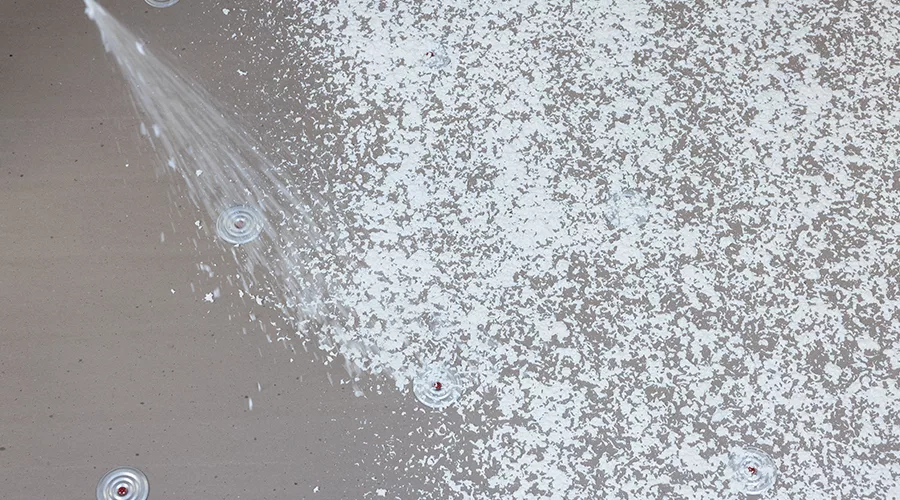
While bead applications remain appropriate for many projects, the roofing industry has been shifting toward dispensing low-rise foam adhesives in spatter application whenever possible to conserve labor and material costs. The spatter method distributes adhesive in a uniform pattern that covers the same surface area in less time and sometimes uses less material than bead applications. The key is to dispense enough adhesive over a given area for the chemical reaction to take place, but not so little adhesive that the foam doesn’t rise or so much that the adhesive pools and doesn’t set correctly.
Testing agencies like Factory Mutual (FM) and Underwriters Laboratories (UL) have increasingly approved spatter application of adhesives to attach fleece-backed membranes to insulation and successive layers of insulation boards, confirming that this innovative application method meets rigorous standards. FM testing exposes test samples to a number of scenarios. Passing these tests gives specifiers and contractors confidence that spatter is not only a convenient option, but a validated, code-compliant solution.
Application Advances: Spray-Gun and Canister Delivery
Spatter application has improved with advancements in spray-gun-nozzle geometry. Where traditional spatter applications would require the technician to "eyeball" the coverage rate and use their own arm and wrist motion to create the spatter pattern, new guns and spray tips have been designed to deliver a fan pattern. This new innovation allows for an evenly applied adhesive that improves consistency, reduces overspray, and improves coverage rates.
Because many adhesives on the market capable of being applied using the spatter method are often packaged in convenient canisters instead of large totes or drums, roofers are often able to forego the use of bulky spray rigs and hoses that require multiple people to operate. The rise of canister sprays has also transformed the jobsite, delivering faster tack, less bending and kneeling, and easier portability for contractors. Instead of hauling pails and rollers up ladders or across the roof, crews can move lightweight canisters quickly and cover more area with less physical strain.
Improving cold-weather performance of compressed adhesives reduces the anxiety of contractors who may worry about changing weather conditions. Canisters need to be heated to 60-80 °F in order to ensure that the propellants in the canister have the appropriate pressure to dispense them, but when stored properly, some adhesives can be installed down to temperatures as low as 30 °F.
FM-Approval and Board-to-Board Spatter Applications
When an adhesive receives FM approval, it represents compliance with rigorous performance standards that are widely recognized by insurers and specifiers. The first FM-approved spatter-applied adhesive in a canister, Elevate™ Twin Jet Y, represents a milestone for the industry, demonstrating that this newer application method is approved for attaching insulation layers and membrane in a demanding market.
Board-to-board applications are particularly important for jobs where mechanically fastening is inefficient or impractical, such as installations over structural concrete roof decks. While the initial layer of insulation must be installed in a bead pattern, each additional layer can be installed with improved efficiency, both from a material and labor perspective. This combination of validated performance and practical benefits reflects the growing role spatter application is playing in the industry.
Sustainability and Environmental Considerations
Adhesives packaged in canisters deliver higher yield, meaning fewer canisters are needed to cover the same area compared to less efficient application methods. For contractors, this can translate into fewer changeouts and less waste on the jobsite. For building owners, it can help reduce dumpster space and disposal costs, helping to make spatter-application adhesives a more sustainable solution.
Outlook: The Future of Adhesive Application in Construction
Spatter application of adhesives represents an important step forward in commercial roofing, offering contractors an efficient and cost-effective way to achieve uniform coverage with strong, reliable bonds. These innovations are part of a broader evolution in adhesives, where ease of use, efficiency, and regulatory compliance are shaping the next generation of products.
Visit the Elevate and Gaco websites for more information. Elevate and Gaco are part of the Amrize Building Envelope portfolio of brands.
Article images courtesy of Amrize Building Envelope.
Looking for a reprint of this article?
From high-res PDFs to custom plaques, order your copy today!