STRATEGIC SOLUTIONS: Facing Strong Headwinds
Housing, crude oil and natural gas afflict U.S. adhesives and sealants industry.
The U.S. adhesives industry is facing strong headwinds halfway through 2008. Primary causes are the sustained drop in residential construction and the rapid rise in crude-oil and natural-gas prices during the first half of 2008.
At the beginning of this year, The ChemQuest Group (CQ) expected growth to continue in 2008 - up 4% in value and 1.5% in volume. This would be driven by increasing applications in fastening, electronic devices, and medical markets. CQ predicted a decline for sealants, with value down 4.5% and volumes plunging 7%, due to continued weak housing and construction markets. In actuality, the adhesives market overall is facing year-on-year volume declines, as formulators are raising prices in an attempt to recover increasing raw-material costs.
Additional problems in housing include the growing number of lender-owned properties, and large inventories of existing homes for sale (11 months’ worth at current sales rates). Other factors include the increased cost of jumbo mortgages over conventional ones, tighter lending standards (which lower the number pool of potential purchasers), and the number of would-be sellers who have yet to put their homes up for sale, given the current market conditions. Efforts to backstop the real-estate market are under consideration by Congress, but the crisis has so far been self-fulfilling - prices continue to decline at a faster rate and homeowners are likely to walk away or be foreclosed upon, thus pushing down prices even more.
As recently as December 1998, crude oil traded at its historic low in real-dollar terms (under $10/barrel) in the aftermath of the Asian and Russian financial crisis. In 2001-2004, oil traded under $40/barrel. In March 2005, Goldman Sachs Analyst Arjun N. Murti predicted a “super spike” in crude oil, with prices of $105/barrel, a level few could envision the prices rising to without a catastrophic disruption in supply.
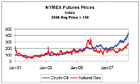
The figure shows the relative change in pricing for crude oil and natural gas based on the average price for 2000.
How did oil get to its current price level so quickly without a major supply interruption? A number of explanations have been put forward, including peak oil; the growing demands of China and India; environmental constraints on drilling; speculation; a lack of refinery capacity; and the weakness of the U.S. dollar. The most plausible explanation is that the capacity to get crude oil out of the ground has not been able to keep up with the growing global demand from emerging markets - China, in particular - resulting in very little excess global capacity should production be disrupted.
In addition to the rise in crude oil, natural-gas prices in the U.S. have increased over 50% since the beginning of 2008 to nearly $12 per million BTUs. These rates are still below the historical highs reached in the aftermath of Hurricane Katrina in 2005. The market for natural gas has traditionally been regional, but with the advent of a liquefied natural gas infrastructure and the ability to ship product around the world, prices have become more uniform across regions. The result is that global pricing is moving toward a higher equilibrium, pushing up the price for countries accustomed to traditionally low natural-gas prices like the United States.
As forecasters continue upward revisions to the average price per barrel, the futures market points to continued high prices for crude oil and natural gas into the next decade. If prices do stabilize at current levels, consumers may be able to adapt their behavior to use less, thus allowing new supplies to be offered. However, there remains a chance, as was demonstrated in the 1970s, that demand destruction will come quickly in the form of a recession.
For more information, phone (513) 469-7555 or visit www.chemquest.com.
The U.S. adhesives industry is facing strong headwinds halfway through 2008. Primary causes are the sustained drop in residential construction and the rapid rise in crude-oil and natural-gas prices during the first half of 2008.
At the beginning of this year, The ChemQuest Group (CQ) expected growth to continue in 2008 - up 4% in value and 1.5% in volume. This would be driven by increasing applications in fastening, electronic devices, and medical markets. CQ predicted a decline for sealants, with value down 4.5% and volumes plunging 7%, due to continued weak housing and construction markets. In actuality, the adhesives market overall is facing year-on-year volume declines, as formulators are raising prices in an attempt to recover increasing raw-material costs.
Housing
The U.S. housing market has continued its slide in 2008, with housing starts down 30% year-over-year to approximately 1 million units a year, a level not seen since 1991. The Federal Reserve’s aggressive efforts to stem the sub-prime crisis through lower short-term interest rates has helped buyers with adjustable-rate mortgages, but has had little effect on the long-term rates; 30-year mortgage rates are the same now as when the Fed began cutting in September 2007.Additional problems in housing include the growing number of lender-owned properties, and large inventories of existing homes for sale (11 months’ worth at current sales rates). Other factors include the increased cost of jumbo mortgages over conventional ones, tighter lending standards (which lower the number pool of potential purchasers), and the number of would-be sellers who have yet to put their homes up for sale, given the current market conditions. Efforts to backstop the real-estate market are under consideration by Congress, but the crisis has so far been self-fulfilling - prices continue to decline at a faster rate and homeowners are likely to walk away or be foreclosed upon, thus pushing down prices even more.
Figure.
Crude Oil and Natural Gas
Historically, raw-material costs are the largest component for adhesives formulators. These costs represent about 52-60% of income (compared to 45-49% in the coatings industry), and more than 80% of the cost of goods sold. This makes the industry particularly vulnerable to the negative effects of rising crude and natural-gas prices. The continuing rise in crude and natural-gas markets during the first half of 2008 have brought a wave of price hikes throughout the value chain, and many resin producers increased prices by to 20% this year.As recently as December 1998, crude oil traded at its historic low in real-dollar terms (under $10/barrel) in the aftermath of the Asian and Russian financial crisis. In 2001-2004, oil traded under $40/barrel. In March 2005, Goldman Sachs Analyst Arjun N. Murti predicted a “super spike” in crude oil, with prices of $105/barrel, a level few could envision the prices rising to without a catastrophic disruption in supply.
The figure shows the relative change in pricing for crude oil and natural gas based on the average price for 2000.
How did oil get to its current price level so quickly without a major supply interruption? A number of explanations have been put forward, including peak oil; the growing demands of China and India; environmental constraints on drilling; speculation; a lack of refinery capacity; and the weakness of the U.S. dollar. The most plausible explanation is that the capacity to get crude oil out of the ground has not been able to keep up with the growing global demand from emerging markets - China, in particular - resulting in very little excess global capacity should production be disrupted.
In addition to the rise in crude oil, natural-gas prices in the U.S. have increased over 50% since the beginning of 2008 to nearly $12 per million BTUs. These rates are still below the historical highs reached in the aftermath of Hurricane Katrina in 2005. The market for natural gas has traditionally been regional, but with the advent of a liquefied natural gas infrastructure and the ability to ship product around the world, prices have become more uniform across regions. The result is that global pricing is moving toward a higher equilibrium, pushing up the price for countries accustomed to traditionally low natural-gas prices like the United States.
As forecasters continue upward revisions to the average price per barrel, the futures market points to continued high prices for crude oil and natural gas into the next decade. If prices do stabilize at current levels, consumers may be able to adapt their behavior to use less, thus allowing new supplies to be offered. However, there remains a chance, as was demonstrated in the 1970s, that demand destruction will come quickly in the form of a recession.
For more information, phone (513) 469-7555 or visit www.chemquest.com.
Links
Looking for a reprint of this article?
From high-res PDFs to custom plaques, order your copy today!