Adhesives and Sealants 101: Fillers
What are fillers and how are they used in adhesives and sealants?
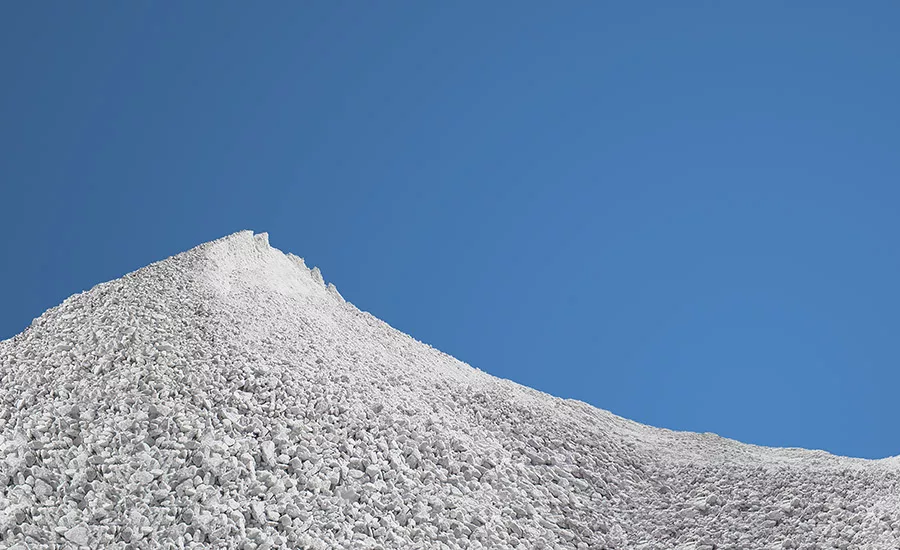

A number of functional fillers are available for various applications, including calcium carbonate, alumina trihydrate, barium sulfate, silica and kaolin clay. Following is a detailed description of each.
Ground Calcium Carbonate
Ground calcium carbonate is among the least expensive mineral fillers on the market, and supply is available from numerous mines located worldwide. Calcium carbonate is available in particle sizes ranging from less than 1.0 micrometer to large white decorative chips.
“Calcium carbonate is a relatively soft, insoluble mineral that is widely used to reduce cost and to control shrinkage in adhesive and sealant formulations,” says Bob Baker, Technical Service director, Huber Engineered Materials’ calcium carbonate and barium sulfate businesses. “It also offers exceptional rheology benefits and is mildly alkaline, making it compatible with most resin systems. Calcium carbonate is blocky in shape, which allows for low surface area and viscosity. Its low surface area allows the formulator to use large amounts in the formulation, compared with most other mineral products.”
However, there can be many differences among calcium carbonate grades, depending upon where they are mined and how they are processed. As a result, brightness, particle-size distribution and surface area can all vary. Calcium carbonate is available in the widest variety of particle-size distributions of any mineral, and an optimum form for an adhesive and sealant application can easily be found.
“In high-end formulations, calcium carbonate helps the product maintain its viscosity, physical strength and properties,” says Baker. “In commodity formulations, it can replace other more-expensive ingredients, improve gap-filling properties and modify viscosity.”
The Hubercarb® lineup of calcium-carbonate products offers a variety of particle-size distributions, resulting in options to meet almost every adhesive and sealant application.
Since calcium carbonate processing involves grinding large rocks into smaller particles - ultimately to sizes useful for formulating - product brightness is heavily dependent on the mine and, thus, the nature of the specific deposit. Some mines yield calcium carbonate with 95 brightness (on a scale of 100), which is ideal for bright-white adhesive applications. Other calcium-carbonate mines may have stone with contaminants that yield lower brightness products. These are used in less-color-critical applications or where the adhesive is not visible. Other deposits have exceptional purity, lower abrasive properties and lower moisture levels than other calcium carbonates.
Alumina Trihydrate (ATH)
Alumina trihydrate (ATH) provides flame retardance and smoke suppression. ATH is the largest-volume flame retardant used in the world and is produced by refining bauxite ore.
“Recent events in flame-retardant legislation and advances in formulating technology, code development, and understanding of fire hazards all combine to make ATH the material to be considered when formulating an adhesive or sealant application,” says Gary Rex, Ph.D., Huber’s Thermoset Technology manager. “ATH has excellent UV resistance and hydrolytic stability, which, when coupled with its FR properties, makes it an ideal functional filler. Therefore, a formulator can incorporate ATH for mild interior adhesives or sealants application near a window, or in the most demanding exterior applications.”
Ultra-fine grades of ATH such as Micral® alumina trihydrate enable formulators to build in desirable rheological characteristics required by the application, such as good sag resistance and substrate wetting, coupled with ease of mixing during manufacture.
Barium Sulfate
Barium sulfate is a very heavy mineral with a density 4.5 times that of water. Its density creates much of the filler’s value. In addition, it is chemically inert and will absorb x-radiation and reduce acoustic vibration.
In an adhesive or sealant formulation, barium sulfate is an excellent filler choice in specialized applications where X-ray absorbance or chemical resistance is a necessity. In an area where acoustic damping is required, such as a quiet room, barium sulfate is an optimum alternative.
Silica
Silicon dioxide products can be manufactured using several different technologies. Precipitated amorphous silicon dioxide is the result of the neutralization reaction between sodium silicate and sulfuric acid. By controlling the reaction conditions, various levels of “structured” products can be produced.
Structured products with small particle size, high surface area and high absorption capabilities are very effective in rheology-control applications. These products are used both as thickeners and thixatropes in various adhesive and sealant applications.
Kaolin Clay
Kaolin clay is one of the most abundant constituents of the earth’s crust. Clay occurs in many different forms, but kaolin, or china clay, is the purest and most versatile. The mineral is also resistant to acid. There are three types of kaolin used by the adhesives and sealants industry: air-floated, calcined and water-washed.
Air-floated clay is the most economical kaolin choice; it also offers rheological advantages and helps flow under the trowel. Calcined kaolin is a viable clay option in moisture-sensitive applications and provides dependable reinforcement. Water-washed clay provides low grit, higher brightness and uniformity.
Choosing the Right Functional Filler
Functional fillers are used in a multitude of adhesive and sealant formulations, and should be chosen in a way that optimizes performance. Before selecting a functional filler for your application, identify the key attributes required of the final product. Since there are a number of functional fillers available for use in compounding adhesives and sealants, formulators should focus on the materials that give the most leverage in helping to achieve the desired result.
For more information, visit www.hubermaterials.com, e-mail hubermaterials@huber.com or phone (866) JMHUBER or (866) 564-8237.
Looking for a reprint of this article?
From high-res PDFs to custom plaques, order your copy today!