ASI Magazine
  Home
  ASI Green
  Subscribe
  eNewsletter Subscription
  Subscription Customer Service
  Updates
  Calendar of Events
  Call for Papers
  Features
  Columns
  Industry News
  Price Adjustments
  New Products
  Ad Index
  Podcasts
  Ask Dr. Dave
  ASI Blog
  Online Exclusives
  Breaking News
  Adhesives in the News
  Resources
  Books
  Archives
  Digital Edition Archives
  Classified Ads
  Career Center
  Industry Links
  Online Solutions Web Seminars
  This to That
  Services Marketplace
  E-Newsletter Archives
  Market Research
  Literature Showcases
  Glossaries
  Directories
  ASI Info
  Media Kit
  Contact Us
  Sales Staff
  Reprints
  List Rental
  Submit Press Releases
  Letter from the Editor
Search in: EditorialProductsCompanies
ONLINE EXCLUSIVE: Reducing Fischer-Tropsch Wax Content in Hot-Melt Adhesives


January 1, 2006

ARTICLE TOOLS
EmailEmailPrintPrintReprintsReprintsshareShare


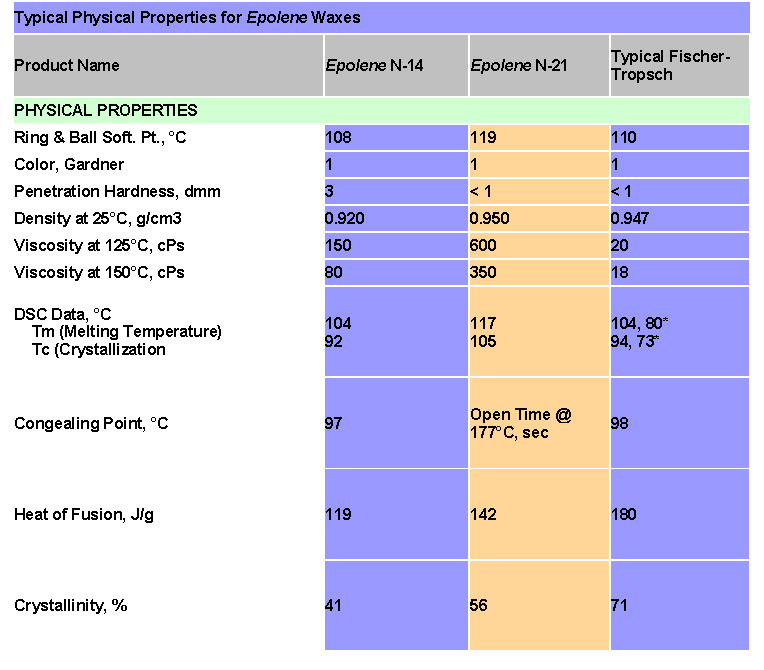
Table 1. Typical Physical Properties of Epolene Waxes


The adhesive industry continues to experience raw-material shortages. In particular, adhesive manufacturers are concerned about the current global shortage of Fischer-Tropsch waxes (F-T waxes). This shortage has been especially challenging for adhesive manufacturers of EVA-based hot-melt packaging adhesives. As F-T waxes have been placed on allocation, hot-melt adhesive (HMA) manufacturers and end users have found it necessary to seek alternative adhesive formulations with reduced F-T wax content.


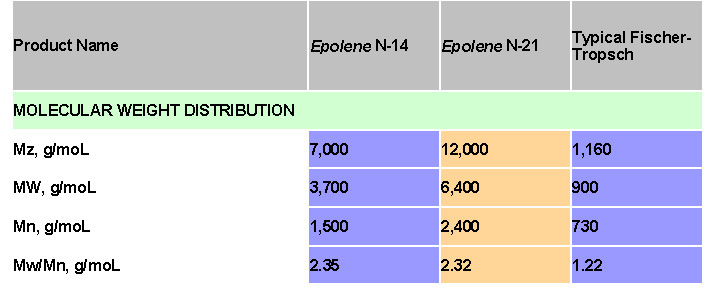
Table 2. Molecular Weight Distribution of Epolene Waxes


To provide adhesives formulators with options, Eastman Chemical Co. has evaluated HMA formulations with reduced levels of F-T waxes. These adhesive formulations are based on either full or partial substitution of F-T waxes.

The adhesive formulations presented are intended to be starting-point formulations and may be optimized by adjusting the proportion of components or by adding various performance-enhancing additives used by most adhesives formulators


Table 3A. Examples of HMA Formulations with Full Substitution of F-T Wax


The following information presents test data generated to illustrate the use of these products in an HMA formulation. The products highlighted in this piece include the following.
  • Epolene N-14 Polyethylene Wax* – A nonemulsifiable medium-density, relatively low molecular weight polyethylene homopolymer. Due to its relatively low viscosity, Epolene N-14 can be used to modify flow properties and set speed in HMAs.
  • Epolene N-21 Polyethylene Wax* – A nonemulsifiable, higher density polyethylene wax. Because of its relatively high softening point and relatively low viscosity, Epolene N-21 is used as an additive to adjust set speed in HMAs.
  • Permalyn 3100 Synthetic Resin* – A hard, low-color, thermoplastic pentaerythritol (PE) ester of rosin. The use of Permalyn 3100 offers useful properties in HMAs by providing specific adhesion, improved wetting characteristics to various substrates, as well as viscosity control.
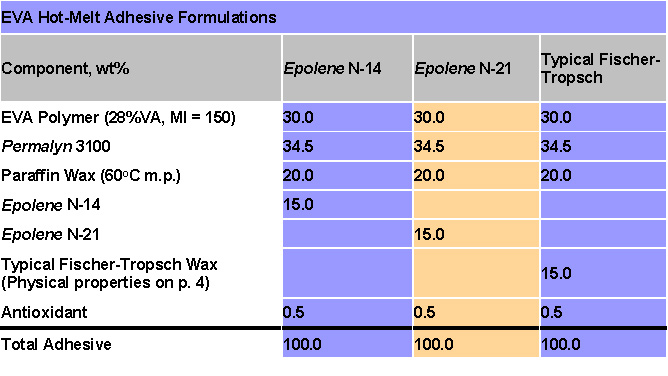
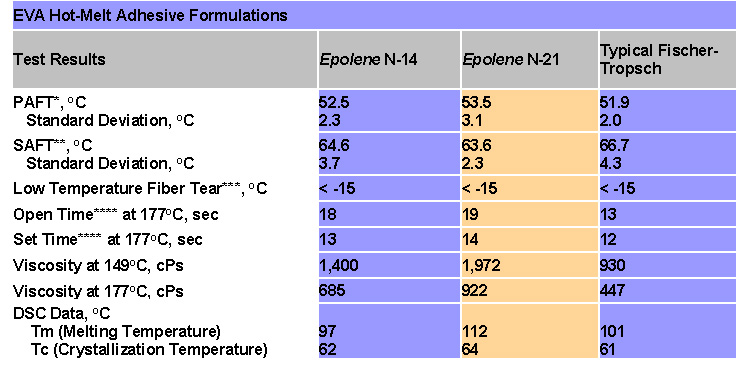
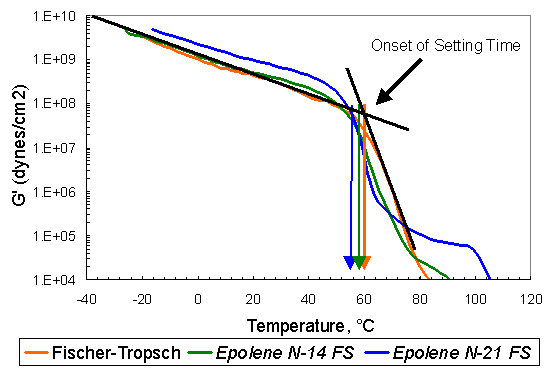
Table 3B. Examples of HMA Formulations with Partial Substitution of F-T Wax


Based on the data shown in Table 4, results suggest that full or partial replacement of F-T wax with Epolene N-14 or Epolene N-21 in the proposed EVA adhesive formulation results in similar adhesion and cohesion as evidenced by peel adhesion failure temperature (PAFT), shear adhesion failure temperature (SAFT) and low-temperature fiber tear results.


*PAFT (peel adhesion failure temperature) was determined on 40lb virgin Kraft paper.  ASTM D-4498 was followed.

**SAFT (shear adhesion failure temperature) was determined on 40lb virgin Kraft paper.  ASTM D-4498 was followed.

***Low temperature fiber tear was determined on recycled corrugated.

****Open time and set time were determined using an Olinger Bond Tester.
Table 4. Adhesive Properties of HMA Formulations with Reduced F-T Wax Content


As illustrated in Figures 1 and 2, the set times as determined by dynamic mechanical analysis (DMA) correlate very well with set times determined by the use of an Olinger Bond Tester (see Table 4). The F-T wax has the shortest set time, followed by Epolene N-14 and then Epolene N-21. It should be noted that the use of Epolene waxes results in higher formulated viscosity and longer open time. It may be possible to fine tune these parameters by increasing the paraffin wax or tackifier level by adjusting the adhesive application temperature.


Conclusion

Figure 1. Full Substitution


These concepts are intended solely as initial work to evaluate HMAs with properties similar to those of a control formula using 15 wt. % F-T wax. Based on these concepts, it may be possible to reduce F-T wax content.

As shown by PAFT, SAFT and low-temperature fiber tear results, full or partial substitution of F-T wax in an adhesive formulation with Epolene waxes provides formulators with similar adhesion, cohesion and set time. In general, the use of Epolene waxes provide higher formulated viscosity and longer open time than F-T waxes.
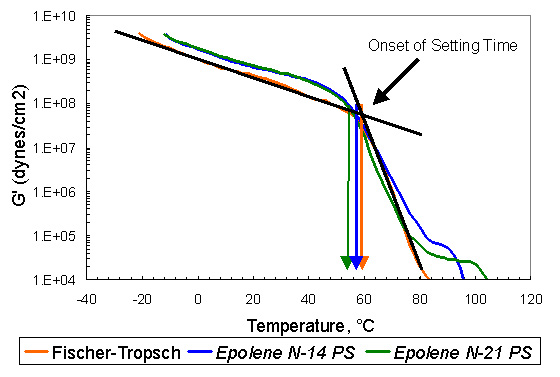


Figure 2. Partial Substitution


The performance properties of Epolene waxes are ideally suited for packaging applications and HMA applications.

Based on ring & ball softening point (R&BSP), congealing point and viscosity, Epolene N-14 is the best functional equivalent.

Epolene N-21 is the best functional equivalent based on density, hardness and heat of fusion.

For more information on formulation strategies using tackifiers, phone (800) EASTMAN or visit www.tackifier.com.

*Epolene N-14 Polyethylene Wax, Epolene N-21 Polyethylene Wax and Permalyn 3100 Synthetic Resin are trademarks of Eastman Chemical Co.



|PrintEmail

Did you enjoy this article? Click here to subscribe to the magazine.


PSTC Technical LibraryPressure Sensitive Tape Council
Access the Pressure Sensitive Tape Council's free technical library.
CLICK HERE


© 2010 BNP Media. All rights reserved. The publisher is not responsible for product claims and representations. Any views or opinions expressed are those of the author and do not represent those of ASI magazine, its staff, Editorial Advisory Board or BNP Media. | Privacy Policy