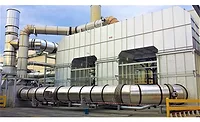
Improving Efficiency with Equipment
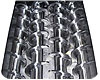
A large-feed hopper feeds batch directly into the extrusion screw.
During tough times, gaining efficiencies is key for manufacturers; unfortunately, efficiency is sometimes achieved through cutbacks. Although not optimal, cuts force an organization to analyze, re-evaluate and take prudent action. Eventually, these efficiencies make the company stronger, affording growth, prosperity, stability and security.
Even in a good economy, efficient operations are not only practical but advantageous; both the manufacturer and the equipment supplier benefit. Automation is the predominant means of increasing efficiency, and can even create new jobs within an organization.
Consider, for example, a butyl tapes manufacturer. This manufacturer has four lines, each of which has one extruder with a die head to produce eight strips; a take-up conveyor; a winding mechanism; and packaging. One extruder operator and two downstream operators work each line. Feeding these lines requires two mixers, each with two operators. When mixing is complete, the workers dump the batch onto a talc-coated floor, carve it into chunks (while coating it with talc), and stack the chunks onto a rack. A forklift driver takes the rack to the line, where the extruder operator feeds one or two chunks at a time while monitoring the die to ensure that all tapes are running true and within specifications.
In a typical eight-hour day, these 17 employees can produce approximately 24,000 lbs. of tape. Assuming an average wage of $8/hour, labor costs $1,088/day. This translates to 0.045¢/lb - a negligible amount until annual shipments of over six million pounds are factored in, which add up to 6,240,000 lbs./year.
Replacing the extruders with a type that takes product right from the mixer (see photo) would potentially eliminate the need for two mixer and two extruder operators. What's more, labor costs would be reduced: 13 employees making $8/hour translates to 0.035¢/lb. What’s more, the increase in throughput achieved through improved machine design, as well as incorporation of a die that produces 12 strips, generates another significant labor cost savings: 13 employees producing 36,000 lbs./day at .023¢/lb., yielding 9,360,000 lbs./year.
Roughly calculated, this means a four-year return on investment. If employee benefits, work-related injuries, energy savings, etc., are all factored in, the return is even greater.
A large-feed hopper all but eliminates the possibility of a hopper running empty, as a single load can be as much as 3,000 lbs. In addition, the equipment avoids time-consuming tasks such as stopping and starting, realigning tape with paper, and reloading the conveyor.
Other efficiencies gained in this process include continuity of size and viscosity. Tape is held to more precise tolerances with improved screw and die design, and through more extensive and effective temperature control. Thus, the line runs more independently and allows time for the operator to monitor - rather than adjust - the equipment.
Electronic technology enables myriad process control and data collection options. Examine what’s available and how it can assist in maintaining your degree of quality, and make sure it is within the limits of your intended staff.
Greater automation can also be achieved on the downstream side of the line; conveying and wind-up equipment is available that, in conjunction with electronics, may require only one operator.
Again, the end result is higher productivity and lower cost, a combination that provides a competitive edge in the marketplace. As market share increases, employees that have been displaced by the implementation of new technology and machinery can be reassigned to other key roles - possibly new lines installed to keep up with this newfound success.
For more information on equipment, visit www.diamondamericacorp.com.
Links
Looking for a reprint of this article?
From high-res PDFs to custom plaques, order your copy today!