Stand Out with Precision PSA Assembly
Benefits of using a standardized platform
for PSA assembly.
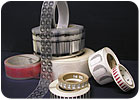
The molding industry landscape has changed significantly over the last few years. It has been spurred by a market transition from local to global, a broadening scope of services from molding products to subassembly offerings and ever-decreasing product lifecycles. Hence, margins are under constant pressure.
Beneath the weight of these challenges is a question: how can a molder stand out in the crowd? To differentiate themselves, molders began to offer subassembly services. However, what used to be a differentiator has now become commonplace. New ways of thinking are required to answer this question. Those who produce innovative solutions will find great opportunity as key suppliers of technology. One such innovation is the adoption of standardized manufacturing equipment instead of expensive custom solutions. Pressure-sensitive adhesive (PSA) assembly is one of the most common elements in today’s subassemblies. However, many organizations still lean on hand assembly or custom automation to accomplish this task. This article will examine standardized PSA assembly technology and what to consider so your investment in PSA assembly equipment answers your market challenges.
A PSA can be defined as a sort of adhesive tape that is aggressive and tacky in dry form at room temperature. PSAs adhere when applied with pressure and do not require activation by water, temperature or solvents. They always require pressure to achieve sufficient wet-out on the application surface. The main types of PSAs are derived from rubber-based, acrylic, modified acrylic and silicone formulations.
Frequently laminated with an additional polymeric material (such as a foam, paper, or polyimide) and then converted into a specific shape, PSAs are used for assembly, but also find use in venting, filtering, or sealing applications. With the variety of materials that can be used, PSAs are popular in many markets and applications. Examples include:
Molding companies cannot predict the requirements of tomorrow. Therefore, when choosing equipment for the PSA assembly, it is important that the platform have the following characteristics.
Standardized machines have established operational criteria, predictable quality and, perhaps most beneficial, quantified process costs. Standardized machinery is also refined and enhanced through years of development in a process that allows for continuous improvement. Thousands of applications solved with the same peeling technology prove the flexibility of such a platform in handling a variety of application requirements. The tooling can be changed within a few minutes, thus allowing another product type to be manufactured on the same equipment.
Global Use Made Easy
Frequently, two or more facilities are running the same program; a standardized platform ensures the same outcome from each location. It also makes the transfer of projects from one location to another easier, as the same manufacturing equipment is available. Technical support and maintenance are simplified as well.
Reusability Allows Splitting of Capital Spending
Short or variable product lifecycles are addressed with a standardized platform, as it has a high reusability rate of 95%, while the reusability of customized solutions cannot be forecasted. Due to its standardization, the equipment is quickly reconfigurable and decreases downtime significantly.
Capital costs are not project-specific but can be spread out over various projects, which, in turn, significantly reduces the overall assembly costs on one project. For every new project, only new tooling needs to be obtained.
The following items should be considered by end users in calculation of the benefits of standardizing adhesive component assembly.
AccuPlace’s patented peeling technology allows accurate placement and permits the handling of the most sensitive and diverse materials, such as double-sided adhesives; foams pads; complex shaped die-cuts; and complex placement such as three dimensional, in-recess areas, and bubble free.
For more information, visit www.accuplace.com.
The molding industry landscape has changed significantly over the last few years. It has been spurred by a market transition from local to global, a broadening scope of services from molding products to subassembly offerings and ever-decreasing product lifecycles. Hence, margins are under constant pressure.
Beneath the weight of these challenges is a question: how can a molder stand out in the crowd? To differentiate themselves, molders began to offer subassembly services. However, what used to be a differentiator has now become commonplace. New ways of thinking are required to answer this question. Those who produce innovative solutions will find great opportunity as key suppliers of technology. One such innovation is the adoption of standardized manufacturing equipment instead of expensive custom solutions. Pressure-sensitive adhesive (PSA) assembly is one of the most common elements in today’s subassemblies. However, many organizations still lean on hand assembly or custom automation to accomplish this task. This article will examine standardized PSA assembly technology and what to consider so your investment in PSA assembly equipment answers your market challenges.
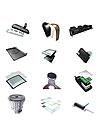
Figure 1. Examples of PSAs: Automotive (row 1); Computer and Peripherals (row 2); Mobile Communications (row 3); and Life Sciences (row 4).
What are Pressure-Sensitive Adhesives?
The simplest example of a pressure-sensitive adhesive is a self-adhesive label; however, PSAs are much more than that.A PSA can be defined as a sort of adhesive tape that is aggressive and tacky in dry form at room temperature. PSAs adhere when applied with pressure and do not require activation by water, temperature or solvents. They always require pressure to achieve sufficient wet-out on the application surface. The main types of PSAs are derived from rubber-based, acrylic, modified acrylic and silicone formulations.
Frequently laminated with an additional polymeric material (such as a foam, paper, or polyimide) and then converted into a specific shape, PSAs are used for assembly, but also find use in venting, filtering, or sealing applications. With the variety of materials that can be used, PSAs are popular in many markets and applications. Examples include:
- Automotive. In automotive applications, PSAs are used as foam pads to eliminate vibration or noise, as double-sided adhesive to assemble decoration, or as moisture vents to ventilate engine control module connectors.
- Computer and Peripherals. PSAs are used as filters to eliminate particulates in hard drives, as heat-activated film to assemble MMC cards, and as flex circuit adhesives to assemble the FPCB on inkjet cartridges.
- Mobile Communications. PSAs find use in mobile communications as protective film on lenses, dust seals, microphone meshes and gaskets in cell phone housings, and as adhesive to assemble a dome switch array onto a PCB.
- Life Sciences. In the life sciences, PSAs are used as labels or temperature strips on diagnostics devices, as double-sided adhesive to assemble medical devices, and as a labels wrapped 360° around syringes.
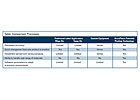
Table. Comparison Processes
Challenging Requirements on Equipment
Due to this infinite range of applications and materials, the requirements for applying PSAs are infinite: absolutely bubble free, highly accurate, time- and pressure controlled, temperature controlled, three-dimensional, wrapped 360° around the target part, handling sensitive materials such as double-sided tape, handling complex shapes of die-cuts, etc.Molding companies cannot predict the requirements of tomorrow. Therefore, when choosing equipment for the PSA assembly, it is important that the platform have the following characteristics.
- It should be flexible enough to handle all different requirements.
- It should be easy to support globally, as well as for operations in low-tech countries.
- It should allow for quick and simple changeovers from one product type to another.
- It should allow for splitting of investment costs between several projects.
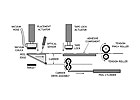
Figure 2. Placement Cycle
Why Standardized Platform is a Solution
Compared to custom equipment, a standardized platform has significant advantages.Standardized machines have established operational criteria, predictable quality and, perhaps most beneficial, quantified process costs. Standardized machinery is also refined and enhanced through years of development in a process that allows for continuous improvement. Thousands of applications solved with the same peeling technology prove the flexibility of such a platform in handling a variety of application requirements. The tooling can be changed within a few minutes, thus allowing another product type to be manufactured on the same equipment.
Global Use Made Easy
Frequently, two or more facilities are running the same program; a standardized platform ensures the same outcome from each location. It also makes the transfer of projects from one location to another easier, as the same manufacturing equipment is available. Technical support and maintenance are simplified as well.
Reusability Allows Splitting of Capital Spending
Short or variable product lifecycles are addressed with a standardized platform, as it has a high reusability rate of 95%, while the reusability of customized solutions cannot be forecasted. Due to its standardization, the equipment is quickly reconfigurable and decreases downtime significantly.
Capital costs are not project-specific but can be spread out over various projects, which, in turn, significantly reduces the overall assembly costs on one project. For every new project, only new tooling needs to be obtained.
The following items should be considered by end users in calculation of the benefits of standardizing adhesive component assembly.
- Shorter lead times of standard equipment allow critical decisions to be made later in the planning process, when more information is available.
- Equipment manufacturers can have the machinery “on the shelf,” or manufacturing sites could have automation in place prior to design finalization.
- Time-proven, predictable production-rate data will provide for extremely accurate planning and forecasting.
- Prototyping runs and capability studies can be performed early in the process, prior to production exposing any problems.
Why the Right Choice of Technology is Important
In addition to standardization, machine capabilities vary from technology to technology. PSAs often have different, more stringent requirements than simple label applications. These requirements can be placement accuracy, PSA location (such as in recess area) and sensitive adhesive component (such as Kapton double-sided adhesive). Therefore, the choice of technology is crucial to making your PSA applications a success.AccuPlace’s patented peeling technology allows accurate placement and permits the handling of the most sensitive and diverse materials, such as double-sided adhesives; foams pads; complex shaped die-cuts; and complex placement such as three dimensional, in-recess areas, and bubble free.
Conclusion
Offering advantages such as multi-functionality and ease-of-use, die-cut pressure-sensitive adhesives are becoming the norm. Standardization of placement technology offers various benefits to molders and EMS companies, providing answers to major marketplace challenges in today’s world. Thus, the decision on standardizing PSA assembly and making the right platform choice can be vital for the molder to differentiate himself.About the Company
AccuPlace, Plantation, FL, provides standardized solutions for assembly of film adhesive, and has provided thousands of adhesive placement applications in the mobile communications, computer and peripherals, automotive, industrial, and medical-device market segments worldwide.For more information, visit www.accuplace.com.
Links
Looking for a reprint of this article?
From high-res PDFs to custom plaques, order your copy today!