RESEARCHERS SAY CONDUCTIVE ADHESIVE COULD REPLACE SOLDER (10/21/08)
Researchers have invented a nanotube-based dry adhesive that
they propose using instead of solder to assemble components on circuit boards.
The adhesive, which has very high electrical and thermal conductivity, models
its sticking power on the foot of the gecko lizard. It works without heat or
solvents, permitting use in the vacuum environments used to make chips and in
space.
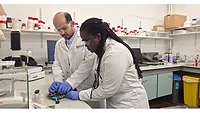
"This will be useful to put electronic components together because the nanotubes have very high thermal conductivity," said professor Liming Dai at Ohio's University of Dayton.
Carbon nanotubes, which have very high electron mobility, enable the adhesive to be used to assemble chips on boards without the heat of soldering. The researchers are also experimenting with patterning the material onto chips themselves.
"We grow (the nanotubes) on silicon wafers, because we use silicon wafers for electronic applications. We can pattern at the microscopic level," said Dai. "If you use this kind of adhesive to put transistors together into circuits, the adhesive will remove the heat generated by the current."
The adhesive force measured by the researchers was similar to that of a gecko's foot - up to 100 Newtons per centimeter in the shear direction and 10 N/cm in the perpendicular direction. Multiwalled nanotube arrays were grown using low-pressure chemical vapor deposition on silicon wafers, with the vertically aligned nanotubes branching out at the top in random directions, thereby maximizing the atomic-scale van der Waals forces. This architecture is similar to that of a gecko's foot, which allows them to walk up walls and across ceilings. The coils and entangled ends of the nanotubes increase the surface area available, accounting for their high adhesive power and thermal conductivity.
The researcher group, which includes members from the University of Dayton, University of Akron, the Georgia Institute of Technology and Air Force Research Laboratory, will next characterize the adhesive power of the nanotube-based material and measure its long-term stability. They also plan to test the feasibility of creating Spiderman-like suits to enable people to scale vertical walls.
In addition to Dai and his research assistant Liangti Qu, others contributing to the work included Georgia Tech professor Zhong Lin Wang, University of Akron professor Zhenhai Xia, and Air Force Research Laboratory scientist Morley Stone.
"This will be useful to put electronic components together because the nanotubes have very high thermal conductivity," said professor Liming Dai at Ohio's University of Dayton.
Carbon nanotubes, which have very high electron mobility, enable the adhesive to be used to assemble chips on boards without the heat of soldering. The researchers are also experimenting with patterning the material onto chips themselves.
"We grow (the nanotubes) on silicon wafers, because we use silicon wafers for electronic applications. We can pattern at the microscopic level," said Dai. "If you use this kind of adhesive to put transistors together into circuits, the adhesive will remove the heat generated by the current."
The adhesive force measured by the researchers was similar to that of a gecko's foot - up to 100 Newtons per centimeter in the shear direction and 10 N/cm in the perpendicular direction. Multiwalled nanotube arrays were grown using low-pressure chemical vapor deposition on silicon wafers, with the vertically aligned nanotubes branching out at the top in random directions, thereby maximizing the atomic-scale van der Waals forces. This architecture is similar to that of a gecko's foot, which allows them to walk up walls and across ceilings. The coils and entangled ends of the nanotubes increase the surface area available, accounting for their high adhesive power and thermal conductivity.
The researcher group, which includes members from the University of Dayton, University of Akron, the Georgia Institute of Technology and Air Force Research Laboratory, will next characterize the adhesive power of the nanotube-based material and measure its long-term stability. They also plan to test the feasibility of creating Spiderman-like suits to enable people to scale vertical walls.
In addition to Dai and his research assistant Liangti Qu, others contributing to the work included Georgia Tech professor Zhong Lin Wang, University of Akron professor Zhenhai Xia, and Air Force Research Laboratory scientist Morley Stone.
Looking for a reprint of this article?
From high-res PDFs to custom plaques, order your copy today!