Reversible Conductive Adhesive Could Improve E-Waste Recovery and Recycling
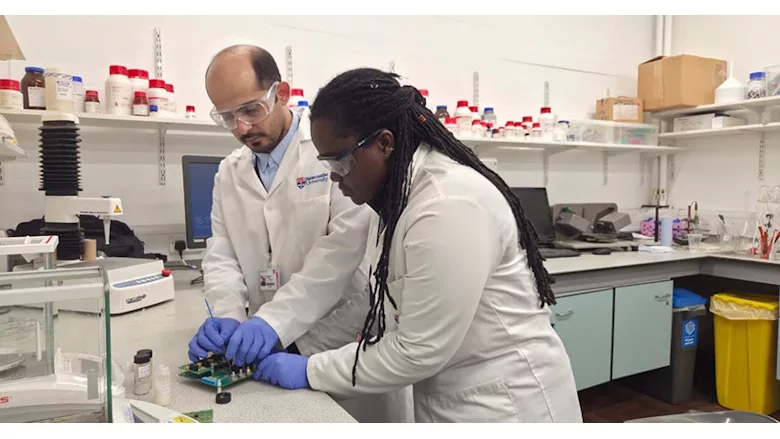
Study authors Bassam Aljohani and Dr Ama Asiedu-Asante pictured in the lab.
Researchers from Newcastle University have developed a reversible electrically conductive adhesive designed to support easier recycling and recovery of electronic components. The project, a collaboration between electrical and chemical engineers, builds on previous work involving reversible adhesive systems for packaging applications. The latest development introduces electrical conductivity, enabling the adhesive to bond electronic components while still allowing debonding and material recovery through exposure to solvents such as acetone or alkaline solutions.
The water-based adhesive is formulated as a “one-pot” system that does not require organic solvents or separate hardeners. According to the researchers, the adhesive offers bond strength comparable to other water-based systems while avoiding many of the volatile organic compounds associated with conventional formulations. The material is manufactured using processes similar to paint production, with silver particles incorporated into the formulation to provide electrical conductivity. While electrically conductive adhesives containing silver are already used in electronics applications, the researchers noted that existing systems are generally permanent and difficult to separate for recycling or repair.
The development comes as the electronics industry faces increasing pressure to address electronic waste (e-waste) and improve circularity in manufacturing. Researchers estimate that approximately 62 billion kilograms of e-waste are generated globally each year, with less than one-quarter currently recycled. Many electronic products also contain valuable critical minerals that can be difficult to recover once permanently bonded into assemblies. “Electrically conductive adhesives have been around for a long time, and making them reversible provides the solution to a very real problem that urgently needs addressing,” said Bassam Aljohani, a Ph.D. student at Newcastle University’s School of Engineering and first author of the paper.
According to the research team, the reversible adhesive was designed using low-cost materials and existing industrial manufacturing methods to support scalability. Unlike some conventional water-based adhesives, the formulation also maintains bond performance under humid conditions. The adhesive demonstrated strong bonding performance on metal substrates as well as plastics and printed circuit boards.
Researchers also highlighted the potential environmental and economic advantages of the technology. “One of the reasons that conducting glues are rarely used is because silver is expensive and toxic in the environment,” explained Mark Geoghegan, Roland Cookson Professor of Engineering Materials and lead investigator on the project. “Being reversible, our glue means that the silver can be recovered and reused, which is important to keep costs down and the environment clean.”
The technology may also provide an alternative to permanent joining methods commonly used in electronics manufacturing, including solder and mechanical fasteners, which can complicate automated recycling processes. “The electronics industry relies on permanent joining methods, including screws, which can make automated recycling more difficult,” said Ama Asiedu-Asante, a researcher in Professor Volker Pickert’s group and co-author of the study. “There is now increasing recognition that water-based formulations can support more sustainable electronics, and this work demonstrates how they can deliver both performance and reversibility.”
Professor Volker Pickert, professor of power electronics and co-investigator on the project, added that the work may encourage manufacturers to reconsider traditional assembly methods. “Solder has the best conductivity, but the best formulations contain lead and now companies need to ask themselves whether the conductivity outweighs environmental considerations,” he said. “In some cases, it will, but there is an opportunity here to revisit how we join electrical components.”
The research was published in Advanced Electronic Materials. The project received funding from the Engineering and Physical Sciences Research Council (EPSRC) and the Royal Commission for Jubail and Yanbu of the Kingdom of Saudi Arabia.
Looking for a reprint of this article?
From high-res PDFs to custom plaques, order your copy today!