CASE STUDY: Advanced Composites for Terrestrial Applications Prove Useful in Space Industry

Figure
1. YLA adhesives provide cryogenic and high-temperature service for solar array
substrate skins. Photo courtesy of Johns
Hopkins University,
Applied Physics Lab.
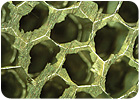
Figure
2. The ability to coat only honeycomb cell walls reduces satellite weight and
increases structural efficiency.
The Challenge
As aerospace technology advances, requirements for innovative composite/adhesive materials have also grown more demanding. Materials must be the lightest weight possible, offer the ability to withstand extreme temperatures, be easily handled and applied, and, where possible, serve dual purposes for multiple parts of structures. Some of the major uses for such materials are government satellite and space programs, and commercial telecommunications satellites.Adhesives that are used for aerospace applications include paste (also used for industrial purposes) and films. Films include both syntactics and pure resin types. Syntactics are microballoon-filled resins that can be nonexpanding or expanding (generally used for honeycomb core splicing), and resin films can be supported or unsupported.
For decades, these films have been used and have proven to be excellent materials for terrestrial applications, such as radomes, antennas, and dielectrically tailored syntactics, but they’ve also demonstrated exceptional results for aerospace structures.

Figure
3. Syntactics provide low-density, low-dielectric constant and loss tangent,
and self-adhesive properties for advanced radomes.
The Solution
Precision adhesives in combination with compatible prepreg resins, such as YLA’s RS-3 (modified polycyanate resin), SF-5 (polycyanate syntactic film) and RS-4A (polycyanate film adhesive), fit the technological needs of aerospace applications. The benefits of these advanced composite materials include the following.- Precise control of chemistry. These materials offer chemical and surface energy compatibility with substrates to be bonded, usually composite-to-composite or composite-to-metal. They have the ability to withstand extremes of exposure to cosmic radiation, atomic oxygen and other chemicals, and feature a range of resin bases for applications from cryogenic to high-temperature or heat-sensitive structures, such as heat pipes or solar arrays (see Figure 1).
- Easy, repeatable control of bondline thickness.
- The ability to reticulate, or selectively coat surfaces (e.g., honeycomb).
- Weight savings vs. paste or liquids (typically as much as 90%).
- The capacity to serve dual-purpose functions (e.g., syntactics as radome interlayers, acting as low dielectric and loss and as functional adhesive for the structural layers)(see Figure 3).
- Easy handling and application. There is a minimum of waste, run-out and cleanup. No mixing is required for these adhesives.
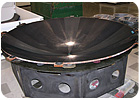
Figure
4. Film adhesive provides secure bonding between antenna core and skin
elements.
The Results
The advantages of YLA’s advanced composite adhesives have proven to be of particular value in commercial telecommunications, scientific, military and reconnaissance endeavors.Examples of aerospace parts that utilize these materials include solar panels, satellite body panels and reflectors. These adhesives provide:
- Thin and lightweight materials.
- The ability to bond skins to cores to make curved and other non-flat geometries.
- The ability to bond metal or composite skins to metal or composite cores.
- Durability and ability to withstand thousands of temperature cycles, from cryogenic deep space temperatures to broiling direct sun exposure.
- Low levels of contaminants to prevent the coating or blinding of satellite optics and sensors.
- Non-expanding syntactics for lightweight, highly selective structural reinforcement (“hardpoints”).
- Expanding syntactics to precisely fill gaps and splice/bond structural core sections together.
About YLA Inc.
YLA Inc. is a recognized global leader in the development and manufacture of high-performance, lightweight composite materials for satellites, aerospace, petrochemical, commercial and military aircraft, radomes, defense, naval/marine, industrial, thermal management, and recreational markets. YLA was presented with an unprecedented fourth “Gold Supplier” declaration by Northrop Grumman, making it the only advanced composites manufacturer to be so recognized.Headquartered in Benicia, CA, the company’s facility houses research, development and manufacturing for a full line of advanced composite materials. YLA’s multiple production lines provide the flexibility to accommodate extremely large production requirements as well as smaller developmental runs.
For more information, phone (707) 747-2750 or visit www.ylainc.com.
Links
Looking for a reprint of this article?
From high-res PDFs to custom plaques, order your copy today!