New High-Efficiency Styrenic Block Copolymers, Tackifier for Adhesives

To achieve improved adhesive performance, two high-efficiency four-arm radial styrene-isoprene-styrene (SIS) block copolymers were developed by Dexco Polymers L.P. for hot-melt adhesive (HMA) and pressure-sensitive adhesive (PSA) applications. Dexco, with manufacturing facilities in Plaquemine, LA, is a limited partnership of affiliates of Dow Chemical Co. and ExxonMobil Chemical Co.
Both copolymers are designated “high-efficiency,” due to their ability to replicate current SIS-based adhesive performance at lower copolymer loading levels in the adhesive formulation. Of the two products, Vector® DPX-618 styrenic block copolymer (SBC) is a high-styrene (30% styrene by weight) SIS copolymer targeted for adhesive applications that require higher temperature shear resistance. Vector DPX-619 SBC, a lower-styrene (20% styrene by weight) SIS copolymer, is designed for PSA applications with hot-melt or solvent-coating technologies.
DPX-619 SBC works extremely well in PSA formulations using ExxonMobil’s EscorezTM 2203LC, a new tackifier for the United States. DPX-618 and DPX-619 SBCs have shown excellent lab performance in a variety of nonwoven, tape, and label-adhesive applications at 20-30% copolymer reductions in formulations.
At full copolymer concentration, DPX-618 and DPX-619 SBCs show enhanced performance vs. the linear SIS and existing SIS radial copolymers. Both copolymers are available in laboratory sample quantities (TNPP-free crumb or pellet form), and Escorez 2203LC tackifier is available in pellet form from ExxonMobil Chemical in the Americas, Europe, and Asia.
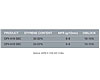
Figure 1.
Solves Cost, Availability Issues
Dexco initiated a program to develop SIS radial copolymers that can be used to lower the required concentration of copolymers in typical adhesive formulations due to the cost and limited availability of SIS copolymers.The radial structure was chosen to minimize the viscosity impact of the higher molecular weight while maintaining the goal of enhanced adhesive performance. DPX-618 and DPX-619 SBCs were polymerized using Dexco’s proprietary methodology and finished at the pilot plant facilities in Plaquemine. The materials were finished as porous crumb or pelletized. Initial samples were produced in the first quarter of 2008 (see Figure 1 for typical properties).
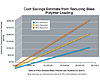
Figure 2.
The Vector series of SBCs are designed for use in a range of adhesive and sealant applications, such as disposables (baby diapers and training pants, adult incontinence products, feminine care pads, etc.), tapes, labels, assembly and construction adhesives. The ability of the hard styrene endblocks and soft elastomeric midblocks of these styrenic block copolymers to phase separate over a wide end-use temperature range makes them one of the key polymer tools used to formulate hot-melt adhesives.
Cost savings can be achieved by using a tackifier and/or oil in an adhesive formulation in place of the base polymer. The potential cost savings are derived from the price difference between the tackifier/oil and the base polymer. The actual cost savings depend on the initial base polymer loading in the formulation, the actual difference in market prices, and the base polymer reduction achieved. Figure 2 shows a plot of total formulated adhesive cost savings as a function of the difference in price between the tackifier/oil and the base polymer for three different polymer-reduction levels.
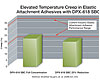
Figure 3.
Performance Results
DPX-618 and DPX-619 SBCs were formulated into typical hot-melt and PSA blends, then performance-tested against standard SIS radial and linear block copolymers. For nonwoven applications (i.e., elastic attachment and core glue adhesives), the adhesives were sprayed using a Nordson spiral spray coater to determine their “sprayability” characteristics (the preferred industry application method). Each adhesive performed very well in the spray tests at both the full copolymer concentration and at reduced levels.DPX-618 SBC
DPX-618 SBC was added to a typical elastic attachment adhesive formula. The elastic attachment adhesive tested had the following formulation: SIS (30%), H2-DCPD/Escorez 5637 tackifier (50%), end-block reinforcement resin (5%) and mineral oil (15%). DPX-618 SBC was added at full concentration and at 25% reduced levels, with the results showing a decrease in viscosity as less DPX-618 SBC is used in the formulation.
In creep resistance, DPX-618 SBC demonstrated improvement (i.e., lower creep) at reduced levels relative to the standard SIS addition in elastic attachment adhesives. Creep resistance also compared favorably with standard elastic attachment adhesives currently sold. Figure 3 shows creep values at full and 25% reduced concentrations.
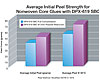
Figure 4.
DPX-619 SBC was tested at both full concentration and 25% reduction using a typical nonwoven core glue adhesive. The performance of nonwoven adhesive formulations containing DPX-619 SBC was compared to those obtained from commercially available core glue adhesives. The results showed that reducing the concentration of DPX-619 SBC in the formulation significantly lowered the viscosity of the core glue.
The initial peel strength of the core glue improved as the concentration of DPX-619 SBC was reduced to levels below the SIS concentration ranges typically used in commercial nonwoven core glues (Figure 4). The initial peel strength of the DPX-619 SBC core glue, at both full and reduced concentrations, compared favorably with standard core glue currently on the market.
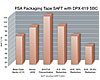
Figure 5.
PSA Tape Applications
For PSA tape applications, a packaging tape formulation was made with DPX-619 SBC at various concentrations. This formulation was compared with a standard adhesive using VectorTM 4113 SBC and Vector 4230 SBC, another low-styrene, four-arm radial SIS from Dexco.The newly available Escorez 2203LC tackifier was used in conjunction with DPX-619 SBC to create several PSA formulations. The base PSA packaging tape adhesive tested contained 43% SIS, 52% Escorez 2203LC tackifier, 4% petroleum oil and 1% antioxidant. The reduced loadings of DPX-619 SBC used increasing levels of Escorez 2203LC tackifier and petroleum oil.
The results showed that although the DPX-619 SBC tape required greater rolling ball tack distance in comparison to the base Vector 4113 SBC and the Vector 4230 SBC, it demonstrated acceptable performance for many applications, with improved performance as the level of DPX-619 SBC in the adhesive is reduced.
The shear adhesion failure temperature (SAFT) of the tape adhesives with the full concentration DPX-619 SBC was superior to that of both the Vector 4113 SBC base case and the Vector 4230 SBC. For the reduced DPX-619 SBC adhesive loadings, the SAFT at 9% reduction was comparable to the Vector 4230 SBC at full concentration and better than Vector 4113 SBC. At 18% reduction, the reduced loading demonstrates a SAFT lower than the Vector 4230 SBC, yet comparable to the Vector 4113 SBC. At 25.5% reduction, the reduced loading fell below the Vector 4113 SBC SAFT (see Figure 5).
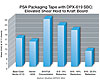
Figure 6.
The elevated shear holding power test was performed on Kraft paper for each of the prepared PSA tape samples. Results showed that the holding time was clearly highest for DPX-619 SBC at full concentration. DPX-619 SBC at 9% and 18% reduced concentrations also proved stronger than the base Vector 4113 SBC and Vector 4230 SBC. Though lower than the Vector 4113 SBC time, the performance of the DPX-619 SBC tape at a substantial reduction of 25.5% demonstrated a reliable shear holding time of almost 11 hours (see Figure 6).
Summary
DPX-618 and DPX-619 SBCs are both fourw-arm, high-molecular-weight radial SIS block copolymers that demonstrate sustainable high-temperature performance while providing the potential for reduced polymer loadings in the following applications:- Standard elastic attachments
- Core glue
- PSA tape
- Label adhesives
For more information, visit www.dexcopolymers.com.
Links
Looking for a reprint of this article?
From high-res PDFs to custom plaques, order your copy today!