Untraditional Use of Adhesives in Structural Metal Bonding
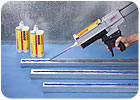
In many industries, manufacturers of metal components are turning to structural adhesives to replace or augment rivets, bolts, welding and other traditional fastening methods in their assembly processes. Adhesives can improve product performance and aesthetics, reduce overall assembly time, and lower production costs.
Advances in structural-adhesive technology have dramatically expanded the scope of potential metal-bonding applications. Until recently, most structural adhesives would lose strength over time on galvanized steel. New patented adhesive technology provides long-term durability on galvanized substrates. Structural adhesives are also excellent alternatives for bonding metal-to-metal, metal-to-plastic and metal-to-composites.
In the light-gauge steel construction industry, structural adhesives for metal bonding were first introduced two years ago. In this industry, they are being used in combination with metal pins to replace expensive sheet metal screws. Used in both residential and commercial structures, these adhesives must maintain their strength through varying temperatures and weather conditions without corroding or failing for the extended life of a building.
Structural adhesive systems have been formulated to bond trusses, joists, shear walls, headers, studs and cantilevered beams. Their use can reduce overall construction costs on the components by 60%, with the majority of savings found in assembly time. Similar bonding applications can be translated to other industries that use galvanized steel, steel, and aluminum, such as HVAC and appliance assemblies where corrosion resistance is critical.
On specialty vehicles such as trailers, truck bodies, buses and construction equipment, structural adhesives are being used to assemble frames, panels, booms, and cabs made of metal, plastic and composites (see "In the Real World"). In moist end-use environments, such as tubs and spas, these adhesives attach and bond galvanized steel frames to fiberglass and ABS tubs. Commercial furniture manufacturers bond plain, painted or powder-coated metals and plastics in chair, desk, and cabinet assembly. On signs and displays exposed to environmental elements, adhesives attach metals, plastics and composites, creating a unique appearance for the customer.
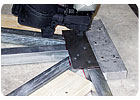
Traditional Metal Assembly
Three major methods of traditional metal-to-metal assembly exist. They are used with varying degrees of effectiveness depending on the final application, end-use requirements, and environmental constraints, such as weather, moisture, salt, or chemicals.Thermal methods weld, braze or solder two homogenous materials with similar melting points. Mechanical fastening secures dissimilar substrates with bolts, screws or rivets. Chemical assembly bonds similar or dissimilar substrates using adhesives.
The most important limitation of both thermal joining and mechanical fastening is cost. Thermal joining is an expensive process that requires specialized labor. Welded joints are often non-uniform and lack the clean aesthetics desired for high-end applications. Parts joined in this manner are very difficult to disassemble.
Mechanical fastening is also an expensive process, requiring labor to drill holes and insert fasteners. The holes can create leak paths, a starting point for corrosion, and may detract from the visual aesthetics of the end product.
As both fasteners and thermal joining concentrate stress at a single point, they may cause premature joint failure and have difficulty withstanding stresses caused by flex or vibration.
Structural Acrylic Adhesives
Structural acrylic adhesives are two-part systems that fill large gaps, seal joints, join dissimilar materials and provide a neat appearance. In addition, these materials deliver thermal and chemical resistance, and distribute stresses evenly across the entire bond joint. With stress spread across larger areas, the joint is stronger. On school buses, where safety is paramount, the steel will actually fracture and split before adhesive joints fail.By eliminating the stress concentrations produced by fasteners, thinner gauge metals may often be used. Rubber-toughened structural acrylic formulations are an excellent choice for applications requiring good cold-impact resistance, long-term fatigue resistance and durability.
These adhesives cure by mixing two separate parts: a resin and an activator. Once the two components are mixed, a room-temperature chemical reaction occurs, delivering a very strong bond to metals, plastics and composites. These adhesives will not bond well to wood or rubber products.
By eliminating the holes made with mechanical fasteners, structural acrylics provide a better looking end product and reduce corrosion. They require little surface preparation and can be formulated to deliver application-specific open times from minutes to hours.
The mix ratio for these adhesives is forgiving and allows some margin for error. Once mixed, the adhesive generates heat during the curing process. The effects of this heat can be minimized by controlling the amount of adhesive dispensed, the size of the assembly and the substrates used. A large metal assembly, for instance, will dissipate heat faster than a small metal, plastic or composite part.
As most structural acrylics typically cannot resist temperatures above 250°F, processing that involves elevated temperatures, such as a paint bake cycle, may present problems. However, a few structural acrylics can withstand temperatures up to 400°F for short periods of time, allowing for use in paint bake cycles without a significant loss in bond strength.
Structural acrylic adhesives require cure time up to 24 hours. However, fixture time is much shorter, and many formulations allow handling of assemblies in just minutes. To keep production lines moving, mechanical fasteners are sometimes used to temporarily hold the assembly in place while the adhesive cures. These small fasteners are used only sparingly and do not require through-holes.
High-performance adhesive formulations are available to bond specific substrates, such as aluminum, stainless steel, carbon steel or galvanized materials. These adhesives also have more advanced toughening agents to improve impact and peel resistance.
In the Real World
Specialty vehicle manufacturers are achieving great success using structural adhesives to replace rivets and mechanical fasteners in truck body and trailer manufacturing. The improved product aesthetics that result from adhesive assembly can greatly enhance the value of the vehicle.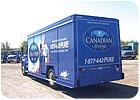
Application #1
Group Hesse of Quebec, Canada, is the oldest beverage trailer and truck body manufacturer in North America. The company was using a time-intensive and expensive riveting process to attach the exterior walls of the trailer to its aluminum frame. The three-step process required holes to be drilled into the wall panels for the rivets. Wall panels were then riveted in place and a white plastic rail was installed around the edges of the front and back walls to cover the rivets. This plastic rail was designed to improve the appearance of the front and back walls that are used for advertising space.The plastic rails did not match the paint job and were easily damaged. The rivets caused the paint to peel and eventually rust and corrode in Canada's extreme weather conditions. Group Hesse was looking for a process that was simpler, less expensive, more attractive and offered long-term performance.
In response, Henkel provided Loctite® H8000TM SpeedbonderTM adhesive, a fast-fixturing structural acrylic that offers excellent impact and peel resistance on aluminum. The adhesive completely replaced the rivets on both the front and rear exterior walls, eliminating the plastic rails. Application and assembly were fast and simple. The adhesive was manually applied to the frame using a pneumatic cartridge dispenser. The flat painted panel was then clamped in position, excess adhesive was removed, and the assembly was allowed to cure for two hours. The assembly process was completed in just four hours - down from 5.25 hours - and no additional reinforcements were required.
Group Hesse tested a fleet of beverage trucks assembled using the structural acrylic adhesive for 18 months on Canadian roads. Tests found that the longevity and aesthetics of the painted graphics improved dramatically. By eliminating the rivets and the plastic rail, painted graphics could extend all the way across the panel. Corrosion that once started at the rivets was completely eliminated with the new assembly process.
Group Hesse is now considering the use of H8000 Speedbonder to assemble the truck body's aluminum frame in order to reduce difficult and expensive welding requirements. The adhesive is expected to increase the overall structural integrity of the assembly by evenly distributing joint stress.
"It is obvious to me that welds will be used less and less in our design, replaced by stronger, more efficient technologies like Speedbonder H8000," explains Martin Barrette, chief engineer at Group Hesse.
Application #2
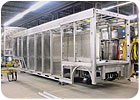
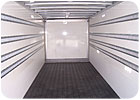
Mickey Truck Bodies of High Point, NC, a manufacturer of beverage delivery trucks and dry freight vans, turned to Henkel to decrease manufacturing costs and improve the aesthetics of their vans without sacrificing strength and durability.A series of galvanized steel e-track bars are attached inside of every truck body to assist with freight management. Truckers secure ratchet straps to the bars to hold cargo in place during transportation. If the e-track bars fail, cargo can move throughout the truck body, potentially causing dangerous weight shifts.
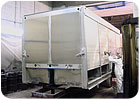
Loctite H8600TM Speedbonder, a structural acrylic formulated for long-term strength on galvanized steel, replaced the through-bolts along the e-track and made the installation process a one man job. First, adhesive is applied along the e-track bar. The bar is then positioned to the wall and tacked in place using sheet metal screws that do not penetrate through the wall. The screws provide stability while the adhesive cures.
Looking for a reprint of this article?
From high-res PDFs to custom plaques, order your copy today!