Adhesives Mag logo
search
cart
facebook twitter linkedin youtube
  • Sign In
  • Create Account
  • Sign Out
  • My Account
Adhesives Mag logo
  • NEW PRODUCTS
  • NEWS
    • Adhesives & Sealants Headlines
    • Mergers/Acquisitions
    • Market Trends
    • TOP 20
  • TOPICS
    • Finished Adhesives and Sealants
    • Pressure-Sensitive Adhesives (PSAs)
    • Coatings
    • Raw Materials and Chemicals
    • Materials Handling/Processing
    • Meter/Mix/Dispense
    • Curing
    • Testing/Quality Control
    • Packaging of Adhesives & Sealants
    • Converting/Packaging
    • Composites
    • Sustainability
  • EVENTS
    • MAX
    • ASI Academy
    • Events Calendar
  • COLUMNS
    • European Perspectives
    • Strategic Solutions
    • Supply Chain Strategies
    • Tape Talk
  • MULTIMEDIA
    • Videos
    • Podcasts
    • Webinars
    • eBooks
  • EXPLORE
    • Adhesives in Action
    • Blog
    • ASI Store
    • Industry Links
    • Market Research
    • Classifieds
  • DIRECTORIES
    • Buyers' Guide
    • Global Adhesives & Sealants Directory
    • Raw Materials, Chemicals, Polymers and Additives Handbook
    • Equipment Handbook
    • Distributor Directory
  • EMAGAZINE
    • EMAGAZINE
    • ARCHIVE ISSUES
    • ADVERTISE
      • Custom Content & Marketing Services
    • CONTACT
  • SIGN UP!
Sustainability

Altered Carbon Points Toward Sustainable Manufacturing
By Shawn Ballard
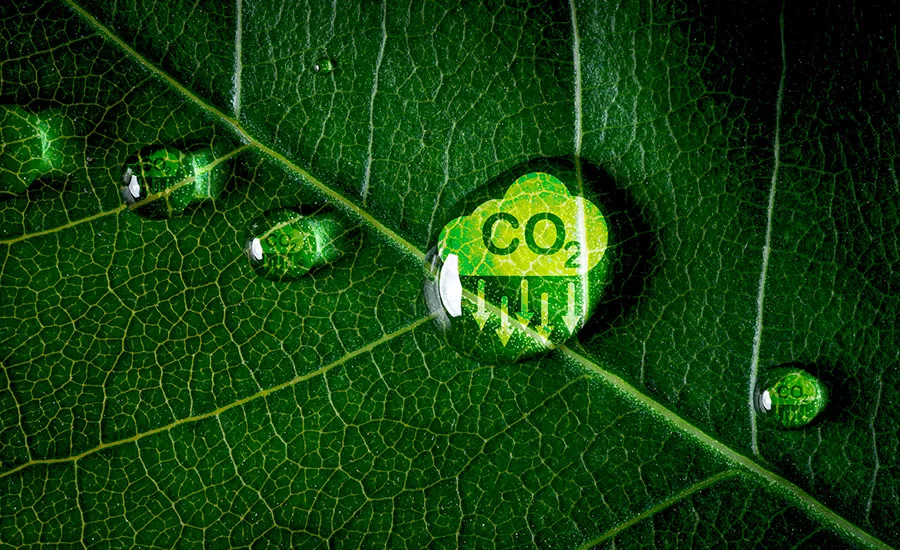
lower co2 emissions
Dilok Klaisataporn / iStock / Getty Images Plus via Getty Images

Dilok Klaisataporn / iStock / Getty Images Plus via Getty Images

March 21, 2025

In research news, Feng Jiao, the Elvera and William R. Stuckenberg Professor in in the McKelvey School of Engineering at Washington University in St. Louis, has developed a two-step process to convert carbon dioxide (CO2) into carbon-based materials used in the production of food, plastics, and other commodity chemicals. Jiao’s tandem CO2 electrolysis produces acetate and ethylene.

In a study1 published June 3 in Nature Chemical Engineering, Jiao demonstrated that his tandem CO2 electrolyzer, which was specifically engineered for enhanced production of multi-carbon products, successfully scales up to produce a kilogram of chemicals per day at high concentration and purity. The paper reports that this represents a 1,000% increase in scale over previous demonstrations, offering a pathway to industrial feasibility, which Jiao and his team further supported with a techno-economic analysis showing the technique’s commercial viability.

“Most work in CO2 electrocatalysis is done at a small scale, about a gram a day,” said Jiao. “Scaling up by three orders of magnitude to produce a kilogram per day, as we have done, is a big step, but still nowhere near the scale of global CO2 emission, which is gigatons per year.

“Scaling up isn’t just about system size,” Jiao continued. “We also have to address engineering challenges, for example, how to separate products and how to maintain performance when dealing with scaled up effects in temperature and transport considerations.”

Building on insights gleaned from smaller scale experiments, Jiao’s team successfully designed and operated a CO2 electrolyzer and carbon monoxide (CO) electrolyzer in a tandem configuration. The two electrochemical reactors work in series – first converting CO2 to CO, then CO to multi-carbon products – which allows the system to be more efficient through task specialization. The electrolyzer stack performed consistently and stably for over 125 hours – a testament to its robustness, Jiao said. During this operational period, the system churned out 98 liters of acetate at high concentration and 96% purity.

Feng Jiao’s two-step system for carbon dioxide (CO2) electrolysis
FIGURE 1 » Feng Jiao’s two-step system for carbon dioxide (CO2) electrolysis works by converting CO2 into carbon monoxide (CO), then processing CO into multi-carbon products like ethylene and acetate, which can be used in the plastics and food industries. Courtesy of Feng Jiao

A key achievement of Jiao’s system is not only enhanced production capability, but also the system's resilience against industrial impurities, a critical factor in real-world applications. This resilience ensures that the system can maintain its high performance amid challenges posed by typical industrial environments.

“This is the first step in scaling up to commercial applications,” Jiao said. “We’re trying to invent a scalable way to produce acetate from CO2, which would allow us to shift carbon feedstocks, provide economical pathways to use CO2 and turn it into something useful, and cut down CO2 emissions associated with traditional chemical manufacturing processes. This new pathway gets us very close to net-zero carbon emission.”

Back to the grocery store. If Jiao’s CO2 conversion process works at a large scale, that’s not just saving big money on buying the sugar required to feed the microbes that do the heavy lifting in biomanufacturing. It also avoids the emissions that come with agricultural production of those sugar feedstocks. Even better, producing acetate and ethylene on a massive scale could set up a circular manufacturing process where captured CO2 feeds microbes instead of contributing to harmful environmental impacts. Then, when CO2 is produced as a byproduct of biomanufacturing, it can be recaptured and reprocessed to feed the next generation of microbes.

“We’re in the process of scaling the system up again, by another order of magnitude,” Jiao said. “We’re working on fine-tuning the system, for example by using different catalysts, and improving performance by making the more stable, robust and efficient. If everything works out, we could be seeing this technology in a commercial scale demonstration in five to ten years.”

This work was supported by the U.S. Department of Energy (DE-FE0031910).

References

1. Crandall BS, Ko BH, Overa S, Cherniack L, Lee A, Minnie I, Jiao F. Tandem CO2 electrolysis: From Watt to Kilowatt-scale for enhanced acetate and ethylene production. Nature Chemical Engineering, June 3, 2024. DOI: https://www.nature.com/articles/s44286-024-00076-8.


Article written by Shawn Ballard and published courtesy of Washington University in St. Louis.  

KEYWORDS: research and development

Share This Story

Looking for a reprint of this article?
From high-res PDFs to custom plaques, order your copy today!
Shawn Ballard, Washington University in St. Louis.  

Recommended Content

JOIN TODAY
to unlock your recommendations.

Already have an account? Sign In

  • mouse in hole

    Using Foam Sealants for Pest Prevention

    According to the National Pest Management Association,...
    Finished Adhesives and Sealants
    By: Kevin Corcoran
  • linked network nodes

    Using the Power of AI for Adhesive and Sealant Formulation

    With the help of software solutions, adhesive formulators...
    Adhesives and Sealants Topics
    By: Karen Parker
  • top20-hero.jpg

    2024 ASI Top 20: Leading Global Manufacturers of Adhesives and Sealants

    ASI's annual ranking of the top 20 global adhesive and...
    Adhesives and Sealants Topics
Manage My Account
  • eMagazine Issues
  • Newsletters
  • Online Registration
  • Manage My Preferences
  • Subscription Customer Service

More Videos

Popular Stories

image of a graph representing markets

Sika Announces Acquisition of Gulf Seal in Saudi Arabia

news on internet screen

Henkel Posts Positive Organic Growth for Third Quarter, Driven by Adhesives Technologies Business

Picture of two men and one woman in dark suits

Bodo Möller Chemie Makes Management Change for CASE Business Unit

ASI Top 20 website

Events

January 1, 2030

Webinar Sponsorship Information

For webinar sponsorship information, visit www.bnpevents.com/webinars or email webinars@bnpmedia.com.

View All Submit An Event

Products

Structural Adhesives: Properties, Characterization and Applications

Structural Adhesives: Properties, Characterization and Applications

See More Products

ASI CASE EBOOK

Related Articles

  • Tape Week 2023

    PSA Tape Companies Work Toward a Sustainable Future at Tape Week 2023

    See More
  • Image of green tree within clear lightbulb

    Celanese Announces New Partnership to Develop Sustainable Paint Solutions Created with Carbon Capture Technology

    See More
  • digital graphic representing a sustainable supply chain

    Sustainable Manufacturing = Uncommon Common Sense

    See More

Events

View AllSubmit An Event
  • December 9, 2025

    2025 American Chemical Manufacturing Summit

    The Generis American Chemical Manufacturing Summit is the premier event for senior executives in the chemical manufacturing industry focused on manufacturing, quality, HSE and supply chain. 
View AllSubmit An Event
×

Keep the info flowing with our newsletters!

Get the latest industry updates tailored your way.

JOIN TODAY!
  • RESOURCES
    • Advertise
    • Contact Us
    • Directories
    • Manufacturing Division
    • Store
    • Want More
  • SIGN UP TODAY
    • Create Account
    • eMagazine
    • Newsletters
    • Customer Service
    • Manage Preferences
  • SERVICES
    • Marketing Services
    • Reprints
    • Market Research
    • List Rental
    • Survey & Sample
  • STAY CONNECTED
    • LinkedIn
    • Facebook
    • Youtube
    • X (Twitter)
  • PRIVACY
    • PRIVACY POLICY
    • TERMS & CONDITIONS
    • DO NOT SELL MY PERSONAL INFORMATION
    • PRIVACY REQUEST
    • ACCESSIBILITY

Copyright ©2025. All Rights Reserved BNP Media.

Design, CMS, Hosting & Web Development :: ePublishing