Adhesives Mag logo
search
cart
facebook twitter linkedin youtube
  • Sign In
  • Create Account
  • Sign Out
  • My Account
Adhesives Mag logo
  • NEW PRODUCTS
  • NEWS
    • Adhesives & Sealants Headlines
    • Mergers/Acquisitions
    • Market Trends
    • TOP 20
  • TOPICS
    • Finished Adhesives and Sealants
    • Pressure-Sensitive Adhesives (PSAs)
    • Coatings
    • Raw Materials and Chemicals
    • Materials Handling/Processing
    • Meter/Mix/Dispense
    • Curing
    • Testing/Quality Control
    • Packaging of Adhesives & Sealants
    • Converting/Packaging
    • Composites
    • Sustainability
  • EVENTS
    • MAX
    • ASI Academy
    • Events Calendar
  • COLUMNS
    • European Perspectives
    • Strategic Solutions
    • Supply Chain Strategies
    • Tape Talk
  • MULTIMEDIA
    • Videos
    • Podcasts
    • Webinars
    • eBooks
  • EXPLORE
    • Adhesives in Action
    • Blog
    • ASI Store
    • Industry Links
    • Market Research
    • Classifieds
  • DIRECTORIES
    • Buyers' Guide
    • Global Adhesives & Sealants Directory
    • Raw Materials, Chemicals, Polymers and Additives Handbook
    • Equipment Handbook
    • Distributor Directory
  • EMAGAZINE
    • EMAGAZINE
    • ARCHIVE ISSUES
    • ADVERTISE
      • Custom Content & Marketing Services
    • CONTACT
  • SIGN UP!

Dispensing Equipment Reduces Production Time and Cost for Electronics Manufacturer
June 1, 2000
A leading contract manufacturer of electronic control, display and sensor products has reduced labor and material costs through the use of an innovative potting compound-dispensing system. Phoenix International Corp., Fargo, N.D., has replaced time-consuming manual-mixing procedures with a new equipment design that precisely meters, mixes and dispenses the urethane material used in production for agricultural, off-highway, heavy-duty truck and construction original equipment manufacturers (OEMs).

The two-part formulation is used to protect circuit boards and components from harsh conditions, such as moisture, high/low temperatures, and physical or electrical stress. Once potted in an enclosure, the unit is typically mounted on the chassis or drive train of heavy machinery such as a tractor or steer loader, where operating temperatures generally range from -40ºC to 85ºC (-40ºF to 185ºF). The potting operation is one example of a manufacturing process that has earned Phoenix products a reputation for exceptional reliability.

A Flexible System

The dispensing system is provided by Fluid Research Corp., Costa Mesa, Calif. According to Phoenix Lead Manufacturing Engineer Mark Nyland, “For us, the key features of the FRC Advantage Work Station® are its shot-size accuracy and range. With the machine’s adjustable flow rate and predictable, consistent ratios, we have a very repeatable process.

“Every time we set up a program, a ratio test is performed to check for variation,” he explained. “With this material, we could handle up to 5% deviation in the mix ratio, but during the nine months since we’ve acquired the FRC machine, the maximum fluctuation has never been anywhere near that,” Nyland added.

When initially qualifying the dispensing system, Phoenix did a matrix comparison with other equipment in the industry. “We found other systems that could deliver a range of 2 to 30 grams of material, but larger-volume requirements would have meant purchasing another machine or extensively revising an existing design,” he observed. Current production at Phoenix includes shot sizes ranging from 9 to 400 grams, but future designs are expected to require accurate delivery of just 2 grams of material.

“The flexibility of this dispensing system is a major benefit,” Nyland continued. “The ability to provide a wide range of shot sizes is important to our type of operation, especially in the lower-volume applications,” he said. “We also like the quick setup and changeover time.”
Manufacturing Process

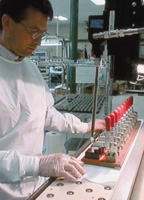
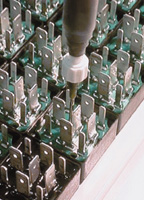
Phoenix technicians program the ratio, flow rate and quantity of the potting compound to be dispensed via the system’s LCD touch panel. The circuit board is then placed under the dispensing machine’s static-mixing nozzle, and the technician simply depresses a foot switch to release the programmed amount.

“The computer-based system allows fast setup, and operators can adjust and store multiple flow rates, mix ratios and even entire dispensing cycles,” commented Fluid Research President Mike Engle. The optically encoded servo drives and microprocessor-controlled hardware are driven by FRC programming technology that delivers extremely accurate and repeatable shot sizes anywhere from 1 cc to many gallons.

“With the components mixed in a static mixer after flowing from the Stat-A-Seal™ Dispense Head, the positive-shutoff valves prevent cured material from clogging the lines,” Engle explained. “And because it requires no dynamic shaft seals, the progressive-cavity design eliminates the valve wear, leakage and potential phasing errors common to piston-pump systems,” he added.

The new equipment replaces labor-intensive procedures that required manual mixing and dispensing of the potting compound. Before acquiring the new, automated system, the company was buying the potting material in kits where the resin and catalyst were separated by a piece of foil. Operators would manually mix the material in the kits and then dispense into the units to be potted.

“The cost of buying the material in kits, plus the labor involved, proved to be very high. According to our calculations, the justification for purchasing this new dispensing system was that it would pay for itself in roughly one year,” said Nyland. The company now purchases the material in 55-gallon kits, and allows the equipment to handle all mixing and metering chores.

For more information on liquid control systems, contact Fluid Research Corp., 3505 Cadillac Ave., Costa Mesa, CA 92626; phone 714-513-2350; fax 714-513-2351; or visit www.fluidresearch.com.

For more information on circuit board manufacturing, contact Phoenix International Corp., 1441 44th St., N.W., Fargo, ND 58102; phone 701-282-9364; fax 701-282-9365.

Links

  • Fluid Research Corp.

Share This Story

Looking for a reprint of this article?
From high-res PDFs to custom plaques, order your copy today!

Recommended Content

JOIN TODAY
to unlock your recommendations.

Already have an account? Sign In

  • mouse in hole

    Using Foam Sealants for Pest Prevention

    According to the National Pest Management Association,...
    Adhesives and Sealants Topics
    By: Kevin Corcoran
  • linked network nodes

    Using the Power of AI for Adhesive and Sealant Formulation

    With the help of software solutions, adhesive formulators...
    Raw Materials and Chemicals
    By: Karen Parker
  • top20-hero.jpg

    2024 ASI Top 20: Leading Global Manufacturers of Adhesives and Sealants

    ASI's annual ranking of the top 20 global adhesive and...
    Pressure-Sensitive Adhesives (PSAs)
Manage My Account
  • eMagazine Issues
  • Newsletters
  • Online Registration
  • Manage My Preferences
  • Subscription Customer Service

More Videos

Popular Stories

Image of scrabble pieces with pictures of people

Avery Dennison Completes Acquisition of Flooring Business

Picture of a laboratory

Henkel Launches Packaging RecycLab in China

adhesives

The Invisible Strength of Polyurethane Adhesives

ASI Top 20 website

Events

January 1, 2030

Webinar Sponsorship Information

For webinar sponsorship information, visit www.bnpevents.com/webinars or email webinars@bnpmedia.com.

View All Submit An Event

Products

Structural Adhesives: Properties, Characterization and Applications

Structural Adhesives: Properties, Characterization and Applications

See More Products

ASI CASE EBOOK

Related Articles

  • Modular, Robotic Dispenser for Small-Scale Work Cells Reduces Payback Time, Builds In Flexibility

    See More
  • Adhesive syringes

    Packaging a Solution for an Electronics Manufacturer

    See More
  • Nonwovens Disposable Hygiene:  A World of Opportunity

    Nonwovens Disposable Hygiene: A World of Opportunity for Adhesive Manufacturers and Dispensing Equipment Suppliers

    See More

Related Directories

  • Applied Rigaku Technologies

    Applied Rigaku Technologies offers high-quality elemental analyzers for determining silicone coating thickness and composition. The NEX LS provides in-line coat weight profiling for roll-to-roll applications, ideal for continuous monitoring. Additionally, the NEX QC Series at-line analyzers measure very low silicone coating weights and metal catalysts in silicone coatings.
×

Keep the info flowing with our newsletters!

Get the latest industry updates tailored your way.

JOIN TODAY!
  • RESOURCES
    • Advertise
    • Contact Us
    • Directories
    • Store
    • Want More
  • SIGN UP TODAY
    • Create Account
    • eMagazine
    • Newsletters
    • Customer Service
    • Manage Preferences
  • SERVICES
    • Marketing Services
    • Reprints
    • Market Research
    • List Rental
    • Survey & Sample
  • STAY CONNECTED
    • LinkedIn
    • Facebook
    • Youtube
    • X (Twitter)
  • PRIVACY
    • PRIVACY POLICY
    • TERMS & CONDITIONS
    • DO NOT SELL MY PERSONAL INFORMATION
    • PRIVACY REQUEST
    • ACCESSIBILITY

Copyright ©2025. All Rights Reserved BNP Media.

Design, CMS, Hosting & Web Development :: ePublishing