Adhesives Mag logo
search
cart
facebook twitter linkedin youtube
  • Sign In
  • Create Account
  • Sign Out
  • My Account
Adhesives Mag logo
  • NEW PRODUCTS
  • NEWS
    • Adhesives & Sealants Headlines
    • Mergers/Acquisitions
    • Market Trends
    • TOP 20
  • TOPICS
    • Finished Adhesives and Sealants
    • Pressure-Sensitive Adhesives (PSAs)
    • Coatings
    • Raw Materials and Chemicals
    • Materials Handling/Processing
    • Meter/Mix/Dispense
    • Curing
    • Testing/Quality Control
    • Packaging of Adhesives & Sealants
    • Converting/Packaging
    • Composites
    • Sustainability
  • EVENTS
    • ASI Academy
    • Events Calendar
  • COLUMNS
    • European Perspectives
    • Strategic Solutions
    • Supply Chain Strategies
    • Tape Talk
  • MULTIMEDIA
    • Videos
    • Podcasts
    • Webinars
    • eBooks
  • EXPLORE
    • Adhesives in Action
    • Blog
    • ASI Store
    • Industry Links
    • Market Research
    • Classifieds
  • DIRECTORIES
    • Buyers' Guide
    • Global Adhesives & Sealants Directory
    • Raw Materials, Chemicals, Polymers and Additives Handbook
    • Equipment Handbook
    • Distributor Directory
  • EMAGAZINE
    • EMAGAZINE
    • ARCHIVE ISSUES
    • ADVERTISE
      • Custom Content & Marketing Services
    • CONTACT
  • SIGN UP!

Adhesives Essentials: Using Tackifier Resins to Facilitate Nonwovens Reformulation

January 1, 2006
This article offers two ways to facilitate nonwovens reformulations. Think of them as the fast-forward button on the reformulation process for for reformulators and end users.

Editor's note: This is the fourth in a series of articles designed to address the fundamentals of adhesive and sealant formulation. See ASI November 2005 for the previous installment.

Adhesives formulators and product managers in the nonwovens industry are increasingly concerned by the cost and viability of their existing nonwoven adhesive formulations. The continued rising cost of petrochemicals and their derivatives, coupled with a series of raw-material shortages, have forced the industry to identify short-term formulation alternatives to meet customer needs. In addition, the increased adoption of olefinic polymers, such as amorphous polyolefins (APO) and the emergence of metallocene polyethylene (m-PE), are broadening the scope of adhesive formulations. Because their availability is not dependent on isoprene, these polymers are being used in a number of new adhesive developments.

Nonwoven adhesive formulators cannot afford to spend time on major formulation adjustments, raw material evaluations and long-term R&D projects. Reformulating the "existing" while incorporating the "new" requires a wealth of experience, data and adhesive concepts to continue to meet customer requirements and deadlines. Fortunately, formulators who embrace these changes have an opportunity to significantly advance nonwoven adhesives.

This article offers two ways to facilitate nonwovens reformulation. Think of these as the fast-forward button on the reformulation process for formulators and end users.


A Shortcut to Tg

There are many physical parameters that are affected when formulators change the polymer in an adhesive. Among them, the glass-transition temperature (Tg) is one of the most important. Adhesive Tg is the temperature at which the adhesive midblock phase (polymer midblock, tackifier resin and oil) has the highest flow (energy loss) to cohesion (energy storage) ratio. It closely follows the Tan δ maximum temperature as measured by dynamic mechanical analysis (DMA). Generally, the temperature range at which a pressure-sensitive adhesive will have optimum tack properties is 20°C above the adhesive Tg. For a typical nonwoven adhesive, the adhesive Tg should range from 15°C and 20°C, corresponding with a service temperature of 37°C.

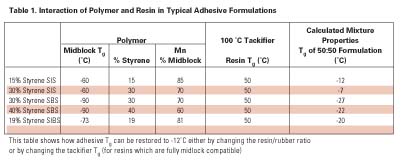
Table 1 contains calculation models that illustrate the complex interaction between resins and polymers. When a fully midblock compatible resin and polymer midblock are combined, they dissolve in one another and form a single phase: the high Tg of the tackifier resin increases the low Tg of the polymer midblock. The Tg of this mixture can be estimated with the Fox equation: (X1+X2)/Tg(m) = X1/Tg1 + X2/Tg2, in which the Tg of the mixture Tg(m) is expressed as function of the Tg and weight fraction X of the individual components. Note that in this calculation, just the weight fraction of the polymer midblock must be used as only it is modified by the midblock tackifier resin.

In the table, some of the benchmark parameters of typical SIS, SBS and SIBS polymers are given. When reformulating an adhesive, formulators will typically change one raw material while trying to keep the formulation and other ingredients constant. As the theoretical model demonstrates, this is not as straightforward as it seems.
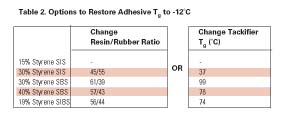
Polymer adjustments can change the calculated Tg of these mixtures by as much as 20°C, enough to significantly alter overall adhesive properties. Changing the ratio of the adhesive materials, such as the resin-to-rubber ratio or the oil content, are options. However, these tend to lead to further reformulation efforts as the fundamentals of the original formulation are changed.

Fortunately, tackifier resins are very well suited to adjusting adhesive Tg without major changes to the formulation. They are commercially available with a range of softening points. As Table 2 shows, by selecting a resin or a resin blend with the proper Tg and softening point, formulators can easily adjust adhesive Tg to a target value.

Nonwoven adhesives are used in the manufacture of diapers, among other products.

The Softening Point Balancing Act

While adhesive Tg is a key parameter linked to the adhesive performance of the nonwoven laminate at room or body temperature, the coating and application performance of nonwoven adhesives is more commonly linked to the adhesive viscosity and the adhesive R&B softening point. The latter is of special interest, as it expresses the temperature at which the adhesive loses its elastic behavior and becomes viscous. Depending on the end use, nonwoven adhesives are formulated and specified for a specific adhesive R&B softening point range. When reformulating, formulators try to maintain the original softening point range to simplify time-consuming requalifications for the manufacturer or end user.

The adhesive R&B softening point is related to a number of parameters, including the polymer type, the amount of diblocks, the resin-to-rubber ratio, the compatibility of the resin phase with styrene and the amount of styrene in the system. Changing a polymer, as shown in Table 1, changes many of these elements. More often than not, a formulator needs to find a way to readjust the adhesive R&B softening point and, if possible, use one that does not require a change in the ingredient ratio.

A conventional approach to this problem is to change the adhesive R&B softening point by changing the softening point of the tackifier resin in the formulation. For example, Eastman Regalite R7100 and Regalite S7125 have a similar aliphatic/aromatic balance but different resin softening points. The change from a 100°C resin to a 125°C resin does increase the adhesive R&B, but it also significantly changes the Tg. In some cases, this may be desirable, but in many others, formulators need to adjust the adhesive R&B softening point without changing the adhesive Tg. Selecting the tackifier resin with the right aliphatic/aromatic balance does just that.
In essence, the aliphatic/aromatic balance of the tackifier resin influences the degree to which, at a given temperature, the styrene end blocks of the polymer can build domain structures that increase the elasticity of the adhesive. If a very aliphatic tackifier resin is used, the domain structures will be very strong and maintained until high temperatures. This, in turn, yields a high adhesive R&B softening point. In contrast, a more aromatic resin will dissolve some of the domain structures, leading to a much lower adhesive R&B softening point.

For example, Regalite S1100 and Regalite S5100 hydrocarbon resins have similar softening points, but different aliphatic/aromatic balance. Substituting one for the other does not affect adhesive Tg, but significantly influences the adhesive softening point. In practice, adhesive formulators can work with resin blends to either increase or decrease the aliphatic/aromatic balance in their products, adjusting the adhesive R&B softening point by changing the ratio between the two.

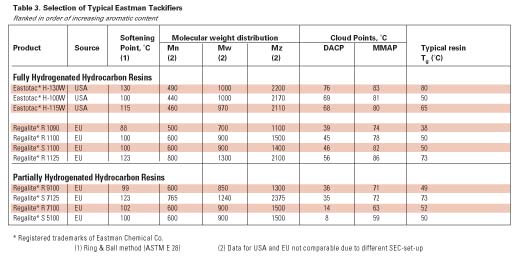
Table 3 shows the range of Regalite and Eastotac aliphatic/aromatic balance and softening points available. By working closely with their resin supplier, formulators can find the precise resin or blend of resins to meet their needs.

Conclusion

Resin selection goes beyond the physical properties discussed in this short article. Formulators must also consider a resin's odor, color and stability - not to mention cost and availability. This article shows that by revisiting the parameters that influence adhesive Tg and R&B softening point, formulators can reach their target performance quickly with the flexibility offered by tackifiers.

About the Author

Ruud van der Eerden is business segment manager, Nonwoven Adhesives, in Europe and the Middle East, and Global Corporate Account manger for Eastman Chemical Co.

For more information, contact Eastman Chemical Co., phone (423) 229-2000, or visit www.tackifier.com.

Share This Story

Looking for a reprint of this article?
From high-res PDFs to custom plaques, order your copy today!
Recommended Content

JOIN TODAY
to unlock your recommendations.

Already have an account? Sign In

  • 2026 ASI Top 20: Leading Global Adhesives and Sealants Manufacturers

    2026 ASI Top 20: Leading Global Adhesives and Sealants Manufacturers

    Every year, we study the leading worldwide manufacturers...
    Adhesives and Sealants Topics
    By: Karen Parker
  • PSA Market

    Trends and Opportunities in Pressure-Sensitive Adhesives: Sustainability, Innovation, and Market Growth

    The pressure-sensitive adhesives market is growing...
    Pressure-Sensitive Adhesives (PSAs)
    By: Chirag Tripathi and Parag Shah
  • science test tubes

    2026 Adhesives and Sealants Raw Materials Roundup

    After more than two years of contraction, the...
    Sustainability
    By: Karen Parker
Manage My Account
  • eMagazine Issues
  • Newsletters
  • Online Registration
  • Manage My Preferences
  • Subscription Customer Service

More Videos

Sponsored Content

Sponsored Content is a special paid section where industry companies provide high quality, objective, non-commercial content around topics of interest to the Adhesives and Sealants Industry audience. All Sponsored Content is supplied by the advertising company and any opinions expressed in this article are those of the author and not necessarily reflect the views of Adhesives and Sealants Industry or its parent company, BNP Media. Interested in participating in our Sponsored Content section? Contact your local rep!

close
  • Assembly automation for medical device manufacturing
    Sponsored byNordson EFD

    Three Proven Principles Powering Quality Assembly

Popular Stories

image of handshake

APPLIED Adhesives Expands Silicone Solutions and East Coast Presence with Acquisition

People shaking hands

Henkel Names Exclusive US Distributor for Flexible Packaging Technologies

Picture of a lobby of a Henkel facility

Henkel Expands Silicon Valley Application Center for Electronics

ASI 2026 Top 20 Adhesives & Sealants List

Events

September 15, 2026

Coatings Trends & Technologies Summit

This annual Midwest coatings conference combines all of the high-quality technical presentations, exhibits and networking opportunities from the Coatings Trends and Technologies and Powder Coating Summit conferences into one new event. The event caters to both liquid and powder coatings formulators and manufacturers.

September 16, 2026

World Adhesive & Sealant Conference (WAC) 2026

As the industry’s premier international event, WAC 2026 offers a unique opportunity for professionals from every continent to connect, collaborate, and shape the future of the sector.
View All Submit An Event

Products

Structural Adhesives: Properties, Characterization and Applications

Structural Adhesives: Properties, Characterization and Applications

See More Products

Related Articles

  • Adhesives Essentials: Strategies to Help Tape and Label Manufacturers Extend Block Copolymer Usage

    See More
  • Adhesives Essentials: Formulating with Resin Dispersions

    See More
  • Using Hydrogenated Rosin Resins to Optimize Adhesive Formulations

    See More

Related Products

See More Products
  • Pressure-Sensitive Adhesives and Applications

  • 9780080447087.jpg

    Volume 2: Handbook of Adhesives and Sealants, 1st Edition

See More Products

Related Directories

  • Epic Resins

    Fast turnaround times, rigorous product testing and cost-effective pricing give OEMs the ability to manufacture better-functioning and more reliable products at lower cost. For over 65 years, Epic Resins has formulated one- and two-component epoxy resin and polyurethane solutions. Our adhesive applications include brush manufacturing, panel bonding and general bonding.
×

Keep the info flowing with our newsletters!

Get the latest industry updates tailored your way.

JOIN TODAY!
  • RESOURCES
    • Advertise
    • Contact Us
    • Directories
    • Manufacturing Division
    • Store
    • Want More
  • SIGN UP TODAY
    • Create Account
    • eMagazine
    • Newsletters
    • Customer Service
    • Manage Preferences
  • SERVICES
    • Marketing Services
    • Reprints
    • Market Research
    • List Rental
    • Survey & Sample
  • STAY CONNECTED
    • LinkedIn
    • Facebook
    • Youtube
    • X (Twitter)
  • PRIVACY
    • PRIVACY POLICY
    • TERMS & CONDITIONS
    • DO NOT SELL MY PERSONAL INFORMATION
    • PRIVACY REQUEST
    • ACCESSIBILITY

Copyright ©2026. All Rights Reserved BNP Media, Inc. and BNP Media II, LLC.

Design, CMS, Hosting & Web Development :: ePublishing