Adhesives Mag logo
search
cart
facebook twitter linkedin youtube
  • Sign In
  • Create Account
  • Sign Out
  • My Account
Adhesives Mag logo
  • NEW PRODUCTS
  • NEWS
    • Adhesives & Sealants Headlines
    • Mergers/Acquisitions
    • Market Trends
    • TOP 20
  • TOPICS
    • Finished Adhesives and Sealants
    • Pressure-Sensitive Adhesives (PSAs)
    • Coatings
    • Raw Materials and Chemicals
    • Materials Handling/Processing
    • Meter/Mix/Dispense
    • Curing
    • Testing/Quality Control
    • Packaging of Adhesives & Sealants
    • Converting/Packaging
    • Composites
    • Sustainability
  • EVENTS
    • MAX
    • ASI Academy
    • Events Calendar
  • COLUMNS
    • European Perspectives
    • Strategic Solutions
    • Supply Chain Strategies
    • Tape Talk
  • MULTIMEDIA
    • Videos
    • Podcasts
    • Webinars
    • eBooks
  • EXPLORE
    • Adhesives in Action
    • Blog
    • ASI Store
    • Industry Links
    • Market Research
    • Classifieds
  • DIRECTORIES
    • Buyers' Guide
    • Global Adhesives & Sealants Directory
    • Raw Materials, Chemicals, Polymers and Additives Handbook
    • Equipment Handbook
    • Distributor Directory
  • EMAGAZINE
    • EMAGAZINE
    • ARCHIVE ISSUES
    • ADVERTISE
      • Custom Content & Marketing Services
    • CONTACT
  • SIGN UP!

The Rotor/Stator Selection Dilemma

August 1, 2002
We've all heard about the increasing popularity of rotor/stator mixers in recent years. Like the term "Sandmill," the term "rotor/stator" mixer is used loosely and can mean many different things to many different people. In a variety of industries, rotor/stator mixers can produce finished dispersions, suspensions or emulsions.

In the adhesives and sealants industry, rotor/stators are used for particle size reduction of various solids. Rotor/stators are commonly used to "cut in" rubber solids and speed up the solution of these solids into various solvents. Sometimes the rotor/stator is used to disperse or break down an additive such as an accelerator or a pigment.

When your objective is an extremely fine "off-gage" dispersion, you are really talking about a sub-micron average particle size with narrow particle distribution. Generally, a media mill is required to achieve these results. In ultra-fine grinding, the rotor/stator is considered a pre-mixing device.

Preparing a good pre-mix for your pigment dispersions can present many problems, especially products with a low starting viscosity. Many times, this viscosity will increase substantially when the pigment agglomerates are broken down and properly dispersed. A traditional high-speed disperser blade is not very efficient in breaking down solids in low-viscosity dispersions because of the absence of hydraulic shear or viscous drag. Many people waste time and energy and put a lot of heat into the batch by trying to beat up a low-viscosity pre-mix to the point where it can be efficiently processed in a media mill.
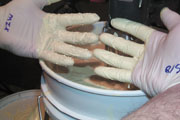
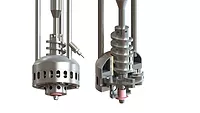
Premier VMS rotor/stator (right) vs. high-speed disperser (left) for a low-viscosity chemical suspension after a processing time of 30 minutes

Emphasis on Pre-Mix Particle Size

Let's discuss the use of rotor/stator mixers as pre-grinding devices used to prepare slurries, dispersions or suspensions of solids in liquid-vehicle systems. It is clear that rotor/stator mixers have shown the capability to produce much finer particles than a single high-speed dispersion blade, and thus dramatically reduce the pre-mix particle size of products that are fed into media mills. Obviously, the finer pre-mix particle size can greatly improve the production rates (efficiency) of continuous media mills. We put great emphasis and analysis on the starting particle size or pre-mix particle size of products before pumping them through our continuous media mills to achieve the ultra-fine finished dispersion.

So, if you have come to the conclusion that you need a rotor/stator, how do you know the type that is best suited for your application? Rotor/stator mixers can be classified in general terms with similar characteristics:

  • High-flow, medium-flow or low-flow capacity;
  • High-shear, medium-shear or low-shear capability;
  • Single-stage or multiple-stage designs with many rows of teeth, or slots;
  • In-line machines with mechanical seals vs. vertical, tank-mounted units; and
  • Materials of construction and abrasion-resistant considerations.
You have to choose the right combination of pumping action vs. shearing action and avoid the most common pitfall of rotor/stators: high temperature, localized heat or "hot spots" in the tank. The rotor/stator must be capable of circulating the batch to prevent heat buildup, but it also has to sufficiently grind the suspended solids.

The second most common problem with rotor/stators is dealing with abrasive solid particles. Most rotor/stator devices operate at fairly close tolerances between the grinding surfaces and also contain shaft bushings that are submerged in the dispersion. A small change in clearances caused by routine wear can cause a dramatic drop-off in dispersion quality in some rotor/stator designs.
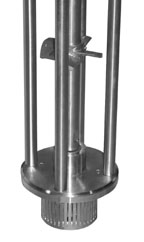
Close-up of the Vertical Max Shear rotor/stator mixer.

Rotor/Stator Mixer Avoids Common Pitfalls

With these concerns in mind, we have designed the Vertical Max Shear (VMS) rotor/stator mixer with a balanced approach that is well suited to a wide range of applications. The VMS rotor is designed with a high suction and pumping capability, with an increased height-to-diameter ratio. This provides a large grinding surface area between the tip of the rotor blade and the inside wall of the stator. In other words, the VMS rotor/stator is taller and narrower in comparison to many other rotor/stator designs. This can increase grinding efficiency in certain applications. Interchangeable VMS stators are available with various slot openings to maximize flow or maximize particle size reduction, whichever is desired.

The VMS rotor/stator was designed with particle size reduction as the main objective but also with a high pumping capability for rapid circulation and blending of liquids for less stringent rotor/stator applications. As standard equipment, the VMS includes an adjustable down-thrust impeller for increased circulation and the ability to handle a wider viscosity range. An abrasive-resistant ceramic shaft coating is also standard to handle dispersions of pigments and other abrasive solids in suspension.

Which rotor/stator is best suited to your application? Consider the characteristics of your product such as temperature sensitivity and abrasive-solids content. Then test different types of rotor/stator devices to get the best combination of flow vs. shear that will produce the results you need for your product - whether the rotor/stator is used as a pre-mix device or to manufacture a finished product.

For additional information on the Vertical Max Shear rotor/stator mixer, contact Premier Mill, A Lightnin Company, One Birchmont Drive, Reading, PA 19606-3298; phone 610-779-9500; fax 610-779-9666; e-mail pmsales@lightnin.spx.com; or visit the Web site www.premiermill.com. Or Circle No. 75.

Links

  • Premier Mill, A Lightnin Company

Share This Story

Looking for a reprint of this article?
From high-res PDFs to custom plaques, order your copy today!
Recommended Content

JOIN TODAY
to unlock your recommendations.

Already have an account? Sign In

  • mouse in hole

    Using Foam Sealants for Pest Prevention

    According to the National Pest Management Association,...
    Finished Adhesives and Sealants
    By: Kevin Corcoran
  • linked network nodes

    Using the Power of AI for Adhesive and Sealant Formulation

    With the help of software solutions, adhesive formulators...
    Raw Materials and Chemicals
    By: Karen Parker
  • top20-hero.jpg

    2024 ASI Top 20: Leading Global Manufacturers of Adhesives and Sealants

    ASI's annual ranking of the top 20 global adhesive and...
    Finished Adhesives and Sealants
Manage My Account
  • eMagazine Issues
  • Newsletters
  • Online Registration
  • Manage My Preferences
  • Subscription Customer Service

More Videos

Popular Stories

image of a graph representing markets

Sika Announces Acquisition of Gulf Seal in Saudi Arabia

news on internet screen

Henkel Posts Positive Organic Growth for Third Quarter, Driven by Adhesives Technologies Business

Picture of two men and one woman in dark suits

Bodo Möller Chemie Makes Management Change for CASE Business Unit

ASI Top 20 website

Events

January 1, 2030

Webinar Sponsorship Information

For webinar sponsorship information, visit www.bnpevents.com/webinars or email webinars@bnpmedia.com.

View All Submit An Event

Products

Structural Adhesives: Properties, Characterization and Applications

Structural Adhesives: Properties, Characterization and Applications

See More Products

ASI CASE EBOOK

Related Articles

  • ROSS Rotor-Stator Mixer

    ROSS: Rotor/Stator Mixer

    See More
  • Hockmeyer Temperature-Regulated Rotor-Stator

    HOCKMEYER: Temperature-Regulated Rotor-Stator

    See More
  • CHARLES ROSS & SON CO.: Bench-Top High-Shear Rotor/Stator Mixer

    See More

Related Products

See More Products
  • handbk-of-ad-and-surface-pr.gif

    Handbook of Adhesives and Surface Preparation

  • acc.jpg

    Adhesives, Coatings and Consolidants, 3E

See More Products
×

Keep the info flowing with our newsletters!

Get the latest industry updates tailored your way.

JOIN TODAY!
  • RESOURCES
    • Advertise
    • Contact Us
    • Directories
    • Manufacturing Division
    • Store
    • Want More
  • SIGN UP TODAY
    • Create Account
    • eMagazine
    • Newsletters
    • Customer Service
    • Manage Preferences
  • SERVICES
    • Marketing Services
    • Reprints
    • Market Research
    • List Rental
    • Survey & Sample
  • STAY CONNECTED
    • LinkedIn
    • Facebook
    • Youtube
    • X (Twitter)
  • PRIVACY
    • PRIVACY POLICY
    • TERMS & CONDITIONS
    • DO NOT SELL MY PERSONAL INFORMATION
    • PRIVACY REQUEST
    • ACCESSIBILITY

Copyright ©2025. All Rights Reserved BNP Media.

Design, CMS, Hosting & Web Development :: ePublishing