Adhesives Mag logo
search
cart
facebook twitter linkedin youtube
  • Sign In
  • Create Account
  • Sign Out
  • My Account
Adhesives Mag logo
  • NEWS
    • Adhesives & Sealants Headlines
    • Mergers/Acquisitions
    • Market Trends
    • TOP 20
  • NEW PRODUCTS
  • TOPICS
    • Finished Adhesives and Sealants
    • Pressure-Sensitive Adhesives (PSAs)
    • Coatings
    • Raw Materials and Chemicals
    • Materials Handling/Processing
    • Meter/Mix/Dispense
    • Curing
    • Testing/Quality Control
    • Packaging of Adhesives & Sealants
    • Converting/Packaging
    • Composites
    • Sustainability
  • COLUMNS
    • From the Editor
    • Strategic Solutions
    • Supply Chain Strategies
    • Tape Talk
  • EVENTS
    • ASI Academy
    • Events Calendar
  • MULTIMEDIA
    • Videos
    • Podcasts
    • Webinars
    • eBooks
  • DIRECTORIES
    • Buyers' Guide
    • Global Adhesives & Sealants Directory
    • Raw Materials, Chemicals, Polymers and Additives Handbook
    • Equipment Handbook
    • Distributor Directory
  • EXPLORE
    • Adhesives in Action
    • Blog
    • ASI Store
    • Industry Links
    • Market Research
    • Classifieds
  • EMAGAZINE
    • EMAGAZINE
    • ARCHIVE ISSUES
    • ADVERTISE
    • CONTACT
  • SIGN UP!

Assembly EndUser: Replacing Lead-Based Solder
September 1, 2005
Molecular wires and corrosion control boost performance of electrically conductive adhesives.

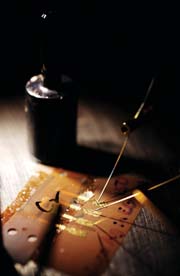
Samples of electrically conductive adhesive are tested in the laboratory of Professor C.P. Wong at Georgia Tech’s School of Materials Science and Engineering.
Electrically conductive adhesive (ECA) materials offer the electronics industry an alternative to the tin-lead solder now used for connecting display driver chips, memory chips and other devices to circuit boards. But before these materials find broad application in high-end electronic equipment, researchers will have to overcome technical challenges that include low current density.

Using self-assembled monolayers - essentially molecular wires - and a three-part anti-corrosion strategy, researchers at the Georgia Institute of Technology have made significant advances toward solving those problems. At the 229th national meeting of the American Chemical Society on March 13, the researchers described improvements that could allow ECA materials to conduct electrical current as well as the metal alloy solders they are designed to replace.

The research has been sponsored by the National Science Foundation, the U.S. EPA and several electronic interconnect companies.

"In certain applications that require high current densities, conductive adhesives still do not measure up to metallic solders," said C.P. Wong, a Regents Professor at Georgia Tech's School of Materials Science and Engineering. "However, by using these self-assembled molecular wires and controlling corrosion at the interface, we can significantly increase the current density."

For environmental reasons, manufacturers are moving away from the tin-lead alloys now used to make the connections for integrating devices into such products as computers, PDAs and cell phones. Japanese manufacturers adopted lead-free electronic interconnection technology in January of this year, and European Union manufacturers are expected to follow suit in June 2006.

Though the United States has no official requirement for halting the use of lead, the European and Japanese decisions have spurred new research into alternative materials. Those alternatives fall into the following two categories.

  • Alloys that combine tin with such metals as silver, gold, copper, bismuth or antimony, and
  • Conductive adhesives that combine flakes of silver, nickel or gold with an organic polymer matrix.

Each alternative has its own set of advantages and disadvantages.

Researcher Grace Yi Li holds samples of electrically conductive adhesive being studied in the laboratory of Professor C.P. Wong at Georgia Tech’s School of Materials Science and Engineering.
Most solders containing two or three metals, such as tin-silver (SnAg) and tin-silver-copper (Sn/Ag/Cu), have a melting point higher than eutectic tin-lead alloy solder, increasing the thermal stress placed on components being connected. The higher reflow temperatures, up to 260°C vs. 230°C, also require more costly circuit board materials and increase energy costs.

Conductive adhesives could simplify electronics manufacturing by eliminating several processing steps, including the need for acid flux and cleaning with detergent and water. Because the materials can be cured at lower temperatures - about 150°C, and possibly even room temperature - they would produce less thermal stress on components, require less energy, and use existing circuit board materials.

"Conductive adhesives have a lot of advantages, but there are a few challenges," Wong said. "After you attach a component to a board with conductive adhesives and then cure it, you must test the connections under conditions of high humidity and heat. When you do that, electrical resistance in the joints increases and conductivity drops. That is a major problem for the industry."

At first, scientists and engineers believed the problem was caused by oxidation. But Wong and colleagues at the National Science Foundation-supported Microsystems Packaging Research Center showed that galvanic corrosion, caused by contact between dissimilar metals in the adhesive and tin-lead alloys used in device contacts, was the real culprit. They have since published numerous papers describing strategies for fighting corrosion.

"By understanding this galvanic corrosion, we can develop improved materials that use an inhibitor such as acid to protect the contacts from corrosion, and we can use an oxygen scavenger such as hydroquinone to grab the oxygen required for corrosion to take place," Wong said. "We can also include a sacrificial material with a lower potential metal that is attacked by the corrosion process first, thus sparing the conductive materials."

Further improvements were made by substituting short-chain dicarboxylic acids for the surfactant stearic acid, used to prevent agglomeration of the silver flakes. Replacing or reducing the stearic acid - which acts as an insulator around the silver flakes - further improved current flow.

Still, the current density provided by conductive adhesives fell short of what's needed to support power-hungry devices like processors.
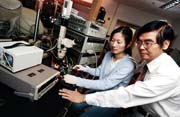
Researchers C.P. Wong (right) and Grace Yi Li test properties of electrically conductive adhesives in their Georgia Tech laboratory.
To overcome that challenge, Wong and collaborators Grace Yi Li and Kyoung-sik Moon developed self-assembled monolayers (SAM) - essentially molecular wires - made up of sulfur-containing conductive materials known as thiols. Fewer than 10 Angstroms long, these molecules chemically bind to gold pads in the device and board, providing a direct electrical connection that bypasses the resistance normally found at the interface.

"Recent studies show that, with incorporation of these self-assembled monolayers, the electrical conductivity and current-carrying capability of conductive adhesives could compete well with traditional solder joints," Wong said. "This could be a significant advance in improving these materials."

But like many advances, the SAM structures aren't yet optimized. Testing shows that they begin to decompose at temperatures above 150°C.

"We need additional research in this area to develop more stable materials that are still able to carry the current density required and have the necessary mechanical properties," said Li, a graduate student in Wong's laboratory.

Georgia Tech has applied for patents on the self-assembled monolayer, and on the techniques for controlling corrosion.

For more information, contact Professor C.P. Wong, School of Materials Science & Engineering, Georgia Institute of Technology, 771 Ferst Drive, Atlanta, GA 30332-0245; phone (404) 894-8391; fax (404) 894-9140; or e-mail cp.wong@mse.gatech.edu.

Share This Story

Looking for a reprint of this article?
From high-res PDFs to custom plaques, order your copy today!
Recommended Content

JOIN TODAY
to unlock your recommendations.

Already have an account? Sign In

  • 2026 ASI Top 20: Leading Global Adhesives and Sealants Manufacturers

    2026 ASI Top 20: Leading Global Adhesives and Sealants Manufacturers

    Every year, we study the leading worldwide manufacturers...
    Pressure-Sensitive Adhesives (PSAs)
    By: Karen Parker
  • PSA Market

    Trends and Opportunities in Pressure-Sensitive Adhesives: Sustainability, Innovation, and Market Growth

    The pressure-sensitive adhesives market is growing...
    Pressure-Sensitive Adhesives (PSAs)
    By: Chirag Tripathi and Parag Shah
  • science test tubes

    2026 Adhesives and Sealants Raw Materials Roundup

    After more than two years of contraction, the...
    Sustainability
    By: Karen Parker
Manage My Account
  • eMagazine Issues
  • Newsletters
  • Online Registration
  • Manage My Preferences
  • Subscription Customer Service

More Videos

Sponsored Content

Sponsored Content is a special paid section where industry companies provide high quality, objective, non-commercial content around topics of interest to the Adhesives and Sealants Industry audience. All Sponsored Content is supplied by the advertising company and any opinions expressed in this article are those of the author and not necessarily reflect the views of Adhesives and Sealants Industry or its parent company, BNP Media. Interested in participating in our Sponsored Content section? Contact your local rep!

close
  • Assembly automation for medical device manufacturing
    Sponsored byNordson EFD

    Three Proven Principles Powering Quality Assembly

Popular Stories

Photo of a person holding a tablet, reading a new story

FTC Successfully Blocks Henkel’s Acquisition of Liquid Nails

news on internet screen

Sika Closes Acquisition of Akkim

Image of a computer keyboard with the letters N E W S highlighted

H.B. Fuller Receives BAS Acquisition Proposal as AMS Deal Proceeds

ASI 2026 Top 20 Adhesives & Sealants List

Events

September 15, 2026

Coatings Trends & Technologies Summit

This annual Midwest coatings conference combines all of the high-quality technical presentations, exhibits and networking opportunities from the Coatings Trends and Technologies and Powder Coating Summit conferences into one new event. The event caters to both liquid and powder coatings formulators and manufacturers.

September 16, 2026

World Adhesive & Sealant Conference (WAC) 2026

As the industry’s premier international event, WAC 2026 offers a unique opportunity for professionals from every continent to connect, collaborate, and shape the future of the sector.
View All Submit An Event

Products

Structural Adhesives: Properties, Characterization and Applications

Structural Adhesives: Properties, Characterization and Applications

See More Products

Related Articles

  • Assembly EndUser: Using Design of Experiments to Trim Plastic Bonding Times

    See More
  • Assembly EndUser: The Use of Valves in Automatic Liquid Dispensing Systems

    See More
  • Assembly EndUser: Crash Course on Choosing the Right Adhesive

    See More

Related Products

See More Products
  • biobased wood.jpg

    Bio-based Wood Adhesives: Preparation, Characterization, and Testing

  • asi1019-COVER-144

    ASI October 2019 Issue

See More Products
×

Keep the info flowing with our newsletters!

Get the latest industry updates tailored your way.

JOIN TODAY!
  • RESOURCES
    • Advertise
    • Contact Us
    • Directories
    • Manufacturing Division
    • Store
    • Want More
  • SIGN UP TODAY
    • Create Account
    • eMagazine
    • Newsletters
    • Customer Service
    • Manage Preferences
  • SERVICES
    • Marketing Services
    • Reprints
    • Market Research
    • List Rental
    • Survey & Sample
  • STAY CONNECTED
    • LinkedIn
    • Facebook
    • Youtube
    • X (Twitter)
  • PRIVACY
    • PRIVACY POLICY
    • TERMS & CONDITIONS
    • DO NOT SELL MY PERSONAL INFORMATION
    • PRIVACY REQUEST
    • ACCESSIBILITY

Copyright ©2026. All Rights Reserved BNP Media, Inc. and BNP Media II, LLC.

Design, CMS, Hosting & Web Development :: ePublishing