Adhesives Mag logo
search
cart
facebook twitter linkedin youtube
  • Sign In
  • Create Account
  • Sign Out
  • My Account
Adhesives Mag logo
  • NEW PRODUCTS
  • NEWS
    • Adhesives & Sealants Headlines
    • Mergers/Acquisitions
    • Market Trends
    • TOP 20
  • TOPICS
    • Finished Adhesives and Sealants
    • Pressure-Sensitive Adhesives (PSAs)
    • Coatings
    • Raw Materials and Chemicals
    • Materials Handling/Processing
    • Meter/Mix/Dispense
    • Curing
    • Testing/Quality Control
    • Packaging of Adhesives & Sealants
    • Converting/Packaging
    • Composites
    • Sustainability
  • EVENTS
    • MAX
    • ASI Academy
    • Events Calendar
  • COLUMNS
    • European Perspectives
    • Strategic Solutions
    • Supply Chain Strategies
    • Tape Talk
  • MULTIMEDIA
    • Videos
    • Podcasts
    • Webinars
    • eBooks
  • EXPLORE
    • Adhesives in Action
    • Blog
    • ASI Store
    • Industry Links
    • Market Research
    • Classifieds
  • DIRECTORIES
    • Buyers' Guide
    • Global Adhesives & Sealants Directory
    • Raw Materials, Chemicals, Polymers and Additives Handbook
    • Equipment Handbook
    • Distributor Directory
  • EMAGAZINE
    • EMAGAZINE
    • ARCHIVE ISSUES
    • ADVERTISE
      • Custom Content & Marketing Services
    • CONTACT
  • SIGN UP!

Strategic Solutions: Bright Idea

August 1, 2005
Recent industry trends and their impact on the use of UV curing and equipment design

Recent worldwide trends are creating a confluence within the coatings and adhesives industries that could have a profound impact on the way these products are formulated and applied. Specifically, high energy prices and environmental concerns about carbon-dioxide emissions are converging to put the spotlight on the use of thermal energy as a viable way to cure these materials. Thermal curing, largely fueled by natural gas, has historically been the primary means for driving off solvents and water and accelerating the crosslinking of the resin, especially in OEM product assembly. The ovens required for thermal curing are often inefficient (as measured by energy generated vs. energy required to crosslink) and are modest sources of carbon dioxide. As a result, alternative curing technologies are gaining traction in North America, especially the use of ultraviolet (UV) light.

UV curing is widely accepted as the curing method of choice for wood coatings, plastic coatings and packaging overprint varnishes. In these applications, the benefits over thermal curing go beyond energy and environmental considerations, and include the following.

  • Less capital investment
  • Less floor space
  • The potential for greatly enhanced coating/adhesive properties
  • Suitability for curing 100%-solids formulations
  • More suitable for curing coatings and adhesives used on heat-sensitive substrates, such as plastics and wood

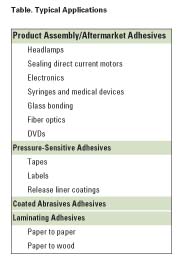
The total North American market for radiation-curing adhesives is growing at 10%/year, with 2004 estimated at $225MM. Of this total, UV curing is estimated at $75MM/year, growing at 12%/year. Typical applications for adhesives can be found in the table.

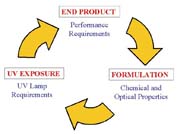
The equipment required to UV cure can impact operating costs for the application process, as well as the finished properties. Substantial progress has been made in this area, specifically the understanding of the relationship between performance properties and UV-curing conditions. As a result, communications between the various stakeholders in the process - end user, process integrator, adhesive formulator and UV lamps supplier - have significantly improved, delivering superior value to the customer. The figure demonstrates the process parameters that are integral to defining the UV-curing process.

It is important to note that, first, the end user dictates the requirements of the process. Next, the formulator develops an adhesive that meets the customer's performance and productivity requirements. Finally, the UV lamps supplier determines the best lamp solution based on the UV spectral requirements of the formulation and heat limitations of the substrate, and how the UV lamp can be integrated into the system.


The specific UV lamp features are dependent on the end-use application and curing conditions. Following are definitions of the primary UV-curing conditions used with adhesives.

  • Linear curing is used in web-based applications, such as pressure-sensitive adhesives, laminating adhesives and coated-abrasive adhesives, where a row or rows of UV lamps are suspended over the web.
  • Flood curing is used primarily in bonding adhesives, though linear curing can be used in high-productivity applications (such as DVD bonding) where larger surface areas need to be cured.
  • Spot curing is used in bonding techniques that require only a very small area to be cured.
  • Linear curing benefits from life of the system coupled with superior UV spectral output stability. The specific features of the UV-curing equipment that relate to this benefit have the most impact. Variable power supplies allow curing conditions to be manipulated based on the product being coated and the speed of the line. Also, the recent development of solid-state power supplies has proven beneficial in terms of lower power consumption, improved curing efficiency and longer system life. Some manufacturers recently increased the warranties on their UV-curing systems and various consumables, thus lowering the cost of ownership.

Flood curing is used in many of the same applications as spot curing, but usually takes precedence when higher productivity is needed. The primary cure configuration consists of a lamp mounted over an indexing or continuous conveyor. The key features of the UV lamps are usually the optics, IR output and spectral stability.

Spot curing is the easiest process to test and apply to production. Key features include portability and flexibility. Workers can either use spot-curing units individually or as part of a larger automated dispensing and curing process.

Various coater manufacturers have made the investment in UV-curing equipment on their pilot lines in order to demonstrate process characterization and verification to end users. These pilot lines are also available to other stakeholders - raw-material suppliers, UV-lamp manufacturers and formulators - to test and quantify the benefits of new product development.

Conclusion

Already well established in the coatings and printing industries, UV curing will gain increased acceptance in the adhesives industry as users and formulators develop products and adhesives for the process. These innovations will result in higher performing products that use less energy and capital and have little or no solvent emissions.

Michael D. Brown is vice president of The ChemQuest Group Inc., Cincinnati, OH, an international strategic management consulting firm specializing in the adhesives, sealants and coatings industries.

Kevin Joesel is market manager of Fusion UV Systems Inc., Gaithersburg, MD, a supplier of UV-curing equipment.

For more information, contact The ChemQuest Group Inc., 8150 Corporate Park Drive, Suite 250, Cincinnati, OH 45242; phone (513) 469-7555; fax (513) 469-7779; or visit http://www.chemquest.com.

Share This Story

Looking for a reprint of this article?
From high-res PDFs to custom plaques, order your copy today!
Recommended Content

JOIN TODAY
to unlock your recommendations.

Already have an account? Sign In

  • mouse in hole

    Using Foam Sealants for Pest Prevention

    According to the National Pest Management Association,...
    Finished Adhesives and Sealants
    By: Kevin Corcoran
  • linked network nodes

    Using the Power of AI for Adhesive and Sealant Formulation

    With the help of software solutions, adhesive formulators...
    Finished Adhesives and Sealants
    By: Karen Parker
  • top20-hero.jpg

    2024 ASI Top 20: Leading Global Manufacturers of Adhesives and Sealants

    ASI's annual ranking of the top 20 global adhesive and...
    Finished Adhesives and Sealants
Manage My Account
  • eMagazine Issues
  • Newsletters
  • Online Registration
  • Manage My Preferences
  • Subscription Customer Service

More Videos

Popular Stories

image of a graph representing markets

Sika Announces Acquisition of Gulf Seal in Saudi Arabia

news on internet screen

Henkel Posts Positive Organic Growth for Third Quarter, Driven by Adhesives Technologies Business

Man reading news on tablet

WACKER to Cut 1,500 Jobs Worldwide

ASI Top 20 website

Events

January 1, 2030

Webinar Sponsorship Information

For webinar sponsorship information, visit www.bnpevents.com/webinars or email webinars@bnpmedia.com.

View All Submit An Event

Products

Structural Adhesives: Properties, Characterization and Applications

Structural Adhesives: Properties, Characterization and Applications

See More Products

ASI CASE EBOOK

ASI webinar

Related Articles

  • STRATEGIC SOLUTIONS: Sustainable Solutions

    See More
  • STRATEGIC SOLUTIONS: Top-Line Growth: The Strategic Implications

    See More
  • STRATEGIC SOLUTIONS: It's Eleven O'Clock ...Do You Know What Your Competition is Doing?

    See More

Related Products

See More Products
  • advances-in-structural-adhe.gif

    Advances in Structural Adhesive Bonding

See More Products
×

Keep the info flowing with our newsletters!

Get the latest industry updates tailored your way.

JOIN TODAY!
  • RESOURCES
    • Advertise
    • Contact Us
    • Directories
    • Manufacturing Division
    • Store
    • Want More
  • SIGN UP TODAY
    • Create Account
    • eMagazine
    • Newsletters
    • Customer Service
    • Manage Preferences
  • SERVICES
    • Marketing Services
    • Reprints
    • Market Research
    • List Rental
    • Survey & Sample
  • STAY CONNECTED
    • LinkedIn
    • Facebook
    • Youtube
    • X (Twitter)
  • PRIVACY
    • PRIVACY POLICY
    • TERMS & CONDITIONS
    • DO NOT SELL MY PERSONAL INFORMATION
    • PRIVACY REQUEST
    • ACCESSIBILITY

Copyright ©2025. All Rights Reserved BNP Media.

Design, CMS, Hosting & Web Development :: ePublishing