Latest Mixing Technology
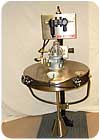
JBW lift system.
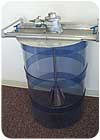
JBW portable drum mixer.
As such, the size of the global industrial mixer market can only be approximated. This is accomplished by examining data from various manufacturers of industrial mixers. There are hundreds of manufacturers of mixers around the world, some owned by large holding companies that have many diversified product lines. Mixer manufacturers are both privately owned and public; most companies with total sales of $10 million or less are privately held and are ripe for buyouts by conglomerates looking to diversify.
By studying various reports, and through much Internet research, it has been conservatively estimated that the overall mixer-market size could be around $600 million. A more optimistic view is that this market is around $900 million. In the industrial mixing market, Lightnin, Nettco, Philadelphia and ITT Flygt mixers have the larger percentage of market share at 10-20% each. Smaller mixing companies, such as JBW Systems Inc., Westerville, OH, make up the difference.
There are many types of industrial mixers, including:
- Pulsed mixing
- Sluicing mixing
- Jet mixing
- Wave mixing machines
- Airlift circulators
- Wave machines
- Sonic probes
- Agitator mixing
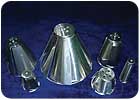
JBW impellers.
- High-shear mixers. These mixers use a high-speed rotating impeller mounted on a shaft. They provide hydraulic and mechanical shear of product. High-shear mixers are used in the manufacturing of emulsions, dispersions and/or homogeneous products.
- Side-entering mixers. Often times mounted at the bottom of the tank and operating at a reduced speed, these mixers use an impeller that creates a liquid jet that creates motion throughout the tank.
- Small portable mixers. These are most often lightweight enough to be moved from one tank to another. They are generally 5 horsepower or less. The most common and older technology mixers are clamped to the side of a tank and operated around 1200-1800 rpm. They may feature more than one propeller/impeller mounted to the shaft. Air-driven motors are lighter weight and more portable. Some older-style mixers use a gear reducer, which can cause more weight and requires oiling, which can be introduced into the product. Few portable mixers use heavier electric motors.
- Turbine mixers. These mixers are generally centered in the tank. Usually one or more multi-bladed impellers are mounted on a shaft that hangs from the motor, which is mounted to a support beam, lid or bridge. They can be used in either enclosed- or open-style tanks. Some are operated at reduced speed by a gear that is enclosed; these are used to mix low-to-medium viscosity.
- Static mixers. Static mixers use mounted fins or baffles in pipes that the product flows through, which results in turbulence that creates a mixing effect.
For more information on JBW mixers, call (614) 882-5008, fax (614) 882-5004, e-mail sales@jbwsystems.com or visit www.jbwsystems.com.
About the Company
Established in 1990, JBW Systems Inc. is a small mixing company located in Westerville, OH, that manufactures and sells agitator mixers. The JBW product line includes agitator-based mixers, as well as turbine, portable, low-shear and special-purpose mixers.JBW president James (Jim) Watkins is the creator of the JBW Mixing System. During his 25 years in the paint industry, he realized that, while bad paint was never intentionally shipped to a customer, paint always had the potential to settle, and the mixers available either could not sufficiently fix the problem or the problem was not resolved as quickly as the customer required.
In the late 1970s, Watkins began to form ideas for the perfect mixing system. In 1990, he invented the JBW Clockwise Impeller, an impeller that is not flat like a boat propeller and does not collapse. Instead, the JBW Impeller is conical in appearance, with five blades equidistant from a machined top and attached to a bottom rim. The basis of the impeller is that it mixes like a pump, first lifting settled, heavier particles from the bottom and then dispersing them throughout the container, resulting in superior agitation.
The mixing action is low shear, which allows the mixing of shear-sensitive products. The impeller is perfect for products with 8000 cps or less. The JBW Impeller pulls two or more times its diameter and consumes less energy than the older conventional ‘clamped-to-the side’ mixers that have been on the market for many decades.
Customer demand eventually necessitated JBW Systems to come up with a complete mixing system. At that time, the JBW Impeller was placed on the shaft of other systems. JBW did not want their impeller mounted with a clamp to the side of the container and ‘angled’ in. The JBW Impeller works best when placed in the center of the drum with the open end down where it can “lift” the heavier settlement. In that position, the JBW Impeller acts as a pump.
After several months of R&D, the JBW Portable Drum Mixer was introduced to the industrial marketplace. At that time, a patent was sought and granted for the unique product line of JBW Mixers.
The Tote Mixer was introduced next. This mixer is used in large containers and Tote® tanks. Its design allows the company’s drum mixer to be transformed into a tote mixer by adding various extensions and impellers that work together to form a vortex for superior agitation. Both the drum and tote mixer are equipped with a 4-horsepower air motor mounted to a patented lid. This lid has hinged flaps that can be raised for insertion of pumps and inspection of the product.
For 10 years, JBW Systems focused sales within the paint industry - mostly the coil industry and paint manufacturers. Several years ago, however, the company expanded into other industries, including adhesives and sealants and chemicals. By branching out into unknown territory and new applications for mixing, JBW realized there was a need to diversify its mixing products. One solution to this was the JBW Lift System. This system is a JBW drum mixer mounted onto a stainless-steel lid. The lid is attached to a pneumatic lift by arms and braces. It has control equipment and safety equipment installed. The JBW Lift can be ordered with or without a double-diaphragm pump and a dispensing hose and nozzle. This unit was well received by the paint industry and remains a mainstay for the company.
For 15 years, JBW considered entering the bung hole mixing niche market. During this time, an application that required mixing through a three-inch opening in drums (known as the bung hole) would occasionally come along, but only in small quantities, and not enough to begin production. In mid-2006, though, a request was made for almost 300 of these mixers. Within 30 days of the request, JBW responded with a much smaller version of the original JBW Impeller for use through bung holes.
Two versions of this mixer are available - one featuring a .75 horsepower air motor and the other with a 1.5 horsepower air motor. Both can be used with the addition of a second impeller (depending on the application) for mixing higher-viscosity products.
Last year, the company received CE approval for sales to Europe.
Links
Looking for a reprint of this article?
From high-res PDFs to custom plaques, order your copy today!