Bio Testing
Nerites
uses ADMET to test biomedical tissue adhesives.
Nerites Corp., a specialized adhesives and coatings startup, develops materials for medical, industrial, and consumer applications using unique synthetic protein adhesives that employ DOPA (L-3,4-dihydroxyphenylalanine). The technology is based on research on mussel adhesive proteins conducted by Dr. Phillip Messersmith at Northwestern University’s Department of Biomedical Engineering.
The company recently opened a research facility in Madison, WI, as it prepares to go to market with its advanced materials for biomedical applications. Jeffrey Dalsin, Ph.D., a Nerites senior scientist, is concentrating on the MedhesiveTM adhesives line in addition to supporting the company’s SurPhysTM coating products. A major aspect of the Medhesive development effort examines the structural adhesive properties of the product.
A number of animal- or human-derived tissue adhesives and sealants are on the market, which presents a host of concerns in terms of viral transmission. Also, in terms of mechanical properties, some have weak cohesive strength and limited sealing ability.
Nerites scientists think that they can overcome biomedical concerns with synthetic molecules. They have conducted toxicology and biocompatibility tests, and the constructs have been found to be non-immunogenic and non-cytotoxic.
In addition to biocompatibility testing, materials properties, such as gelation and adhesion, are important. Other considerations, such as elasticity, viscosity and curing time, are also important for biomedical applications. Adhesives must be easy to handle with the proper viscosity and a cure rate of 10-20 seconds. Some available adhesives, such as cyanoacrylates, provide tremendous adhesion but are very brittle, especially in relation to human tissue, which is very elastic.
“We’re interested in looking at the mechanical properties of our adhesives to make sure that they are a good mechanical match for biological tissues,” Dalsin says.
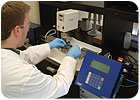
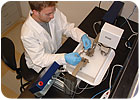
Nerites conducts lap shear testing of adhesive strength by using glass slides coated with metal (if looking for metal-to-metal adhesion) or tissues (for tissue adhesion tests). The two surfaces are joined using Medhesive. The specimen is then fitted into flat rubber-faced grips and pulled apart using a lap shear configuration. Dalsin also conducts axial testing using a number of backings.
Understandably, the measured forces are low. “Generally, depending on the substrate size and whether we’re testing lap shear or axial tension, we’re in the 50-500 kilopascal stress range,” Dalsin says. “Though we are planning to move into the megapascal range.”
When the time came to specify a machine for the new research facility in Madison, Dalsin knew that he wanted a small, horizontally configured tabletop machine that could test materials in a temperature-controlled saline bath, which is akin to the biological environment.
“When we moved up here, we were looking for a more cost-effective solution,” Dalsin says. “Luckily, we found ADMET on the Internet.
“I contacted ADMET and explained our needs, the force ranges in which we would be working, and the fact that we wanted to have a certain amount of computerized control. I also explained that we wanted to test underwater. ADMET came through with a really good design and a quote that was very competitive. We got a quote from one other vendor that was two-to-three times the price.”
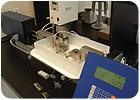
ADMET delivered its eXpert 5602 tabletop testing machine equipped with an eP Digital Controller. The grips are suspended in a tray that can accommodate wet specimens. The delivery took about six weeks, and setup was virtually automatic.
The in-house ADMET machine makes it easier to test different formulations. “The pressure generated in the brain and spinal cord is much different than the pressure generated in, say, a blood vessel, especially in the arterial system,” Dalsin explains. “So we’re developing different formulations - they may be closely related - for applications where different forces are involved.”
According to Dalsin, Nerites tests its competitors’ products in addition to its own formulations. “We can compare our peak stress with the peak stress generated with other commercially available products in this space,” he says.
Dalsin has plans for the future. “At this point,” he says, “I’ve been looking at peak stresses but have not been paying a lot of attention to stress/strain relationships, although the interface seems quite straightforward and it would not be too difficult to extract modulus and other numbers.”
For more information, contact ADMET, 51 Morgan Drive, Norwood, MA 02062; visit www.admet.com; or e-mail sales@admet.com.
Nerites Corp., a specialized adhesives and coatings startup, develops materials for medical, industrial, and consumer applications using unique synthetic protein adhesives that employ DOPA (L-3,4-dihydroxyphenylalanine). The technology is based on research on mussel adhesive proteins conducted by Dr. Phillip Messersmith at Northwestern University’s Department of Biomedical Engineering.
The company recently opened a research facility in Madison, WI, as it prepares to go to market with its advanced materials for biomedical applications. Jeffrey Dalsin, Ph.D., a Nerites senior scientist, is concentrating on the MedhesiveTM adhesives line in addition to supporting the company’s SurPhysTM coating products. A major aspect of the Medhesive development effort examines the structural adhesive properties of the product.
Synthetic Molecules Have an Advantage
Nerites seeks to replicate natural adhesive properties. “We know that, in nature, mussels can generate a tremendous amount of adhesion on wet surfaces - whether it’s a rock, or a pier or the bottom of a boat,” Dalsin explains. “Our goal, using DOPA, is to develop those same properties in a synthetic molecule.”A number of animal- or human-derived tissue adhesives and sealants are on the market, which presents a host of concerns in terms of viral transmission. Also, in terms of mechanical properties, some have weak cohesive strength and limited sealing ability.
Nerites scientists think that they can overcome biomedical concerns with synthetic molecules. They have conducted toxicology and biocompatibility tests, and the constructs have been found to be non-immunogenic and non-cytotoxic.
In addition to biocompatibility testing, materials properties, such as gelation and adhesion, are important. Other considerations, such as elasticity, viscosity and curing time, are also important for biomedical applications. Adhesives must be easy to handle with the proper viscosity and a cure rate of 10-20 seconds. Some available adhesives, such as cyanoacrylates, provide tremendous adhesion but are very brittle, especially in relation to human tissue, which is very elastic.
“We’re interested in looking at the mechanical properties of our adhesives to make sure that they are a good mechanical match for biological tissues,” Dalsin says.
Specialized Materials Tests
Dalsin gained experience conducting materials properties tests on these types of adhesives when he worked on the original research project at Northwestern University. There, the team used an Instron universal tester located in the Materials Sciences Department.Nerites conducts lap shear testing of adhesive strength by using glass slides coated with metal (if looking for metal-to-metal adhesion) or tissues (for tissue adhesion tests). The two surfaces are joined using Medhesive. The specimen is then fitted into flat rubber-faced grips and pulled apart using a lap shear configuration. Dalsin also conducts axial testing using a number of backings.
Understandably, the measured forces are low. “Generally, depending on the substrate size and whether we’re testing lap shear or axial tension, we’re in the 50-500 kilopascal stress range,” Dalsin says. “Though we are planning to move into the megapascal range.”
When the time came to specify a machine for the new research facility in Madison, Dalsin knew that he wanted a small, horizontally configured tabletop machine that could test materials in a temperature-controlled saline bath, which is akin to the biological environment.
“When we moved up here, we were looking for a more cost-effective solution,” Dalsin says. “Luckily, we found ADMET on the Internet.
“I contacted ADMET and explained our needs, the force ranges in which we would be working, and the fact that we wanted to have a certain amount of computerized control. I also explained that we wanted to test underwater. ADMET came through with a really good design and a quote that was very competitive. We got a quote from one other vendor that was two-to-three times the price.”
ADMET delivered its eXpert 5602 tabletop testing machine equipped with an eP Digital Controller. The grips are suspended in a tray that can accommodate wet specimens. The delivery took about six weeks, and setup was virtually automatic.
The in-house ADMET machine makes it easier to test different formulations. “The pressure generated in the brain and spinal cord is much different than the pressure generated in, say, a blood vessel, especially in the arterial system,” Dalsin explains. “So we’re developing different formulations - they may be closely related - for applications where different forces are involved.”
According to Dalsin, Nerites tests its competitors’ products in addition to its own formulations. “We can compare our peak stress with the peak stress generated with other commercially available products in this space,” he says.
Dalsin has plans for the future. “At this point,” he says, “I’ve been looking at peak stresses but have not been paying a lot of attention to stress/strain relationships, although the interface seems quite straightforward and it would not be too difficult to extract modulus and other numbers.”
For more information, contact ADMET, 51 Morgan Drive, Norwood, MA 02062; visit www.admet.com; or e-mail sales@admet.com.
Links
Looking for a reprint of this article?
From high-res PDFs to custom plaques, order your copy today!