Two-Component Products, One-Component Applicators
This article reviews the technical design and benefits of the use of a two-component packaging system designed to deliver product with a standard caulking gun. This package is expected to provide the adhesives and sealants industry with a lower cost, lower waste two-component delivery system.
The adhesives and sealants industry is a technically mature market. Companies are continuously investing in new technologies to differentiate their product lines. As formulations and product line offerings become generic, an area that has become increasingly interesting is adhesives and sealants delivery systems.
Currently, some pump systems are used to dispense fast-curing systems. These pumps are relatively expensive and require continuous maintenance. If these pump systems break down, then the project or process is not delivering product. These pumps, or hand mixing of plural-component systems, may result in a high percentage of material waste.
This article reviews the technical design and benefits of the use of a unique two-component packaging system designed to deliver product with a standard caulking gun. This package will provide the adhesives and sealants industry with a lower cost, lower waste, safe two-component delivery system.
Product Description
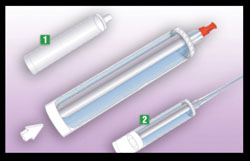
The Capsule in a Cartridge (CIC) is a laminate or foil capsule within a single-component cartridge (see Figure 1).
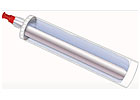
The capsules uniformly compress, which controls the ratio of the two components, and material is combined/dispensed via a mixing nozzle. The CIC capsule compresses as the components are extruded (see Figure 2).
Design
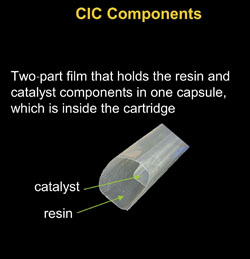
CIC is a two-compartment - or component - laminate film capsule in an injection-molded cartridge (see Figure 3). The capsule contains the two-product chemistry, and controls the ratio of the A & B components.
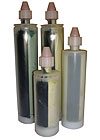
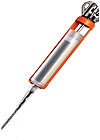
CICs have been manufactured to fill volumes of 150 ml, 330 ml, 550 ml and 800 ml cartridges (see Figure 4). The volume range from 150ml (5 fl oz) to 300ml (suits a standard 10 fl oz sealant cartridge) and the quart diameter over 800ml (30 fl oz) are compatible with standard dispensing North American cartridge guns.
Features
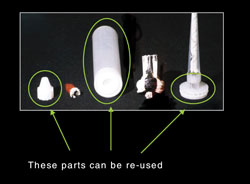
The CIC provides for a low-cost packaging option. As compared to other two-part packaging options, the CIC components are lower in cost and waste. The CIC delivers over 95% of the two-component material, and the low-waste packaging is demonstrated by the number of recyclable components (see Figure 6). The outer cartridge is clean and can be recycled or reused. The plastic cartridge can be replaced by aluminum for even easier recycling.
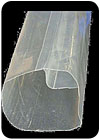
The capsule is produced by a machine, which takes the roll of laminate film, folds the film into a figure-eight and continuously heat-seals the film to create a two-component package (see Figure 7). The continuous length of the film is then filled with the two components and each end is clipped before the individual capsules are cut out of the continuous length of filled and clipped film. The chemical resistance of the film is important for the durability of the heat seals used to create the capsule. Since chemical attack could weaken the seals and increase the risk of bursting during extrusion, it is necessary to test for the right film for each chemistry.
Future developments for the CIC will be to provide for more new packaging options. Future packaging developments include expanding the range of mix ratios of the resin/polymer:catalyst systems to include 1:1 and 2:1. There is an ongoing development project to define the compatible laminate films for a range of adhesive and sealant systems. The critical technical challenge is to approve films that are stable with adhesive and sealant technologies and can be heat sealed. Based on standard-sized applicators, the CIC is being designed for a range of cartridge fill volumes.
Dispensing the CIC
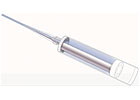
The CIC capsules uniformly compress (which controls the ratio of the two components), and material is combined/dispensed via a mixing nozzle (see Figure 8). The CIC is a two-compartment - or component - laminate film capsule in an injection-molded cartridge. The capsule contains the two-component product chemistry and controls the ratio of the A & B components. The procedure to use the CIC includes: removing the cap, exposing the red seal clip, cutting the film to expose both components, screwing on the static mixer nozzle, installing into the standard applicator and dispensing the material (see Figure 9).
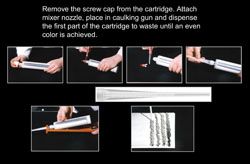
This system allows for the mixing and dispensing of an adhesive or sealant using a standard caulking gun with a static mixer. The base and curative are filled into a laminate film that provides for system stability. The CIC is designed to supply two-component chemistry with one-component ease of application. A standard caulking gun can be used for a two-component cartridge.
Applications
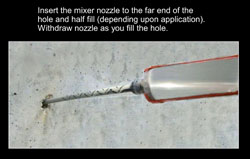
The CIC packaging technology has a significant current use for the dispensing of a high-performance construction system. The CIC has the potential to dispense a variety of two-component adhesives and sealants with a single-component delivery system. The current use for the CIC is the packaging and application of chemical anchors (see Figure 10). The CIC system is used for anchoring threaded rod and reinforcing bar and is applied with a standard sealant applicator gun. The mixer nozzle ensures complete mixing ratio of the product. This bonded anchor system combines high strength and a stress-free fixing with excellent weathering and chemical resistance properties.
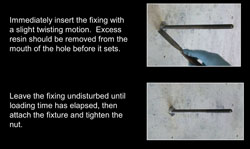
Using a CIC resin system (instead of a traditional mechanical fixing), the anchor can be installed without expansion pressure and can be fixed close to free edges of the substrate. Anchors/fixings can be installed straight into holes in solid base materials such as concrete, hard stone, solid rock and masonry (see Figure 11). The product has been formulated to ensure its use in a range of temperatures and environments.
The CIC system is a potential package for a range of two-component adhesive and sealant technologies, including polyesters, epoxies, silicones, modified silicones, methacrylates, and urethanes. Potential construction applications include chemical anchors, crack repair, joint sealing and glazing. Potential industrial applications include sealing, bonding, insulating, potting and glazing. Potential automotive applications would include sealing, bonding, glazing, windshield replacement and general multi-substrate repairs.
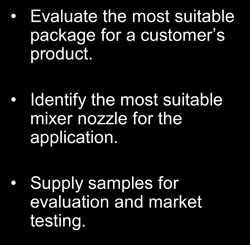
A three-phase CIC package protocol is used to test two-component adhesive and sealant chemistries (see Figure 12). New CIC application/market evaluation processes will include a complete test of potential films for product compatibility and evaluation of the ability of the film to be heat-sealed. The second phase of the protocol is CIC product application testing - including extrudability as the capsule collapses - and specifying a usable static mixer nozzle. Finally, the CIC system will be tested for product handling and physical properties with the final feasibility confirmed with a customer-based field test.
Summary
The Capsule in a Cartridge (CIC) is a laminate or foil capsule within a single-component cartridge. The capsules uniformly compress, which controls the ratio of the two components, and material is combined/dispensed via a mixing nozzle. The capsule controls the ratio of the two components. The CIC capsule compresses as the components are extruded.
This two-component packaging system can deliver product with a one-component applicator, and may provide the adhesives and sealants industry with a lower cost, lower waste, safe two-component delivery system.
This article is based on a paper presented at the Fall 2006 Adhesive and Sealant Council Convention. For more information, visit www.ascouncil.org.
For more information, visit www.exchem.com.
Links
Looking for a reprint of this article?
From high-res PDFs to custom plaques, order your copy today!