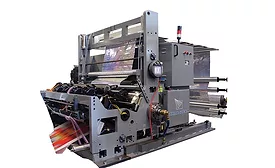
Long regarded as a highly specialized option for curing and crosslinking adhesives, coatings and inks, ebeam technology continues to earn a reputation for being both powerful and cost-effective.
This weekly roundup highlights the adhesives, sealants and coatings news stories that garnered the most attention during the previous week on our website, as well as our eNewsletter and social media platforms.
This weekly roundup highlights the adhesives, sealants and coatings news stories that garnered the most attention during the previous week on our website, as well as our eNewsletter and social media platforms.
The waterborne adhesives market in Europe was estimated at $3.26 billion in 2014 and is projected to grow at a compound annual growth rate (CAGR) of 5.8%.
March 1, 2016
The waterborne adhesives market in Europe was estimated at $3.26 billion in 2014 and is projected to grow at a compound annual growth rate (CAGR) of 5.8%, according to “Europe Waterborne Adhesives Market Segmented by Product Type, By Polymer, By Application, By End User Industry, and Geography Trends and Forecasts (2015-2020)” during the forecast period.
The global consumption of coatings, adhesives, sealants and inks (CASI) is being driven primarily by construction applications.
March 1, 2016
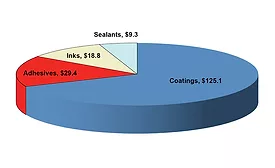
Global consumption of coatings, adhesives, sealants and inks (CASI) was 54.1 million tons in 2014, worth $182.6 billion, according to Kusumgar, Nerlfi & Growney. Volume growth is forecast at a 5% annual rate, with coatings, adhesives and sealants matching the overall growth, but inks trailing at only 2% per year.
Growth in the UV-curable ink market is being spurred by increased use in food and beverage packaging.
February 1, 2016
Introduced in 1960, ultraviolet (UV) curable ink has resulted in increased automation, particularly in the manufacturing sector. Originally, water- and solvent-based inks were used for flexographic printing, textile printing, screen printing, and more.
Growth areas for flexible packaging include both food and nonfood applications.
February 1, 2016
Demand for converted flexible packaging in the U.S. is projected to increase 3.3% annually to $20.7 billion in 2019. Although advances will decelerate from the pace of the past decade, converted flexible packaging will remain a growth area in both food and nonfood applications due to the inherent cost and performance advantages of lightweight bags and pouches.
Downtime—both planned and unplanned—can have a pronounced impact on packing line efficiency and throughput. This downtime, caused by film roll changes, registration errors, catastrophic film failures, bottlenecks, and more, is costly and may seem impossible to avoid. Taking appropriate steps to streamline processes wherever possible can help to mitigate the repercussions of downtime, improving overall line efficiency and thus profitability.
A corrugated converter cuts defects to near zero and increases output and customer satisfaction with new gluer, detection, and trim systems.
February 1, 2016
It’s tough to be perfect when producing millions of custom boxes every year—but customers expect it. If defective boxes turn up in a shipment, customers gladly return them—along with a complaint.