Adhesives Mag logo
search
cart
facebook twitter linkedin youtube
  • Sign In
  • Create Account
  • Sign Out
  • My Account
Adhesives Mag logo
  • NEW PRODUCTS
  • NEWS
    • Adhesives & Sealants Headlines
    • Mergers/Acquisitions
    • Market Trends
    • TOP 20
  • TOPICS
    • Finished Adhesives and Sealants
    • Pressure-Sensitive Adhesives (PSAs)
    • Coatings
    • Raw Materials and Chemicals
    • Materials Handling/Processing
    • Meter/Mix/Dispense
    • Curing
    • Testing/Quality Control
    • Packaging of Adhesives & Sealants
    • Converting/Packaging
    • Composites
    • Sustainability
  • EVENTS
    • MAX
    • ASI Academy
    • Events Calendar
  • COLUMNS
    • European Perspectives
    • Strategic Solutions
    • Supply Chain Strategies
    • Tape Talk
  • MULTIMEDIA
    • Videos
    • Podcasts
    • Webinars
    • eBooks
  • EXPLORE
    • Adhesives in Action
    • Blog
    • ASI Store
    • Industry Links
    • Market Research
    • Classifieds
  • DIRECTORIES
    • Buyers' Guide
    • Global Adhesives & Sealants Directory
    • Raw Materials, Chemicals, Polymers and Additives Handbook
    • Equipment Handbook
    • Distributor Directory
  • EMAGAZINE
    • EMAGAZINE
    • ARCHIVE ISSUES
    • ADVERTISE
      • Custom Content & Marketing Services
    • CONTACT
  • SIGN UP!
Home » Store » Books » Strength Prediction of Adhesively-Bonded Joints
strength.jpg

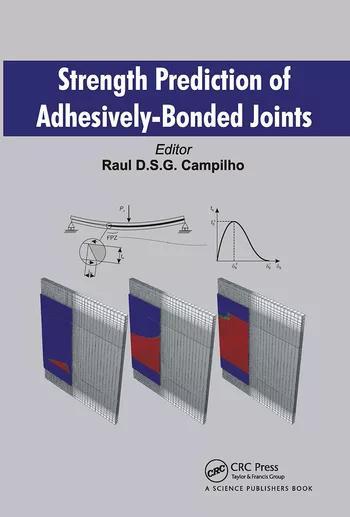
Strength Prediction of Adhesively-Bonded Joints

$59.95
Books

Product Details

ISBN 9780367782412 - paperback
March 31, 2021
421 Pages
 
Adhesively-bonded joints provide many advantages over conventional mechanical fasteners and are increasingly receiving attention as an alternative to mechanical joints in engineering applications. The traditional fasteners usually result in the cutting of fibers and hence the introduction of stress concentrations, both of which reduce structural integrity. By contrast, bonded joints are more continuous and have potential advantages of strength-to-weight ratio, design flexibility, and ease of fabrication. This book provides an overview of available analytical methods as well as numerical methods.
 

Table of Contents

Introduction. Analytical Modelling for the Single-lap Joint. Analytical Modeling for Composite Structures. Analytical Modelling of Dynamic and Impact Loads. Continuum Mechanics Modelling by Finite Elements. Cohesive Zone Modelling for Static Applications. Parameter Identification in Cohesive Zone Modelling. Cohesive Zone Modelling for Fatigue Applications. Damage Mechanics for Static and Fatigue Applications. Extended Finite Element Modelling in Static Applications. Numerical modelling of Bonded Joints and Repairs. Mixed Adhesive Joints for the Aerospace Industry.

Editor(s)

Biography

Raul D. S. G. Campilho is affiliated with Instituto Superior de Engenharia do Porto, Portugal.

Keep the info flowing with our newsletters!

Get the latest industry updates tailored your way.

JOIN TODAY!
  • RESOURCES
    • Advertise
    • Contact Us
    • Directories
    • Manufacturing Division
    • Store
    • Want More
  • SIGN UP TODAY
    • Create Account
    • eMagazine
    • Newsletters
    • Customer Service
    • Manage Preferences
  • SERVICES
    • Marketing Services
    • Reprints
    • Market Research
    • List Rental
    • Survey & Sample
  • STAY CONNECTED
    • LinkedIn
    • Facebook
    • Youtube
    • X (Twitter)
  • PRIVACY
    • PRIVACY POLICY
    • TERMS & CONDITIONS
    • DO NOT SELL MY PERSONAL INFORMATION
    • PRIVACY REQUEST
    • ACCESSIBILITY

Copyright ©2025. All Rights Reserved BNP Media.

Design, CMS, Hosting & Web Development :: ePublishing