Beetles' Feet: Inspiration for Dry Adhesive Material
German researchers have taken inspiration from nature to create a dry adhesive material that sticks to the smoothest of surfaces.
People have long marveled at the ability of creatures such as insects and certain lizards to climb up vertical walls and even walk across ceilings without falling off. Recently, research has shown that these animals owe their ‘stickiness’ to the presence of extremely fine hairs on their feet, which optimize contact with surfaces. Many people have tried to reproduce these systems, but until now the resulting artificial materials have had a limited lifecycle and were simply not as sticky as the natural versions.
Now, researchers from the Max Planck Institute for Metals Research and Gottlieb Binder, a company specializing in attachment systems, have successfully produced an adhesive material whose microstructure is based on the soles of insects’ feet. Their findings are reported in the early online edition of Journal of the Royal Society Interface.
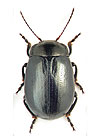
In this case, the insects in question were beetles of the family Chrysomelidae, which are known to be experts in the art of sticking to very smooth surfaces.
The ‘hairs’ of the new material resemble tiny mushrooms; a thin plate 40 micrometres in diameter sits atop a pillar which has a sturdy base but a narrow neck and is 100 micrometers high. The ‘mushrooms’ are arranged hexagonally on the surface of the material.
The material was made by pouring a polymer mixture into a mold and waiting for it to set before carefully removing the material from the mold. According to the researchers, the creation of the mold, with its delicate microstructure, was incredibly challenging, and the details of the process are a closely guarded secret. Creating the polymer mixture was also difficult; mixtures that were too liquid simply flowed out of the mold, while mixtures which were too viscous were unable to penetrate into the fine microstructure.
A battery of tests revealed that five square centimeters of the material are able to stick objects weighing up to 100 grams to a smooth wall. The material can be used several times without losing stickiness, and if it gets dirty, simply washing it in soapy water will restore its adhesive qualities. Furthermore, it does not leave behind visible marks when removed from a surface.
The material does not perform as well on rougher surfaces, which does not surprise the researchers. “Insects also have difficulties walking on surfaces that are slightly rough,” explained project leader Stanislav Gorb of the Max Planck Society. “This is a fundamental problem of the adherence mechanism.”
The researchers credit the success of their system down to a number of factors. The thin plate at the top of the ‘mushroom’ is flexible enough to form a reliable contact with the surface, even in the presence of small particles of dirt. Meanwhile, larger particles are able to slip into the space between the pillars where they do not affect the ability of the plates to stick to the surface. The thin neck of the pillar also offers flexibility in the face of uneven surfaces. Finally, broken pillars do not alter the effectiveness of neighboring pillars.
The scientists describe their work as “a considerable step towards the development of an industrial dry adhesive.” The new material could be used in a protective tape for sensitive glass surfaces, or in reusable pads for the attachment of small objects to smooth surfaces. It has already been attached to the feet of a robot, which was subsequently able to walk up a vertical glass wall. The researchers now plan to improve the ‘stickiness’ of their material by refining its structure.
For more information, visit www.mpg.de/portal/index.html or www. www.journals.royalsoc.ac.uk/.
Source: CORDIS News
People have long marveled at the ability of creatures such as insects and certain lizards to climb up vertical walls and even walk across ceilings without falling off. Recently, research has shown that these animals owe their ‘stickiness’ to the presence of extremely fine hairs on their feet, which optimize contact with surfaces. Many people have tried to reproduce these systems, but until now the resulting artificial materials have had a limited lifecycle and were simply not as sticky as the natural versions.
Now, researchers from the Max Planck Institute for Metals Research and Gottlieb Binder, a company specializing in attachment systems, have successfully produced an adhesive material whose microstructure is based on the soles of insects’ feet. Their findings are reported in the early online edition of Journal of the Royal Society Interface.
In this case, the insects in question were beetles of the family Chrysomelidae, which are known to be experts in the art of sticking to very smooth surfaces.
The ‘hairs’ of the new material resemble tiny mushrooms; a thin plate 40 micrometres in diameter sits atop a pillar which has a sturdy base but a narrow neck and is 100 micrometers high. The ‘mushrooms’ are arranged hexagonally on the surface of the material.
The material was made by pouring a polymer mixture into a mold and waiting for it to set before carefully removing the material from the mold. According to the researchers, the creation of the mold, with its delicate microstructure, was incredibly challenging, and the details of the process are a closely guarded secret. Creating the polymer mixture was also difficult; mixtures that were too liquid simply flowed out of the mold, while mixtures which were too viscous were unable to penetrate into the fine microstructure.
A battery of tests revealed that five square centimeters of the material are able to stick objects weighing up to 100 grams to a smooth wall. The material can be used several times without losing stickiness, and if it gets dirty, simply washing it in soapy water will restore its adhesive qualities. Furthermore, it does not leave behind visible marks when removed from a surface.
The material does not perform as well on rougher surfaces, which does not surprise the researchers. “Insects also have difficulties walking on surfaces that are slightly rough,” explained project leader Stanislav Gorb of the Max Planck Society. “This is a fundamental problem of the adherence mechanism.”
The researchers credit the success of their system down to a number of factors. The thin plate at the top of the ‘mushroom’ is flexible enough to form a reliable contact with the surface, even in the presence of small particles of dirt. Meanwhile, larger particles are able to slip into the space between the pillars where they do not affect the ability of the plates to stick to the surface. The thin neck of the pillar also offers flexibility in the face of uneven surfaces. Finally, broken pillars do not alter the effectiveness of neighboring pillars.
The scientists describe their work as “a considerable step towards the development of an industrial dry adhesive.” The new material could be used in a protective tape for sensitive glass surfaces, or in reusable pads for the attachment of small objects to smooth surfaces. It has already been attached to the feet of a robot, which was subsequently able to walk up a vertical glass wall. The researchers now plan to improve the ‘stickiness’ of their material by refining its structure.
For more information, visit www.mpg.de/portal/index.html or www. www.journals.royalsoc.ac.uk/.
Source: CORDIS News
Links
Looking for a reprint of this article?
From high-res PDFs to custom plaques, order your copy today!