Adhesives Mag logo
search
cart
facebook twitter linkedin youtube
  • Sign In
  • Create Account
  • Sign Out
  • My Account
Adhesives Mag logo
  • NEW PRODUCTS
  • NEWS
    • Adhesives & Sealants Headlines
    • Mergers/Acquisitions
    • Market Trends
    • TOP 20
  • TOPICS
    • Finished Adhesives and Sealants
    • Pressure-Sensitive Adhesives (PSAs)
    • Coatings
    • Raw Materials and Chemicals
    • Materials Handling/Processing
    • Meter/Mix/Dispense
    • Curing
    • Testing/Quality Control
    • Packaging of Adhesives & Sealants
    • Converting/Packaging
    • Composites
    • Sustainability
  • EVENTS
    • MAX
    • ASI Academy
    • Events Calendar
  • COLUMNS
    • European Perspectives
    • Strategic Solutions
    • Supply Chain Strategies
    • Tape Talk
  • MULTIMEDIA
    • Videos
    • Podcasts
    • Webinars
    • eBooks
  • EXPLORE
    • Adhesives in Action
    • Blog
    • ASI Store
    • Industry Links
    • Market Research
    • Classifieds
  • DIRECTORIES
    • Buyers' Guide
    • Global Adhesives & Sealants Directory
    • Raw Materials, Chemicals, Polymers and Additives Handbook
    • Equipment Handbook
    • Distributor Directory
  • EMAGAZINE
    • EMAGAZINE
    • ARCHIVE ISSUES
    • ADVERTISE
      • Custom Content & Marketing Services
    • CONTACT
  • SIGN UP!
NewsAdhesives and Sealants TopicsAdhesives & Sealants HeadlinesFinished Adhesives and SealantsRaw Materials and Chemicals

Researchers Identify Freshwater Mussel Protein as Inspiration for Medical-grade Glues
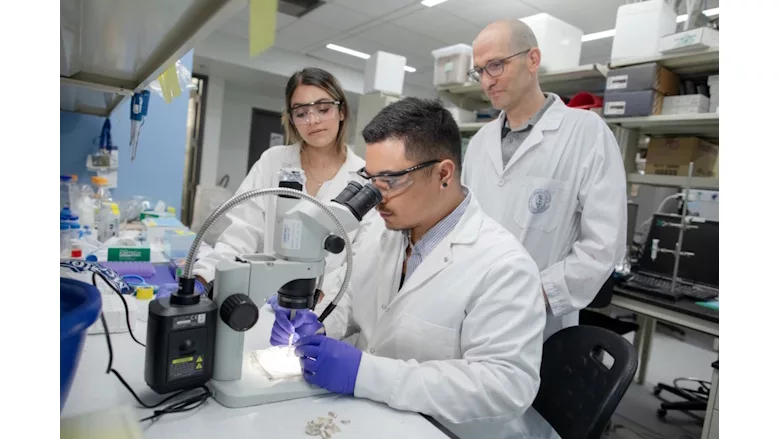
Picture of a scientist looking through a microscope
Image courtesy of Tim Fraser, KITE Studio

Researchers are investigating existing adhesion strategies in nature. From left to right Rida Hasan (BME PhD candidate), Angelico Obille (BME PhD candidate) and Professor Eli Sone (BME, MSE).

May 4, 2026

Researchers at the University of Toronto have identified a protein from the quagga mussel that can stick to surfaces underwater, even though it lacks a chemical feature long thought to be essential for this kind of adhesion. The protein, called Dbfp7, is the first freshwater mussel adhesive protein to be functionally characterized.  

The finding, published in a recent issue of PNAS, helps explain how some organisms attach themselves in wet environments and could inform the design of future medical glues — such as medical sealants and surgical adhesives — or other materials that need to work reliably in water.

Most studies of underwater adhesion have focused on marine mussels, which use proteins rich in a modified amino acid called 3,4-dihydroxyphenylalanine (DOPA) to bond to surfaces. Freshwater species have been studied less, and whether they rely on the same chemistry has not been clear.

The quagga mussel, an invasive species in the Great Lakes, uses a structure called a byssus to anchor itself in moving water. Until now, the specific proteins at the contact point between this structure and a surface have not been well defined.

“There are multiple examples where nature solves the problem of wet adhesion, with some species from varying environmental conditions evolving different strategies. Studying freshwater bio-adhesives helps us expand the current set of known biological adhesives,” explained Angelico Obille, lead author of the study and a PhD candidate at the Institute of Biomedical Engineering at the University of Toronto.

“DOPA-based adhesives face some limitations because of its susceptibility to oxidize into non-adhesive forms. Insights from freshwater mussel adhesives may help us circumvent the need for DOPA or at least find ways to enhance the efficacy of even small amounts of DOPA.”

To identify the proteins, the team analyzed the material at the interface where the mussel attaches to a surface using quantitative proteomics, allowing them to localize the specific set of proteins directly in contact with surfaces. They found several proteins that were more abundant at this interface, with Dbfp7 standing out because of its size and high expression in the mussel’s foot, the organ that produces the adhesive.

The researchers then purified Dbfp7 and used atomic force microscopy to map the mechanical properties of this protein in water. The tests showed that Dbfp7 could adhere to surfaces in wet conditions, despite containing little to no DOPA. The team compared its performance with other known proteins and found that Dbfp7’s adhesive strength was in the same range as some marine mussel proteins that are used as benchmarks in the field.

“We’re currently investigating the properties of Dbfp7 and other footprint proteins in the overall mechanism of adhesion, such as sequence motifs and structural features that are tailored for freshwater conditions,” said Professor Eli Sone (BME, MSE), the corresponding author of the study.

“Uncovering the adhesion strategies used by these invasive freshwater mussels can lead to improved medical adhesives, as well as anti-fouling technologies.”

KEYWORDS: bio-based materials research and development

Share This Story

Looking for a reprint of this article?
From high-res PDFs to custom plaques, order your copy today!

Recommended Content

JOIN TODAY
to unlock your recommendations.

Already have an account? Sign In

  • linked network nodes

    Using the Power of AI for Adhesive and Sealant Formulation

    With the help of software solutions, adhesive formulators...
    Finished Adhesives and Sealants
    By: Karen Parker
  • ASI top 20 global manufacturers

    2025 ASI Top 20: Leading Global Adhesives and Sealants Manufacturers

    ASI's annual ranking of the top 20 global adhesive and...
    Finished Adhesives and Sealants
    By: Karen Parker
  • science test tubes

    2026 Adhesives and Sealants Raw Materials Roundup

    After more than two years of contraction, the...
    Sustainability
    By: Karen Parker
Manage My Account
  • eMagazine Issues
  • Newsletters
  • Online Registration
  • Manage My Preferences
  • Subscription Customer Service

More Videos

Popular Stories

Image of hands holding green globe

Bio-Based Resins Suitable for High-Performance Adhesives and Composite Applications

image of a graph representing markets

H.B. Fuller Posts Drop in Net Revenue for First Quarter of 2026

Picture of an older man

Dow Names New CEO, Fitterling to Become Executive Chair of Board

ASI Top 20 website

Events

January 1, 2030

Webinar Sponsorship Information

For webinar sponsorship information, visit www.bnpevents.com/webinars or email webinars@bnpmedia.com.

View All Submit An Event

Products

Structural Adhesives: Properties, Characterization and Applications

Structural Adhesives: Properties, Characterization and Applications

See More Products

ASI CASE EBOOK

ASI raw materials roundup

Related Articles

  • Picture of mussels

    Researchers Draw Inspiration from Mussels and Mistletoe to Design Sustainable Materials

    See More
  • Image of green tree within clear lightbulb

    Researchers Receive Award to Develop Mussel-Inspired Underwater Adhesion

    See More
  • Juya Jeon

    Researchers Engineer Customizable Bio-Adhesive for Personalized Medical Repair

    See More

Related Products

See More Products
  • Technology of Pressure-Sensitive Adhesives and Products

See More Products
×

Keep the info flowing with our newsletters!

Get the latest industry updates tailored your way.

JOIN TODAY!
  • RESOURCES
    • Advertise
    • Contact Us
    • Directories
    • Manufacturing Division
    • Store
    • Want More
  • SIGN UP TODAY
    • Create Account
    • eMagazine
    • Newsletters
    • Customer Service
    • Manage Preferences
  • SERVICES
    • Marketing Services
    • Reprints
    • Market Research
    • List Rental
    • Survey & Sample
  • STAY CONNECTED
    • LinkedIn
    • Facebook
    • Youtube
    • X (Twitter)
  • PRIVACY
    • PRIVACY POLICY
    • TERMS & CONDITIONS
    • DO NOT SELL MY PERSONAL INFORMATION
    • PRIVACY REQUEST
    • ACCESSIBILITY

Copyright ©2026. All Rights Reserved BNP Media, Inc. and BNP Media II, LLC.

Design, CMS, Hosting & Web Development :: ePublishing