Adhesives Mag logo
search
cart
facebook twitter linkedin youtube
  • Sign In
  • Create Account
  • Sign Out
  • My Account
Adhesives Mag logo
  • NEW PRODUCTS
  • NEWS
    • Adhesives & Sealants Headlines
    • Mergers/Acquisitions
    • Market Trends
    • TOP 20
  • TOPICS
    • Finished Adhesives and Sealants
    • Pressure-Sensitive Adhesives (PSAs)
    • Coatings
    • Raw Materials and Chemicals
    • Materials Handling/Processing
    • Meter/Mix/Dispense
    • Curing
    • Testing/Quality Control
    • Packaging of Adhesives & Sealants
    • Converting/Packaging
    • Composites
    • Sustainability
  • EVENTS
    • MAX
    • ASI Academy
    • Events Calendar
  • COLUMNS
    • European Perspectives
    • Strategic Solutions
    • Supply Chain Strategies
    • Tape Talk
  • MULTIMEDIA
    • Videos
    • Podcasts
    • Webinars
    • eBooks
  • EXPLORE
    • Adhesives in Action
    • Blog
    • ASI Store
    • Industry Links
    • Market Research
    • Classifieds
  • DIRECTORIES
    • Buyers' Guide
    • Global Adhesives & Sealants Directory
    • Raw Materials, Chemicals, Polymers and Additives Handbook
    • Equipment Handbook
    • Distributor Directory
  • EMAGAZINE
    • EMAGAZINE
    • ARCHIVE ISSUES
    • ADVERTISE
      • Custom Content & Marketing Services
    • CONTACT
  • SIGN UP!
Meter/Mix/Dispense

How to Identify the Right Nozzle for Dispensing
By Kevin Brownsill
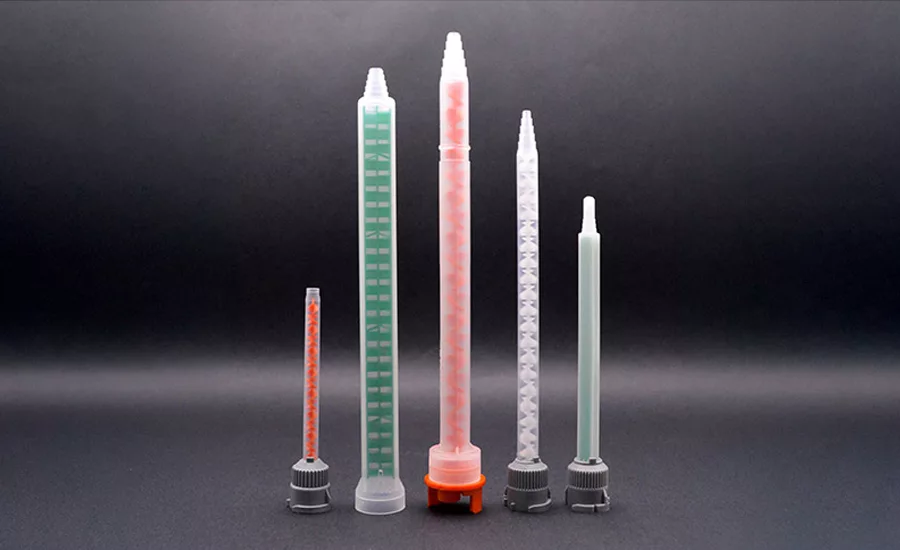
adhesive dispensing nozzles
Image courtesy of Intertronics.

Image courtesy of Intertronics.

February 26, 2025

Static mixing nozzles are vital for dispensing and are used for mixing or blending of two-part adhesives, potting compounds, and other protective materials, where products are packaged in cartridges or used in metering and mixing equipment. But how do you identify which one you have so you can order more? Kevin Brownsill, head of Learning and Development for adhesives and dispensing specialist Intertronics, explains the key features in the company’s latest Technical Bulletin.


Design Features

A static mixing nozzle has several key design features and characteristics. These include the mixer's element shape and style, mix ratio, inner diameter, the number of elements, connection interface, and nozzle termination.

The first aspect is the shape of the element section. Static mixers are typically round (helical) or square (Quadro). Element sections are usually white, yellow, or blue if they are round, and green if they are square. This is typically the case for 1:1 and 2:1 mix ratio. However, this can deviate when nozzles are designed for wider ratios such as 4:1 and 10:1, where they often have elements or features that are orange instead. The ratio will depend on the material you are using.

As well as style and ratio, the inner diameter and the number of elements contained can be identified from the elements section. The inner diameter for round nozzles, or width for square nozzles, is typically measured in millimeters and rounded to the next whole number. Typically in multiples of four, elements can be determined simply by counting.


The Interface

Another distinguishing design feature is the interface between the metering and mixing equipment or dispensing cartridge, and the nozzle. Intertronics supplies medmix MIXPAC™ nozzles, which have a number of designs to cater for different sizes and design of cartridge and equipment.

Categorized into "systems" based on size, design, and application, its unique B-System and F-System cartridges and mixers are molded to keep the two material parts separate further into the mixer to help avoid cross-contamination. These systems have an interlocking mechanism, whereas the A-System uses a bayonet, and the C-System uses a retaining threaded nut, emulated by the molded-thread "G" type nozzles.


The Tip

The opposite end of the static mixing nozzle is the tip, which is the dispensing end of the mixer. The tip can have different termination designs. Nozzles can have a variety of tip types to accommodate flow rates, attachments, or other requirements. They are available in several designs to help with high flow, attachment of a blunt Luer lock dispensing tip, or other specialty ends including spreaders.

Mixing nozzles can have key information molded into them. This could include the brand, diameter, and number of elements. These marks help you to have the necessary information to identify the static mixing nozzle.


Additional information about Intertronics is available at www.intertronics.co.uk.  

KEYWORDS: dispense equipment nozzles static mixers

Share This Story

Looking for a reprint of this article?
From high-res PDFs to custom plaques, order your copy today!

Kevin Brownsill, Head of Learning and Development, Intertronics, Kidlington, England

Recommended Content

JOIN TODAY
to unlock your recommendations.

Already have an account? Sign In

  • mouse in hole

    Using Foam Sealants for Pest Prevention

    According to the National Pest Management Association,...
    Finished Adhesives and Sealants
    By: Kevin Corcoran
  • linked network nodes

    Using the Power of AI for Adhesive and Sealant Formulation

    With the help of software solutions, adhesive formulators...
    Raw Materials and Chemicals
    By: Karen Parker
  • top20-hero.jpg

    2024 ASI Top 20: Leading Global Manufacturers of Adhesives and Sealants

    ASI's annual ranking of the top 20 global adhesive and...
    Adhesives and Sealants Topics
Manage My Account
  • eMagazine Issues
  • Newsletters
  • Online Registration
  • Manage My Preferences
  • Subscription Customer Service

More Videos

Popular Stories

image of a graph representing markets

Sika Announces Acquisition of Gulf Seal in Saudi Arabia

Picture of two men and one woman in dark suits

Bodo Möller Chemie Makes Management Change for CASE Business Unit

news on internet screen

Henkel Posts Positive Organic Growth for Third Quarter, Driven by Adhesives Technologies Business

ASI Top 20 website

Events

January 1, 2030

Webinar Sponsorship Information

For webinar sponsorship information, visit www.bnpevents.com/webinars or email webinars@bnpmedia.com.

View All Submit An Event

Products

Structural Adhesives: Properties, Characterization and Applications

Structural Adhesives: Properties, Characterization and Applications

See More Products

ASI CASE EBOOK

Related Articles

  • Dr. Dave

    How do I select the right adhesive or sealant to bond and seal industrial components?

    See More
  • Adhesive processing equipment

    Identifying the Right Adhesive Processing Equipment for the Job

    See More
  • from the editor

    How to Manage Extreme Change: A Lesson for the New Year

    See More

Related Products

See More Products
  • pressure-sensitive-advesive.gif

    Pressure-Sensitive Adhesives and Applications

See More Products
×

Keep the info flowing with our newsletters!

Get the latest industry updates tailored your way.

JOIN TODAY!
  • RESOURCES
    • Advertise
    • Contact Us
    • Directories
    • Manufacturing Division
    • Store
    • Want More
  • SIGN UP TODAY
    • Create Account
    • eMagazine
    • Newsletters
    • Customer Service
    • Manage Preferences
  • SERVICES
    • Marketing Services
    • Reprints
    • Market Research
    • List Rental
    • Survey & Sample
  • STAY CONNECTED
    • LinkedIn
    • Facebook
    • Youtube
    • X (Twitter)
  • PRIVACY
    • PRIVACY POLICY
    • TERMS & CONDITIONS
    • DO NOT SELL MY PERSONAL INFORMATION
    • PRIVACY REQUEST
    • ACCESSIBILITY

Copyright ©2025. All Rights Reserved BNP Media.

Design, CMS, Hosting & Web Development :: ePublishing