Researchers Develop Photo-Switchable and Eco-Friendly Smart Adhesives

As aerospace, electronics, and automotive engineering advance, the adhesives industry that supplies these sectors is shifting toward high-performance, multifunctional systems that address the inherent sustainability flaws of petroleum-based legacies. Traditional formulations pose significant challenges regarding soil and water contamination, high production footprints, and end-of-life recycling difficulties. Consequently, R&D is increasingly focused on developing high-strength, reusable, and bio-based alternatives that satisfy both performance requirements and circular economy mandates.
Currently, demand is growing for advanced adhesives with diverse functionalities. For example, stimuli-responsive adhesives that can vary their adhesive strength based on external stimuli are attracting attention. Among them, photo-responsive adhesives are especially attractive, as they allow localized wireless control of adhesion through light while also possessing non-invasive properties.
A research team led by Professor Kwang-Un Jeong, along with Ph.D. Student Mr. Mintaek Oh from the Department of Nano Convergence Engineering at Jeonbuk National University, South Korea, has developed a novel eco-friendly, photo-switchable smart adhesive.
“We synthesized a tetrahydrogeraniol-based monomer, a derivative of rose oil, and successfully fabricated an eco-friendly adhesive containing 95% of it,” explained Jeong. “The final adhesive, incorporating a small amount of a functional monomer that responds to light and adheres strongly to various substrates, exhibits high-responsive adhesion, allowing quantitative control of its bonding strength. It is eco-friendly, cost-effective, versatile, and reusable.” Their study was published in Volume 520 of the Chemical Engineering Journal on September 15, 2025.
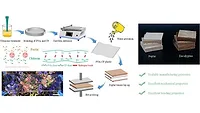
To fabricate the adhesive, the researchers first synthesized two key components: an acid azobenzene-based methacrylate monomer (AAMM) and a biomass-based tetrahydrogeraniol methacrylate monomer (TGMM). AAMM consists of azobenzene, carboxylic acid, and methacrylate. Azobenzene derivatives are well known for their reversible photo-switchable behavior, which makes them ideal for light-responsive systems. The carboxylic groups can form strong hydrogen bonds with a variety of substrates, facilitating strong adhesion.
TGMM, made from rose-oil-derived tetrahydrogeraniol, contributes to biodegradability and sustainability. It also helps maintain balance between flexibility and mechanical stability in the adhesive. By copolymerizing AAMM and TGMM through their methacrylate groups, the researchers successfully created a new eco-friendly and photo-switchable adhesive, termed the T/A adhesive.
During testing, the optimized T/A adhesive demonstrated excellent photo-switchable adhesion, with strong adhesion to a wide range of substrates, including metals, plastics, rubber, glass, cork, and paper. When exposed to ultraviolet (UV) light, the adhesive becomes more liquid-like, and its adhesion strength decreases. After subsequent exposure to visible light, it returns to its original adhesion strength and becomes more solid-like again, demonstrating fully reversible, light-controlled adhesion.
In addition to light, adhesion strength can also be switched using heat and chemical treatments. Specifically, increasing temperature beyond 500 °C significantly reduces adhesion strength, which can then be restored by cooling. Similarly, the adhesive can be dissolved by solvents like chloroform and recovered when the solvent evaporates. The researchers also found that the reused T/A adhesives in all three processes were able to retain more than 90% of their original adhesive strength across repeated usage cycles.
The scientists further demonstrated a smart UV sensor built using the new adhesive and a spring-based mechanism that can serve as a UV-light sensitive switch in electrical circuits. In this device, the T/A adhesive holds the spring to maintain an open circuit. When exposed to UV-light, its adhesion strength reduces, causing the spring to close the circuit.
“Our smart, reusable adhesive is promising for a wide range of practical applications,” said Oh. “It can play a valuable role in environmental monitoring, smart electronics, and adaptive assembly systems, where controllable and reusable adhesion is critical. It could also enable reusable light-responsive smart packaging, wearable devices with detachable sensors, and reconfigurable robotic components.”
Looking for a reprint of this article?
From high-res PDFs to custom plaques, order your copy today!