Polymer Encapsulation Protects Underwater Electromagnetic Transmitter
Adhesives and encapsulants expert facilitates design challenges for underwater transmitter.

While developing the EM-2, a pioneering underwater electromagnetic transmitter, underwater communications solution provider CSignum sought a reliable potting compound. Designed for applications that include transmitting environmental and structural data from subsea installations to surface hubs, as well as environmental monitoring, the EM-2 transmits data from beneath the water’s surface to a receiver on the surface using electromagnetic (EM) fields. A completely wireless device, the communication system can transfer sensor readings through water, ice, soil, or concrete up to 200 m, with longer reach available with the addition of boosters.
Adhesives and encapsulants expert Intertronics outlines in a new case study how its polyurethane encapsulation technology helped CSignum to conquer structural challenges and make the EM-2 market ready, providing expertise and guidance across design and production.
CSignum packaged the company’s initial product in a sealed pressure vessel, the industry standard for subsea electronics. The EM-2’s new design, which incorporates a three-axis antenna and transmission loop, is structurally unsuitable for this approach. Rather than a costly rethink, a decision was made to try a polymer encapsulation.
The manufacturer undertook a search for a partner experienced in potting compounds. This led to Intertronics, where CSignum began a trial with Intertronics’ IRS 3071. A polyurethane potting compound, IRS 3071 is designed for encapsulating low- to medium-voltage electrical and electronic applications. The thermally conductive potting compound is nontoxic and economical with a long pot life and excellent adhesion. With a flame retardant to UL94 V-0 at 6mm, the product can be cured with heat or at room temperature. It is RoHS and WEEE compliant.
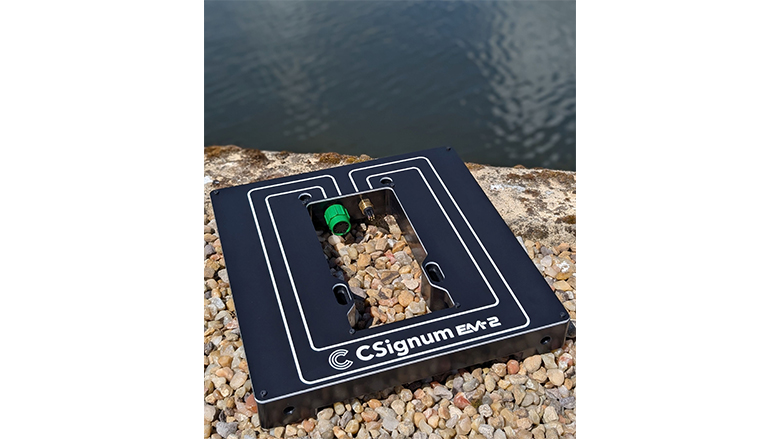
The collaboration’s first efforts met a challenge when air pockets formed in the potted device, creating process-orientated design issues. “As soon as I had an issue, I spoke with Intertronics to come up with a solution,” explained Kyle Watson, mechanical engineer at CSignum. “Its expertise saved us money and engineering time and enabled the EM-2 to become a market-ready, certified product.”
According to the case study, at depths of around 100 m, air pockets and voids threaten the product’s structural integrity, as pressure differentials could cause implosion. Intertronics recommended adding vents to the housing to release air during potting and verify complete filling.
The successful partnership between the two companies continues; Intertronics supplies materials and answers questions on equipment for CSignum to take agency over scaling up production and automating its manufacturing process. The EM-2 is commercially available, providing an environmentally safe alternative to cabled or acoustic transmission methods.
“We aim to go beyond the basic supplier relationship: the automated mixing and dispensing product that we’ve suggested to CSignum helps it prepare for its next phase of growth,” said Ian Mann, sales specialist at Intertronics. “Our partners trust us to have an eye on the future, just like they do.”
To understand how Intertronics’ solution solved CSignum’s underwater challenges, read the full case study: https://www.intertronics.co.uk/CSignum-case-study.
Looking for a reprint of this article?
From high-res PDFs to custom plaques, order your copy today!