PFAS Update 2026: Continued Refinement of U.S. and Global Strategies — and Greater Focus on Adhesives and Sealants
State-level bans and federal mandates are creating a more complex compliance landscape for adhesive and sealant manufacturers.

We have come a long way, globally, since 2019, when the topic of PFAS (per- and polyfluoroalkyl substances) was of interest largely to non-specialists and a handful of forward-looking lawmakers and regulators. Within just a few years, it was the most talked-about topic in the global specialty chemical industry, given the staggering settlements in lawsuits and the range of substances and ubiquitous range of applications where PFAS have been used, including: high-temperature-resistant polymers; lubricants; and "super-wetting" and "dirt-repellent" surfactants, dispersants, and defoamers. Whether producers or users, regulators (with authority in air, water, and land), or politicians within every level of government, everyone was talking about PFAS and trying to decide what was to be done about this issue that had so grabbed the global public's attention. Of course, concerns had been raised decades ago. While certain dangers to human health by a small number of PFAS had been known since the late 1960s, they were a more "specialist concern," if I may use so dismissive a term.
It has now been five years since the concerned parties have begun working together to address the overall issue, with emphasis on: which chemicals to classify as PFAS, which PFAS to ban outright, which PFAS to restrict, and to which levels any restrictions should be set. Because a lot of different actions with regard to the entire PFAS topic are planned for implementation during 2026, now is the perfect time to take a look at "what's on the books," so to speak, and what it will mean to producers of specialty chemicals and formulated products such as adhesives and sealants.
Current U.S. Federal and State Regulatory Activities
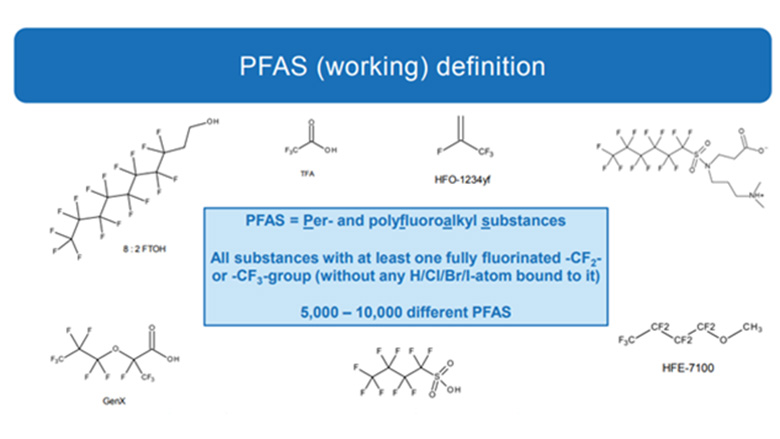
To avoid any possible confusion, it should be mentioned that the definition of PFAS that I use is one defined quite a few years ago, but which is still accepted as being the most straightforward and easily understood of the minor variations that one occasionally runs into (see Figure 1).
Right out of the gate, we should acknowledge that, at least in the United States, the majority of the changes appear to be driven by a shift in federal enforcement focus and a steady increase in state-level bans. Looking first at the U.S. federal regulations, which are issued under the authority of the U.S. Environmental Protection Agency (EPA), we see:
- The Safe Drinking Water Act (SDWA): The EPA has affirmed the limits of four parts per trillion (ppt) for PFOA (perfluorooctanoic acid) and PFOS (perfluorooctane sulfonate) in drinking water. The compliance deadline, however, has been extended from 2029 to 2031. Standards for four other PFAS are currently expected to be rescinded and "reconsidered," including:
- PFHxS (perfluorohexane sulfonic acid)
- PFNA (perfluorononanoic acid)
- HFPO-DA (hexafluoropropylene oxide dimer acid)
- PFBS (perfluorobutane sulfonate)
- Comprehensive Environmental Response, Compensation, and Liability Act (CERCLA): PFOA and PFOS will remain designated as designated hazardous substances under CERCLA (aka the Superfund law). Current enforcement efforts are aimed at "significant" polluters, while the EPA encourages Congress to provide liability protection for the "passive receivers" such as water utilities and landfills.
- Toxic Substances Control Act (TSCA): Since 2011, the one-time reporting rule has required companies to report PFAS use. Most manufacturers must report by October 26, 2026, though small business article importers have until April 13, 2027.
- Toxics Release Inventory (TRI): Nine additional PFAS were added to the TRI for reporting year 2025, raising the total of reportable chemicals to 205. Reporting forms for these are due on July 1, 2026.
U.S. State-Level Regulations
In the absence of what any given state might consider to be "insufficiently stringent" regulations or outright prohibitions, such states have taken matters into their own hands (as the federal government fully expected and encouraged) and enacted (or are currently enacting) their own strict prohibitions, with particular emphasis on consumer products. The following examples are not intended to be either exhaustive or comprehensive; they should, however, give the reader a flavor for where the overall PFAS issue in the United States is, effective January 1, 2026.
- The State of Maine prohibits the sale of cleaning products, cookware, cosmetics, dental floss, and textile articles containing "intentionally added" PFAS.
- The State of Colorado bans "intentionally added" PFAS in cosmetics, indoor textile furnishings, and indoor upholstered furniture.
- The State of Minnesota, following a delay, is requiring that all manufacturers of products containing "intentionally added" PFAS must submit an initial report to the Minnesota Pollution Control Agency (MPCA) by July 1, 2026. Under Amara's Law, this applies to products sold or distributed in Minnesota and requires details on chemical usage, concentrations, and functions, with annual reports due each February 1 thereafter.
- The State of Vermont prohibits artificial turf, juvenile products, and residential rugs with "intentionally added" PFAS.
- Multiple states, including both California and Michigan, either maintain or are in the process of developing state-level Maximum Contaminant Levels (MCLs) that may be more strict than current federal guidelines.
- Michigan, for example, enforces maximum levels of 8 ppt (PFOA) and 16 PFOS, respectively, but has committed to adopting the stricter 4 ppt limit by late 2026.
- New Jersey was one of the first states to set MCLs at 14 ppt for PFOA and 13 ppt for PFOS. It is currently evaluating updates to meet the federal 4 ppt limit.
- Massachusetts currently enforces a combined limit for six PFAS compounds:
- PFOS
- PFOA
- PFHxS
- PFNA
- PFHpA
- PFDA
- New York enforces a limit of 10 ppt each of PFOA and PFOS. In light of the rescinding of the federal 2024 rule, however, it is currently in a "pre-evaluation phase" to determine if it must re-promulgate its 2023-era state standards for compounds like PFNA and PFHxS.
- Pennsylvania established MCLs of 14 ppt for PFOA and 18 ppt for PFOS in 2023 but now finds itself in the same position as New York.
- New Hampshire currently enforces limits of 12 ppt for PFOA, 15 ppt for PFOS, 18 ppt for PFHxS, and 11 ppt for PFNA.
PFAS and the Adhesive Industry
While much of the emphasis in the United States, EU, and APAC has been on restriction of PFAS in paints, coatings, specialty chemicals, and HI&I (household, industrial, and institutional cleaners), surprisingly little has been turning up in the literature with regard to adhesives and — by extension — sealants. More to the point, as many adhesives and sealants companies also produce packaging coatings and components, they will be further impacted by PFAS legislation. I assume, without knowing for sure, that this is because the other market spaces that have been so heavily targeted are so much larger and have a higher potential for consumer exposure. As a result, they have therefore received higher priority from the "powers that be." Regardless of the reasons, however, I see 2026 as the year when the adhesives and sealants market spaces will be facing a dual challenge:
- Complying with the strict new reporting mandates
- Navigating bans on consumer products where adhesives are critical components
First Things First
As we have already seen, the reporting and transparency mandates have 2026 deadlines. What does this mean in practical terms? It means that the most immediate and unpleasant impact on the adhesive industry will be the massive data collection effort required by both U.S. federal and state laws and regulations, including (but almost certainly not limited to):
- TSCA Section 8(a)(7) will require that both adhesive manufacturers and importers must report all PFAS used since 2011. The submission window opens for a six-month period on April 13, 2026, and closes on October 13, 2026. This requires that manufacturers and importers identify PFAS not only in raw materials but also in processing aids and "hidden" additives.
- Minnesota (Amara's Law): By July 1, 2026, manufacturers must report every product containing intentionally added PFAS sold within the state. This includes detailed chemical IDs (CAS numbers) and the specific function the PFAS serves in the adhesive.
Second Things, Almost as Important as the First
Adhesives are subject to any number of "indirect product bans." While there aren't many laws currently on the books that ban "adhesives" as a unique category, their use is heavily restricted because they are considered to be "intentionally added" components in certain banned product classes. Some of these include:
- Textiles and furniture: As of January 1, 2026, Maine and California prohibit intentionally adding PFAS in textile articles and upholstered furniture, which had long been a preferred ingredient for repelling dirt/soiling. Adhesives used in the assembly of these products must now be PFAS-free to remain complaint.
- Cleaning and maintenance: Colorado and Maine have banned cleaning products that contain PFAS as of 2026. Adhesives or sealants marketed for "general maintenance" or "household repair" often fall under the "cleaning and maintenance" category and may also need to comply with the requirements.
- Hard surface sealers: Washington State requires manufacturers to report and track PFAS in hard surface sealers, with potential future bans depending on the concentrations found.
Third Thing, Possibly Even More Important than the First Two
This applies to products sold or distributed in Minnesota, requiring details on chemical usage, concentrations, and functions, with annual reports due February 1. The adhesives industry is being reshaped by many factors, but especially by "private-sector mandates" for "PFAS-free" adhesives. Major OEMs in the automotive, aerospace, and electronics sectors now require "material-level visibility" and "PFAS-free declarations" in suppliers' contracts.
Internationally, restrictions imposed by EU REACH are causing the adhesive industry to monitor the RO2 framework. While broad bans are pending, specific compounds like PFHxA, which are often found in both specialty coatings and adhesives, will face restrictions starting in April 2026.
The year 2026 will be one in which global adhesives manufacturers, importers, distributors, and users will need to be on their toes.
A High-Level View of PFAS Outside of the U.S.
Following its review of more than 5,600 comments in August 2025, the European Chemicals Agency (ECHA) issued an updated document to restrict the use of PFAS under the EU's REACH regulations. This is expected to exercise significant influence on developments going forward in 2026, which will, at the very least, result in a "second public consultation" expected to begin sometime in March and to run for 60 days. It is currently expected that Public Consultation Period #2 will focus on the original 14 sectors. Although the update in 2025 mentioned eight new sectors (seating applications; printing applications; technical textiles; wider industrial uses (e.g., solvents and catalysts); machinery applications; "other medical uses," such as pharmaceutical packaging and excipients; military applications; and explosives), it is not likely that these will receive significant attention at this specific Public Consultation Period.
ECHA will also be evaluating options that would allow PFAS-related activities to continue where "risks can be adequately managed." These are likely to include:
- PFAS manufacturing
- Electronics and semiconductors
- Energy sector uses
- Sealing applications
- Transport
- Machinery applications
- Technical textiles
The next steps in the EU will likely include a review of the proposal by the ECHA's Committee for Risk Assessment (RAC) and the Committee for Socio-economic Analysis (SEAC). Their opinions will inform the European Committee, which, along with the individual member states, will make the final decisions on PFAS restrictions.
For many EU member countries, the main regulatory activities have thus far involved firefighting foams, with multiple phase-out dates, although many members are implementing more rapidly than some, while others are taking advantage of certain extensions.
Currently, the EU PFAS restriction proposal is moving in the direction of a three-pronged approach:
- Restriction Option 2 (RO2): Time-limited Derogations. The standard transition period is 18 months, but sectors without viable alternative are granted five-year or 12-year derogations.
- Five-year (until approximately 2032): Includes specific industrial bakeware, certain medical device components, and flexible plastic film extrusion
- 12-year (until approximately 2039): Reserved for "critical" uses such as specialized medical devices (stents, pacemakers), certain petroleum and mining applications, and specific green energy initiatives
- Restriction Option 3 (RO3): Conditional Continued Use. This is a new "controlled use" derogation being evaluated for sectors where risks can be managed with a ban. It is specifically targeted at semiconductors, electronics, energy, transport, and machinery sealing.
- Firefighting Foam Exemption: Under separate rules effective beginning in October 2026, a general ban applies to most foams, but "critical" applications (military, offshore oil/gas, and civilian ships) have limited derogations available through 2025.
What Should Be Expected Going Forward?
The short, and at least for now, the best answer is: "More of same, but with greater willingness to take an approach more nuanced than 'it's either in or it's out.'" The work done over the recent past by the U.S. federal and state governments, as well as by the EU, has at least exposed the exceptionally complex nature not only of banning PFAS outright but even the difficulty of banning a variety of members of the PFAS family tree. These materials are essentially used everywhere, from household cleaners to the most sophisticated aspects in the manufacturing of microchips — with paints, coatings, adhesives, sealants, lubricants, personal care items (lotions, shampoos, hairsprays), self-cleaning surfaces, and a vast number of other products, processes, articles, and market sectors and sub-sectors in between. It would be nice if complex problems admitted of simple solutions, but this is seldom the case. The truth is that complex problems more often than not require complex solutions — and complex solutions typically involve applying Edison's Dictum of "1% inspiration, 99% perspiration" to the problem-solving process. It isn't just the scientists and technologists who are faced with this harsh reality — so, too, are legislators and regulators. The truth is they have done a remarkable job, thus far, of "getting it right" (at least in the United States), and there are hopeful signs the same will be true in the EU. Regardless, there is no turning back at this point.
To learn more, reach out to the author at gpilcher@chemquest.com or visit https://chemquest.com.
References:
[1] F. Averbeck, “PFAS under REACH Universal Restriction Proposal,” Bundesanstalt für Arbeitsschutz und Arbeitsmedizin (BAUA), 2022, https://www.asercom.org/wp-content/uploads/2022/05/Averbeck.pdf.
Looking for a reprint of this article?
From high-res PDFs to custom plaques, order your copy today!