Plasmatreat delivers sustainable plasma surface treatment solutions that clean, activate, and coat materials, helping manufacturers improve adhesion, reliability, product quality and performance across demanding industrial applications worldwide.


Engineering the Molecular Interface: Atmospheric Plasma Cleaning and Activation for Reliable Bonding
When it comes to bonding and sealing, the most critical interface is often the hardest to see: the outermost molecular layers of the substrate.
While joint performance is traditionally evaluated through polymer chemistry, cure mechanisms, stress distribution and environmental exposure, these factors assume a fundamental prerequisite: intimate, defect-free contact at that interface. An adhesive joint rarely fails because the polymer backbone was poorly chosen; more often, it fails because the substrate presented hydrocarbons, silicone mold-releases, surface oxides, migrated plasticizers, or intrinsically low-energy polymer chains that prevented the true interfacial bonding.
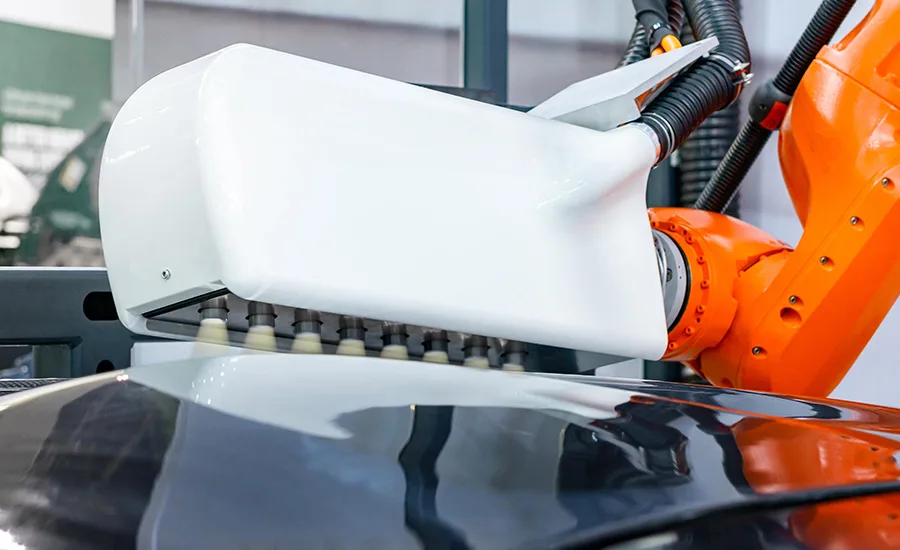
Atmospheric pressure plasma pretreatment resolves these interfacial defects directly at the surface. Rather than masking low surface energy with chemical primers or compensating with excess joint gap, plasma modifies only the near-surface region without altering the bulk mechanical, optical or thermal properties of the material. In modern automated manufacturing, it provides a dry, selective, non-contact pretreatment step that integrates inline before bonding, sealing, gasketing or potting operations.
Why Surface Preparation Determines Bond Reliability
Most adhesive and sealant failures originate as interfacial disbonds caused by poor wetting or weak boundary layers. When an adhesive is applied to a surface, it must spread and penetrate into micro-topographical features and establish close molecular contact with the substrate. If the substrate surface energy is lower than the liquid surface tension of the adhesive, the adhesive will bead up or pull back, leaving microscopic voids and air pockets at the bondline. These voids act as stress concentrators and moisture channels, drastically lowering the long-term shear, peel and environmental resistance of the joint.
The nature of these surface barriers varies significantly across common industrial materials:
| Substrate Category | Primary Surface Contaminant / Barrier | Practical Engineering Challenge |
|---|---|---|
| Metals & Alloys | Machining oils, drawing compounds, native oxide layers, skin lipids | Hydrocarbon films prevent direct metallic or chemical bonding, creating a weak boundary layer. |
| Glass & Ceramics | Adsorbed environmental moisture, silanol degradation, nanometer-scale particulates | Invisible residues prevent uniform wet-out and disrupt chemical-coupling. |
| Engineering Plastics & Polyolefins | Low intrinsic surface energy, mobile plasticizers, internal/external mold releases | Nonpolar surfaces lack reactive sites for chemical or secondary bonding interactions. |
Because surface energy and cleanliness directly control wetting behavior, they cannot be treated as peripheral quality metrics. They are fundamental process variables. A water-based coating, low-VOC adhesive, silicone sealant, polyurethane, epoxy or pressure-sensitive tape will behave entirely differently on an unconditioned surface than on one that has been micro-cleaned and activated. Pretreatment gives engineers a controlled, repeatable way to condition that surface immediately before dispensing.
What Plasma Does at the Interface
Plasma is often referred to as the fourth state of matter. It is an ionized gas containing a mix of reactive species, including free radicals, ions, electrons, excited molecules and ultraviolet photons. In atmospheric plasma systems, compressed air or industrial gases are passed through an electrical discharge inside a nozzle head. The resulting plasma stream is directed onto the substrate surface at ambient pressure, eliminating the need for vacuum chambers or batch processing. When this ionized gas stream contacts the material, it performs two distinct, complementary functions at the surface:
Micro-Fine Cleaning
Plasma removes thin, invisible organic films that standard industrial cleaning operations leave behind. High-energy reactive species break the molecular bonds of hydrocarbon contaminants, converting oils, residues and flash films into volatile gases such as carbon dioxide and water vapor, which are continuously swept away by the gas stream. Unlike abrasive wiping or solvent washing, plasma operates at the nanometer scale, leaving no chemical residue, evaporation lines or cross-contamination on the part.
Chemical Surface Activation
For nonpolar polymers, cleaning alone is insufficient because the material inherently lacks chemical reactivity. Plasma activation cleaves polymer chains on the immediate surface, creating highly reactive radical sites. These radicals instantly combine with oxygen and nitrogen species present in the plasma stream, grafting polar functional groups (such as hydroxyl, carbonyl and carboxyl groups) onto the polymer backbone. These polar groups dramatically raise the substrate’s surface energy, transforming a hydrophobic, water-repellent surface into a hydrophilic, highly wettable substrate.
Replacing Solvent Wiping and Chemical Primers
Historically, manufacturing engineers faced with difficult-to-bond materials relied on three main workarounds: solvent wiping, mechanical abrasion (such as grit blasting or sanding) or chemical primers. While these methods can improve adhesion, each introduces significant operation, environmental and quality challenges into high-volume production lines.
Solvent wiping depends heavily on operator technique. Inconsistent wiping pressure, dirty rags or incorrect solvent flash-off times can recontaminate parts or leave fluid streaks behind. Furthermore, solvents generate high volatile organic compound (VOC) emissions, require complex hazardous material handling and incur ongoing consumable costs.
Chemical primers face similar drawbacks. Primers are chemical coatings applied to bridge the gap between low-energy plastics and adhesives. They add a wet chemistry step to the production floor, require dedicated flash-off ovens or air-drying lines, present limited shelf-life issues and introduce toxic solvents into the workplace. If applied too thickly or unevenly, the primer layer itself can become the weakest point in the joint stack.
Inline atmospheric plasma eliminates these chemical inputs. Operating entirely on compressed air (or nitrogen) and electrical power, plasma provides a dry, continuous pretreatment process. Parts move directly from the plasma cell to the adhesive dispensing station without waiting for solvents to evaporate or primers to cure, reducing footprint inventory work-in-progress and environmental compliance burdens.
Important Process Variables in Production
To successfully integrate atmospheric plasma into an automated assembly line, engineers must treat plasma application as a controlled manufacturing operation rather than a simple plug-and-play accessory. Treating a complex 3D part requires balancing several kinetic, electrical and geometrical parameters.
- Line Speed and Robot Trajectory: The speed at which the plasma nozzle moves across the surface dictates the treatment energy density per unit areas. Moving too quickly results in insufficient cleaning or activation; moving too slowly can over-treat heat-sensitive polymers, leading to localized thermal degradation or chain scuffing.
- Working Distance (Standoff): The distance between the nozzle tip and the substrate determines the density of active species reaching the surface. Standoff distances typically range from 5 to 25 mm depending on the nozzle type and substrate material.
- Treatment Pattern and Overlap: For wide bond paths or large sealing flanges, multiple passes or multi-nozzle arrays must be configured to ensure uniform coverage across the entire bonding area without leaving untreated gaps.
- Gas Type and Pressure: While dry, oil-free industrial air is the standard workhorse gas, specialized gas mixtures (such as nitrogen-hydrogen blends) can be utilized to optimize radical generation for specific target chemistries or delicate substrates.
Geometry and Structural Complexity
A flat lap-shear test coupon is easy to treat uniformly, but real-world engineering components feature complex geometries, including deep rib structures, seal grooves, bosses and radiused edges. Robotic programming must maintain a perpendicular orientation and constant working distance along the entire contour of the bondline. For tight channels or recessed gasket paths, specialized narrow-jet nozzles or rotary discharge heads are often specified to reach interior walls without arching against conductive metal features.
Open Time Management
A vital consideration when designing a plasma-assisted bonding process is open time, which is the allowable time window between plasma treatment and adhesive application. A common misconception across manufacturing is that all plasma treatment effects decay almost immediately. In practice, the functional longevity of a plasma-treated surface depends heavily on substrate chemistry, polymer morphology and storage conditions, with many materials retaining elevated surface energy far longer than anticipated.
On inorganic substrates such as metals, glass and ceramics, micro-cleaning and surface activation remain stable across extended timeframes. When protected from airborne hydrocarbons, ambient dust and shop-floor oils, these treated parts can often be stored for days or weeks while maintaining excellent bond receptivity.
Some treated polymer surfaces undergo a natural phenomenon known as hydrophobic recovery. Over time the flexible, modified polymer chains at the surface tend to rotate back into the bulk material, while untreated low-energy chain segments migrate outward to minimize surface free energy.
For these surfaces, plasma systems are ideally positioned directly inline with adhesive dispensing, potting or gasketing equipment. Integrating plasma treatment immediately upstream of dispensing ensures the adhesive contacts the substrate while surface energy and functional group density are at their absolute peak.
Requirements from a Plasma Technology Partner
Integrating plasma surface treatment into an automated assembly line should never be treated as a simple equipment purchase or a generic “add-on” tool. Because surface modification interacts directly with incoming resin formations, additives, mold-release agents and adhesive chemistries, process development must occur well before capital equipment is ordered or installed on the plant floor.
However, not all equipment vendors provide the engineering depth required to establish a production-ready bonding window. When evaluating a plasma technology partner, process and design engineers should expect comprehensive, pre-installation application testing that covers:
- Substrate & Failure-Mode Auditing: Laboratory analysis of incoming production parts to determine whether adhesion challenges stem from organic contamination, low native surface energy or weak boundary layers.
- Surface Energy & Kinetic Mapping: Precise characterization using contact-angle analysis or dyne solutions to map surface energy shifts across varying line speeds, stand-off distances and nozzle configurations.
- Open-Time & Environmental Validation: Destructive lap-shear or peel testing performed after simulated storage intervals and accelerated environmental aging (such as thermal cycling and humidity exposure) to verify long-term joint durability.
- Inline Integration & Quality Monitoring: Engineering support to integrate programmable multi-axis motion, optical emission monitoring and parameter tracking into the final assembly cell.
Adhesive joint performance relies entirely on the condition of the substrate’s outermost molecular layers. By partnering with a plasma provider capable of qualifying these variables on actual production parts, manufacturers can eliminate guesswork, avoid costly line modifications and ensure repeatable, high-reliability bond performance from day one.
Looking for a reprint of this article?
From high-res PDFs to custom plaques, order your copy today!