WAX: The Other Plastic
Simpler solutions to engineering problems are often missed in the eternal quest for the latest technology that requires the latest in engineered materials. Simple solutions using common materials are often passed over as being less than "state of the art." Waxes are one such material. Petroleum waxes have been around for over 100 years, but regardless of wax's longevity, manufacturers familiar with its utility continually develop new applications.
Wax is a simple, easy-to-use material that can deliver consistent properties to engineered products. Consider the issues of encapsulation, lubrication and timed release. These applications were all addressed by Calwax Corp., a specialty wax manufacturer located in Irwindale, CA. Calwax specializes in developing custom solutions to issues involving the use of wax as the primary performance material.
Encapsulation
A major manufacturer of steel alloys needed to put an additive material into an exotic molten metal using a robotic arm. Additives needed to be pre-measured, completely self-contained, and able to be handled by a robotic arm. The idea developed to encapsulate the additive in a block of blended wax. The robotic arm could grip the block and add it to the alloy, and the wax vaporized from the intense heat after it did its job. The wax became a temporary package."Because the wax was inert, there was no contamination of the additive," said Henry Shishido, Calwax Manufacturing manager.
A second engineering problem solved by encapsulation was how to add a surfactant into a mix just before use. In this case, there was a need for manual insertion, but a pre-measured amount of surfactant was required. The surfactant was needed to add several performance factors to the mix, but it had to be done in the field where the mix was being made. The "container" had to be durable enough for shipping and handling, but friable enough to break when required.
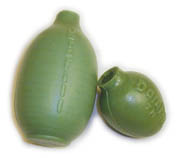
A wax mold was devised that looked much like an egg or a hand grenade. There were two sizes to provide options in concentration. The operator would simply throw the right size and number of "eggs" into the mix, allow the mixing to break up the wax capsule, then apply the mix.
Protectant and Lubricant
Wax is a "green" material; it is safe for the environment and even consumable by humans. It provides excellent temporary protection for surfaces. It can lubricate, seal and absorb impact. An example is the use of wax with orthodontic braces. Using a small piece of wax over the braces delivers a great amount of relief. The wax lubricates, protects, and is not a contaminant for humans since it can be refined to food grade. It is also acceptable for use as a chewing gum additive; it provides some degree of texture control and also acts as a release agent from the teeth. Without the wax, chewing gum would be like eating peanut butter.Wax can also be used for therapeutic and personal care. Paraffin hot baths for joints and extremities are a very popular application for wax. It can deliver a predictable amount of heat to the surface of the body. Immersion also helps skin soften and have a smooth, lubricated feel. The wax can be blended to provide other enhancements such as aroma, color, active ingredients and form, whether it be in pellet form or solid blocks.
Timed Release
Wax bars are used in a commercial process to deliver a chemical in a controlled manner. Wax serves as a packaging method, but provides other important characteristics as well. The wax is used as a release agent to allow for the gradual release of the additive material during the process cycle. It calls for a careful design of the wax for melting point, mix concentration, and physical shape and size of the bar."The wax is much less expensive than other materials, and wax lends itself to automated molding of the bars," said Al Case, Calwax vice president of Sales and Marketing. "The cost of tooling and production equipment for high volumes is much less than for other materials. Wax is really an easy material to work into many kinds of applications."

Wax as a Phase Change Material
Consider temperature regulation, where even distribution of heat is required. Pre-warmed pizza delivery bags are an example. The energy absorbed by wax when the bag is heated is released as the wax cools during delivery. As the wax gives up its heat, the pizza absorbs it, slowing the cooling process. Wax is also used in microwave towers to control heat variations from the environment and to stabilize the operating temperatures of the electronics. At night, wax will give up heat, slowing the cooling of the electronics. When the sun comes up, the wax absorbs heat, slowing the warming of the electronic components. Temperature swings for electronics are an enemy of long-term reliability. Wax provides a cost-effective, simple and long-lasting solution to a very complicated problem.Summary
Wax can be used as a binder or carrier for other materials. For example, an active chemical compound may be mixed with wax and molded into a bar form. The active ingredient may be released by heat when the wax softens or melts, or by abrasion as the bar is worn away. In extreme cases, the wax may be burned away, leaving a high temperature material such as metal or ceramic behind. The advantage to using wax as the binder or carrier is that it is inert, inexpensive, and easy to work with. These thermal properties also allow wax to act in some capacity as a thermostat.Paraffin wax is biodegradable. Several studies have shown that various microbes common in the environment can digest paraffin wax. The composting process is especially effective in breaking down wax.
Petroleum wax is a close cousin to motor oil. You can even think of it as "solid" oil. For decades it has been used as a lubricant by rubbing it onto everything from the ramps used to launch ships to zippers to orthodontic braces.
How the legacy of wax progresses in the future as an engineering material is strictly in the hands of the engineer who can creatively leverage the natural capabilities of the "other plastic." It is a very versatile material with plenty of uses to yet be discovered.
For more information on waxes, contact Calwax Corp., 5367 Ayon Ave., Irwindale, CA 91706-2019; phone 800-7CALWAX (800-722-5929); e-mail waxworker@calwax.com ; or visit http://www.calwax.com .
Looking for a reprint of this article?
From high-res PDFs to custom plaques, order your copy today!




.webp?height=200&t=1709670950&width=200 "markets-GettyImages-113925850")
