Adhesives Mag logo
search
cart
facebook twitter linkedin youtube
  • Sign In
  • Create Account
  • Sign Out
  • My Account
Adhesives Mag logo
  • NEW PRODUCTS
  • NEWS
    • Adhesives & Sealants Headlines
    • Mergers/Acquisitions
    • Market Trends
    • TOP 20
  • TOPICS
    • Finished Adhesives and Sealants
    • Pressure-Sensitive Adhesives (PSAs)
    • Coatings
    • Raw Materials and Chemicals
    • Materials Handling/Processing
    • Meter/Mix/Dispense
    • Curing
    • Testing/Quality Control
    • Packaging of Adhesives & Sealants
    • Converting/Packaging
    • Composites
    • Sustainability
  • EVENTS
    • ASI Academy
    • Events Calendar
  • COLUMNS
    • European Perspectives
    • Strategic Solutions
    • Supply Chain Strategies
    • Tape Talk
  • MULTIMEDIA
    • Videos
    • Podcasts
    • Webinars
    • eBooks
  • EXPLORE
    • Adhesives in Action
    • Blog
    • ASI Store
    • Industry Links
    • Market Research
    • Classifieds
  • DIRECTORIES
    • Buyers' Guide
    • Global Adhesives & Sealants Directory
    • Raw Materials, Chemicals, Polymers and Additives Handbook
    • Equipment Handbook
    • Distributor Directory
  • EMAGAZINE
    • EMAGAZINE
    • ARCHIVE ISSUES
    • ADVERTISE
      • Custom Content & Marketing Services
    • CONTACT
  • SIGN UP!

Online Exclusive: Automating Adhesive Application - A Case Study
September 1, 2005
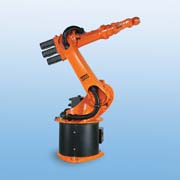
KR 6 robot.
Founded in 1962, Reinhardt-Technik is a major supplier of dispensing and mixing equipment located outside of Dortmund, Germany. Recently, the company needed to automate a process for preparing car headlights for bonding that could be easily adapted to changes in the headlight models without affecting the cell's efficiency.

To solve this problem, a system using two six-axis KUKA robot was developed. One KR 6 six-axis robot was employed, which uses a plasma treatment to improve the adhesive properties of the plastic headlight housing. A KR 30 six-axis robotwas used to apply the adhesive.

An operator places the headlight housings on carriers, which transport them on a conveyor into the cell. Before the first station is reached, the controller monitors whether a headlight is present and, if so, whether it is the left or right headlight. A computer transfers this information to the KR 6 robot. The robot then applies the plasma treatment by using a torch nozzle to spray ionized air into the groove of the plastic component, thus increasing the surface tension of the material and enabling the adhesive to bond better.

While the carrier is moving from the plasma and bonding stations, the KR 30 robot receives a message about the type of headlight and whether it has been sprayed with plasma. If it has not, it is moved through the bonding station without further treatment. If the headlight has been sprayed with plasma, the robot applies a highly viscous, non-free-flowing two-part silicone adhesive. Filling of the groove, which is slanted in most places, can only be carried out by a jointed-arm robot with six axes. While moving about the component, the robot has to hold the nozzle of its mixing and application unit perpendicular to the bottom of the groove at all times. Otherwise, the required bead geometry would not be possible since the downward motion of the nozzle would ruin the bead.
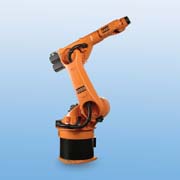
A KR 30 robot.
Reinhardt-Technik installed the dispensing module for the adhesive on axis 4 of the KUKA KR 30 robot, and the mixing unit on axis 6. This ensured reproducible traversing velocity and a short supply line for the adhesive - important for precise dispensing. If too little adhesive is applied, the headlight in question will not be seal-tight; if too much adhesive is applied, the unit will be rejected. After the adhesive has been applied, the carrier moves out of the cell and to an unloading position, where an employee fits the polycarbonate lens onto the plastic component and removes the now-finished headlight.

Reinhardt-Technik found that their new automated cell provided an efficient system that not only accurately produced up to five headlights per minute, but also had the added benefit of adapting quickly and simply to changes in models. Changing the system is done by simply exchanging carriers and selecting a corresponding program. All in all, the implementation of the KUKA robots proved to be a successful project that improved quality, increased production and cut costs.

For more information, contact KUKA Robotics Corp., 22500 Key Drive, Clinton Township, MI 48036; phone (866) USE-KUKA; fax (866) FAX-KUKA; e-mail info@kukarobotics.com; or visit http://www.kukarobotics.com.

Share This Story

Looking for a reprint of this article?
From high-res PDFs to custom plaques, order your copy today!
Recommended Content

JOIN TODAY
to unlock your recommendations.

Already have an account? Sign In

  • 2026 ASI Top 20: Leading Global Adhesives and Sealants Manufacturers

    2026 ASI Top 20: Leading Global Adhesives and Sealants Manufacturers

    Every year, we study the leading worldwide manufacturers...
    Finished Adhesives and Sealants
    By: Karen Parker
  • PSA Market

    Trends and Opportunities in Pressure-Sensitive Adhesives: Sustainability, Innovation, and Market Growth

    The pressure-sensitive adhesives market is growing...
    Pressure-Sensitive Adhesives (PSAs)
    By: Parag Shah and Chirag Tripathi
  • science test tubes

    2026 Adhesives and Sealants Raw Materials Roundup

    After more than two years of contraction, the...
    Sustainability
    By: Karen Parker
Manage My Account
  • eMagazine Issues
  • Newsletters
  • Online Registration
  • Manage My Preferences
  • Subscription Customer Service

More Videos

Sponsored Content

Sponsored Content is a special paid section where industry companies provide high quality, objective, non-commercial content around topics of interest to the Adhesives and Sealants Industry audience. All Sponsored Content is supplied by the advertising company and any opinions expressed in this article are those of the author and not necessarily reflect the views of Adhesives and Sealants Industry or its parent company, BNP Media. Interested in participating in our Sponsored Content section? Contact your local rep!

close
  • Assembly automation for medical device manufacturing
    Sponsored byNordson EFD

    Three Proven Principles Powering Quality Assembly

Popular Stories

Image of a computer keyboard with the letters N E W S highlighted

Huntsman to Merge with Olin, Creating $12 Billion Chemicals Leader

Image of a computer keyboard with the letters N E W S highlighted

H.B. Fuller Announces Offer to Buy Advanced Medical Solutions Group

Picture of the words Ask 3M in red and white

3M Launches AI-Powered Tool That Provides Access to Technical Expertise

ASI 2026 Top 20 Adhesives & Sealants List

Events

September 15, 2026

Coatings Trends & Technologies Summit

This annual Midwest coatings conference combines all of the high-quality technical presentations, exhibits and networking opportunities from the Coatings Trends and Technologies and Powder Coating Summit conferences into one new event. The event caters to both liquid and powder coatings formulators and manufacturers.

September 16, 2026

World Adhesive & Sealant Conference (WAC) 2026

As the industry’s premier international event, WAC 2026 offers a unique opportunity for professionals from every continent to connect, collaborate, and shape the future of the sector.
View All Submit An Event

Products

Structural Adhesives: Properties, Characterization and Applications

Structural Adhesives: Properties, Characterization and Applications

See More Products

Related Articles

  • close up of laser

    Sourcing Assembly Adhesives: A Case Study for End Users

    See More
  • Pursuing Profitable Growth Strategies: A Case Study in Value Creation

    Pursuing Profitable Growth Strategies: A Case Study in Value Creation

    See More
  • 3M Case Study

    Case Study: A Standardized Bonding and Application Solution

    See More

Related Products

See More Products
  • thirdedition.jpg

    Handbook of Adhesive Technology, Third Edition

  • Optimizing Social Media from a B2B Perspective

  • Adhesive Bonding: Materials, Applications and Technology

See More Products

Events

View AllSubmit An Event
  • June 20, 2012

    Spray Polyurethane Foam Case Study: On-site MDI Monitoring

    MDI (polyisocyanurate) and recommended safety considerations will be covered as they relate to a home weatherization upgrade.
View AllSubmit An Event

Related Directories

  • Azelis Americas CASE

    Specialty chemical distributor in the U.S. CASE market providing superior technical service, quality products, end-market expertise, and application labs.
×

Keep the info flowing with our newsletters!

Get the latest industry updates tailored your way.

JOIN TODAY!
  • RESOURCES
    • Advertise
    • Contact Us
    • Directories
    • Manufacturing Division
    • Store
    • Want More
  • SIGN UP TODAY
    • Create Account
    • eMagazine
    • Newsletters
    • Customer Service
    • Manage Preferences
  • SERVICES
    • Marketing Services
    • Reprints
    • Market Research
    • List Rental
    • Survey & Sample
  • STAY CONNECTED
    • LinkedIn
    • Facebook
    • Youtube
    • X (Twitter)
  • PRIVACY
    • PRIVACY POLICY
    • TERMS & CONDITIONS
    • DO NOT SELL MY PERSONAL INFORMATION
    • PRIVACY REQUEST
    • ACCESSIBILITY

Copyright ©2026. All Rights Reserved BNP Media, Inc. and BNP Media II, LLC.

Design, CMS, Hosting & Web Development :: ePublishing