Adhesives Mag logo
search
cart
facebook twitter linkedin youtube
  • Sign In
  • Create Account
  • Sign Out
  • My Account
Adhesives Mag logo
  • NEW PRODUCTS
  • NEWS
    • Adhesives & Sealants Headlines
    • Mergers/Acquisitions
    • Market Trends
    • TOP 20
  • TOPICS
    • Finished Adhesives and Sealants
    • Pressure-Sensitive Adhesives (PSAs)
    • Coatings
    • Raw Materials and Chemicals
    • Materials Handling/Processing
    • Meter/Mix/Dispense
    • Curing
    • Testing/Quality Control
    • Packaging of Adhesives & Sealants
    • Converting/Packaging
    • Composites
    • Sustainability
  • EVENTS
    • MAX
    • ASI Academy
    • Events Calendar
  • COLUMNS
    • European Perspectives
    • Strategic Solutions
    • Supply Chain Strategies
    • Tape Talk
  • MULTIMEDIA
    • Videos
    • Podcasts
    • Webinars
    • eBooks
  • EXPLORE
    • Adhesives in Action
    • Blog
    • ASI Store
    • Industry Links
    • Market Research
    • Classifieds
  • DIRECTORIES
    • Buyers' Guide
    • Global Adhesives & Sealants Directory
    • Raw Materials, Chemicals, Polymers and Additives Handbook
    • Equipment Handbook
    • Distributor Directory
  • EMAGAZINE
    • EMAGAZINE
    • ARCHIVE ISSUES
    • ADVERTISE
      • Custom Content & Marketing Services
    • CONTACT
  • SIGN UP!

THE JOINING OF MEDICAL PLASTICS
By Rory Wolf
February 27, 2006


When Alexander Parkes developed the first man-made plastic in the 1860s, he had no idea what an integral role the material would come to play in daily life. Plastics today play an important part in cutting-edge technologies such as the space program, bullet-proof vests and prosthetic limbs, as well as in everyday products like beverage bottles, automobiles, and particularly medical devices.

Plastics use in medical devices has sustained an average annual growth rate far in excess of the Gross Domestic Product (GDP). U.S. demand for medical plastics will increase nearly 3% per year to 3.6 billion pounds in 2008, valued at $5.0 billion.

Key drivers of medical plastics usage include the following.

  • Aging of the U.S. population
  • Continuing cost reduction pressures in the healthcare field
  • Advances in polymer performance
  • Introduction of new and often life-saving devices
  • Environmental/disposable/non-disposable medical device triad
The strongest advances in plastics usage are expected for engineered resins such as polycarbonate and thermoplastic elastomers, which have favorable cost-performance benefits. Polypropylene, polyethylene, polyurethane and polyvinyl chloride will retain leading positions in non-invasive medical products and standard medical packaging due to their low cost and amenability to radiation sterilization. Inherently, however, polyolefins are difficult materials to effect surface bonding. Polypropylenes, for instance, are crystalline and, although they have excellent thermal and chemical resistance properties and high moisture resistance, they are nonpolar. As such, polypropylenes are a difficult substrate to bond since they feature no surface functional sites or inherent surface roughness to which an adhesive can secure itself. In addition, polypropylenes are linear or branched carbon chain polymers, have low surface energies and low porosity.

Hard-to-bond plastics like polyolefins are most often assembled using adhesives. While adhesives are the most versatile assembly method for plastics, only a few industrial adhesives offer suitable bond strengths on hard-to-bond plastics. Cyanoacrylate, light-curing cyanoacrylate, hot-melt and light-curing acrylic adhesives have typically been used with typical difficult-to-bond plastics.

To make an adhesive formulation, the fluid adhesive should have a surface tension no higher (and preferably 10 mN/m lower) than the critical surface tension of the solid adherend.

Adhesion impediments with medical plastics include:

  • Low surface tension
  • Migration of formulation components
  • Mold release agents
  • Low temperaturev
  • UV light
  • Mechanical stresses
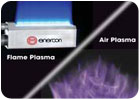
Air plasma systems apply discharge to the surface of medical plastics through an air gap by way of an electrode design. When air is exposed to different voltages, an electrical discharge develops, causing neutral and electrically charged molecules to collide. Collisions cause neutral molecules to become electrically charged, resulting in filamentary discharges that create a cloud of ionized air, or an "air plasma." Electrons bombard the treatment surface with energies 2 to 3 times that necessary to break the molecular bonds on the surface of most substrates. The resulting free radicals react rapidly with other free radicals on the same or different molecular chain, resulting in crosslinking. Oxidative effects increase surface energy as a result of polar groups being created on the surface, primarily in the form of hydroxyl groups, carbonyl groups, amide groups and carboxylic acid.

Flame plasma systems are comprised of a combustion/electrical station and a burner assembly, manufactured with two primary burner configurations: ribbon and enhanced velocity. A flame plasma is formed when a flammable gas and atmospheric air are combined and combusted to form an intense blue flame. Medical plastics are made polar as species in the flame plasma affect electron distribution and density on the surface. Polar functional groups such as ether, ester, carbonyl, carboxyl and hydroxyl are contained in a flame plasma; these are incorporated into the surface and affect the electron density of the polymer material. This polarization and functionalization is made through reactive oxidation of a surface.

Atmospheric chemistry plasma systems generate a chemical plasma field in an electrically charged atmosphere. This method blends gases that deposit various chemical groups on the substrate surface to improve its surface energy. Chemical plasma treatment is essentially a nano-cleaning, micro-etching and functionalizing process that provides different surface characteristics depending on the gas chemistry employed.

For more information on surface treatment, contact Enercon Industries at (262) 255-6070, e-mail info@enerconind.com, or visit www.enerconind.com.

Polymers:    gc (20°C): mN/m:
Polymers:Poly(tetrafluoroethylene)   gc (20°C): mN/m:18
Polymers:Silicone, polydimethyl   gc (20°C): mN/m:24
Polymers:Poly(ethylene)   gc (20°C): mN/m:31
Polymers:cis-Poly(isoprene)   gc (20°C): mN/m:31
Polymers:Poly(styrene)    gc (20°C): mN/m:33
Polymers:Poly(vinyl alcohol)   gc (20°C): mN/m:37
Polymers:Poly(methyl methacrylate)   gc (20°C): mN/m:39
Polymers:Poly(vinyl chloride)   gc (20°C): mN/m:40
Polymers:Poly(acrylonitrile)   gc (20°C): mN/m:44
Polymers:Amine-cured epoxide   gc (20°C): mN/m:44
Polymers:Poly(ethylene terephthalate)   gc (20°C): mN/m:45
Polymers:Cellulose   gc (20°C): mN/m:45
Polymers:Poly(hexamethylene adipamide)
Polymers: (nylon 6,6)   gc (20°C): mN/m:46

Share This Story

Looking for a reprint of this article?
From high-res PDFs to custom plaques, order your copy today!

Rory Wolf is vice president of Business Development for Enercon Industries.

Recommended Content

JOIN TODAY
to unlock your recommendations.

Already have an account? Sign In

  • mouse in hole

    Using Foam Sealants for Pest Prevention

    According to the National Pest Management Association,...
    Finished Adhesives and Sealants
    By: Kevin Corcoran
  • linked network nodes

    Using the Power of AI for Adhesive and Sealant Formulation

    With the help of software solutions, adhesive formulators...
    Raw Materials and Chemicals
    By: Karen Parker
  • top20-hero.jpg

    2024 ASI Top 20: Leading Global Manufacturers of Adhesives and Sealants

    ASI's annual ranking of the top 20 global adhesive and...
    Pressure-Sensitive Adhesives (PSAs)
Manage My Account
  • eMagazine Issues
  • Newsletters
  • Online Registration
  • Manage My Preferences
  • Subscription Customer Service

More Videos

Popular Stories

image of a graph representing markets

Sika Announces Acquisition of Gulf Seal in Saudi Arabia

Picture of two men and one woman in dark suits

Bodo Möller Chemie Makes Management Change for CASE Business Unit

news on internet screen

Henkel Posts Positive Organic Growth for Third Quarter, Driven by Adhesives Technologies Business

ASI Top 20 website

Events

January 1, 2030

Webinar Sponsorship Information

For webinar sponsorship information, visit www.bnpevents.com/webinars or email webinars@bnpmedia.com.

View All Submit An Event

Products

Structural Adhesives: Properties, Characterization and Applications

Structural Adhesives: Properties, Characterization and Applications

See More Products

ASI CASE EBOOK

Related Articles

  • Joining Technology of the Future

    See More
  • Adhesive Technologies for the Assembly of Hard-to-Bond Plastics

    See More
  • image of confetti in air

    The Association of Plastics Recyclers Recognizes Three Dow Laminating Adhesives

    See More

Related Products

See More Products
  • handbook advesives and sealants.gif

    Volume 1: Handbook of Adhesives and Sealants, 1st Edition

  • handbk-of-ad-and-surface-pr.gif

    Handbook of Adhesives and Surface Preparation

  • technology-of-pressure-sens.gif

    Technology of Pressure-Sensitive Adhesives and Products

See More Products

Related Directories

  • Plastics Industry Association

×

Keep the info flowing with our newsletters!

Get the latest industry updates tailored your way.

JOIN TODAY!
  • RESOURCES
    • Advertise
    • Contact Us
    • Directories
    • Manufacturing Division
    • Store
    • Want More
  • SIGN UP TODAY
    • Create Account
    • eMagazine
    • Newsletters
    • Customer Service
    • Manage Preferences
  • SERVICES
    • Marketing Services
    • Reprints
    • Market Research
    • List Rental
    • Survey & Sample
  • STAY CONNECTED
    • LinkedIn
    • Facebook
    • Youtube
    • X (Twitter)
  • PRIVACY
    • PRIVACY POLICY
    • TERMS & CONDITIONS
    • DO NOT SELL MY PERSONAL INFORMATION
    • PRIVACY REQUEST
    • ACCESSIBILITY

Copyright ©2025. All Rights Reserved BNP Media.

Design, CMS, Hosting & Web Development :: ePublishing