Converting to Electron Beam Technology
Interest in EB technology has grown significantly in recent years.
The world continues to embrace initiatives fostering more environmentally friendly “green” processes, and the converting industry is not exempt from this pursuit.
| Jump to: |
All aspects of the converting process are being scrutinized, including the need to make the adhesives and sealants component of converting more environmentally friendly. To this end, the industry is working to use fewer volatile organic compounds (VOCs), thus reducing emissions and odors that can contribute to things like respiratory issues and compromised air quality.
Certainly the adhesives and sealants themselves are a worthy target for green innovation. In recent years, adhesive and sealant formulators and manufacturers have made great strides in improving their formulations, not only increasing product quality and durability, but also reducing VOC emissions.
A second, perhaps less obvious target for greener adhesive and sealant use in converting lies in the curing processes being used. As the industry is beginning to realize, not all converting processes are created equal. Electron beam (EB) curing technology has grown to become an influential option for forward-thinking converters, especially those that harness web technology. Among its numerous advantages over other curing methods, EB technology produces almost no VOCs, unlike oven-based (thermal) curing.
How EB Curing Works
In an EB system, clouds of electrons are generated in a vacuum chamber using an electronically charged filament, usually tungsten. These electrons are then accelerated through a thin, metallic foil window and are directed onto a moving web surface at atmospheric pressure. These accelerated electrons ionize most organic materials, leading to the formation of free radicals that induce crosslinking of polymers or initiate polymerization of liquid monomers and oligomers (called curing). Crosslinking can be effective for improving the properties of polymers.
Curing results in the instantaneous “drying” of an ink, coating or adhesive. EB systems are used primarily in the curing of printing inks and coatings for packaging applications; curing coatings on metal, wood and composite building material substrates; curing adhesives in the lamination of film and/or foil to paper for packaging; crosslinking plastic shrink films; and crosslinking of hot-melt pressure-sensitive adhesives (HMPSAs).
An alternate to ultraviolet (UV) curing and thermal drying, EB technologies have been used in industrial applications for more than 30 years. During this time, printers and converters have documented numerous real-world advantages enabled by EB technology, including improved product performance, superior product consistency, higher process throughput, and greater energy savings. Additional advantages include:
• EB curing is able to penetrate thicker or more opaque materials more effectively than UV.
• EB machines generate very little heat in the substrate, making them a superior choice over thermal and UV curing for heat-sensitive materials like thin films.
• Unlike UV, EB technology does not require a photoinitiator in its curing process.
• EB technology does not produce VOCs like thermal curing.
• EB provides higher conversion and more consistent output while offering more efficient energy usage than other drying or curing technologies.
Trends in EB Technology
Interest in EB technology has grown significantly in recent years because of the increased availability of EB-friendly adhesives, coatings, inks and other materials,
Interest in EB technology has grown significantly in recent years because of the increased availability of EB-friendly adhesives, coatings, inks and other materials, as well as increased affordability. In the past, EB machines were large and could be very expensive. |
as well as increased affordability. In the past, EB machines were large and could be very expensive. Customers requested that smaller, less expensive EB systems be developed to provide cheaper, easier and less cumbersome integration directly into existing and new process lines. Equipment providers have responded to these requests by introducing innovative new designs that leverage advances in technology and years of industrial EB system experience.
Integrated Shield Roll Design
One innovative new design uses a “shield roll” for proper radiation shielding. This patented design uses a temperature-controlled roll to support the material while the roll simultaneously serves as a functional portion of the required shielding. The results are reduced size and materials, minimization of the volume that must be made inert with nitrogen, and easier machine access for threading and cleaning.
Low Profile
An important printing technology that has emerged in recent years involves the use of variable sleeves on web offset presses. This style of press requires the accompanying EB system to accept a low web entry height. The latest EB system designs accommodate these web handling requirements and maintain a “side fire” orientation, which is preferred for the maintenance access that is required to perform a window foil change.
Extended Voltage Low Energy Systems
The first generation of more compact, lower cost EB equipment was introduced about 10 years ago. This equipment operated in the range of 80-125 kV, which was suitable for curing relatively thin layers of inks and coatings. Curing adhesives for lamination or crosslinking of thicker materials requires industrial EB processors operating from 150-300 kV.
In recent years, compact equipment has been introduced that can operate at up to 150 kV. This range has now been extended up to 175 kV. These higher energies allow one-side treatment of materials up to 150 g/m2 (150 microns for materials with a density of 1.0 g/cm3).
Integrated Converting
Another key evolution in EB’s role in the converting process extends beyond its traditional curing and crosslinking capabilities. With the addition of a recently developed integrated converting line, package printers can now also harness an EB machine to create innovative package design enhancement capabilities. An integrated converting line offers four interchangeable package enhancement operation modes, including coating, laminating, cold foil transfer and Cast and Cure™.
Cast and Cure from Breit Technologies is a decorative coating process that offers decorative effects such as ultra-high gloss, matte and holographic images on a variety of substrates. It also has anti-counterfeiting applications. It has proven to be a low cost, environmentally friendly process that uses reusable film to micro-emboss decorative effects into the surface of energy-curable varnishes.
Crosslinking of PSAs
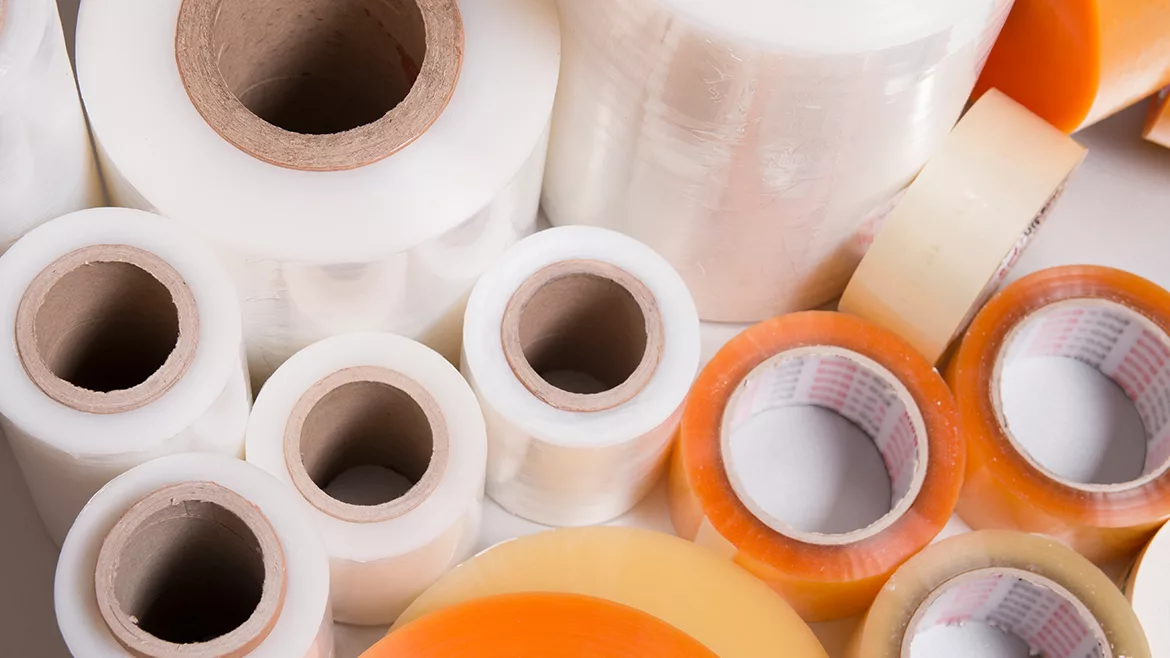
Many high-performance pressure-sensitive tapes are produced by coating adhesive polymers from solvent-based solutions. These solvent coating lines must be equipped with incinerators to prevent VOC emissions. Hot-melt adhesive technology is very environmentally friendly since no solvents are used. The main disadvantage of hot-melt adhesives is the relatively low performance of these non-crosslinked systems.
EB can be used to crosslink certain types of hot-melt polymers after application to the tape substrate. Low-energy EB systems operating up to 175 kV can effectively penetrate even relatively thick adhesive layers. This crosslinking dramatically increases the tape performance properties, particularly the temperature resistance, chemical resistance and shear properties.
Exciting Times
In what many call a tepid economy, package converting continues to put up strong numbers, and analysts predict healthy growth will continue for some time. Sealants and adhesives continue to set the pace, and continued development of new, innovative products will help contribute to any gains in the coming years. For suppliers and manufacturers that arm themselves with versatile technologies like EB to help evolve new products and production techniques, this is a very exciting time to be involved in package converting.
For more information, visit www.teampct.com.
Looking for a reprint of this article?
From high-res PDFs to custom plaques, order your copy today!