Testing Adhesives: Force Measurement to the Rescue
Recent advancements in force measurement can help adhesives manufacturers keep up with changing customer demands.
The global pandemic has accelerated demand for manufactured goods of many types, as consumers stay home and manufacturers continue to operate as essential businesses. Adhesives of all stripes make it possible to join parts together, seal shipping cartons, secure packaging, and much more. Force measurement increases adhesives manufacturers’ confidence by providing the data to determine whether their products are acceptable or might cause issues down the road.
What is Force Measurement?
Force measurement is the measure of a push (compression) or pull (tension) against an object. The term is often used interchangeably with materials testing and tensile testing, but important distinctions abound.
Materials testing is the scientific analysis of materials such as metals, elastomers, and textiles, usually requiring the determination of stress, strain, modulus of elasticity, elongation, and other calculations. While important to the manufacturers of materials, and sometimes to the users of such materials, many day-to-day applications can be achieved with force measurement equipment, which is generally simpler and less expensive to operate.
Force measurement equipment is commonly employed to test components and assemblies, such as the adhesive strength of tape or the pull-off strength of two joined components. Adhesives manufacturers measure force to ensure end user safety and compliance, assist with product design and improvement, and validate quality.
End User Safety
Manufacturers keep end users in mind, as their reputation and legal responsibility are on the line. High/low acceptance criteria or minimum force requirements are used to mitigate risk and predict successful performance in the field.
Compliance
Compliance is an ever-increasing burden on industry, as the web of local, national, and international standards and regulations expands. In certain sensitive industries, such as medical device and aerospace, adhesives and sealant strength must satisfy norms to avoid penalties or restricted market access.
While ensuring compliance can be burdensome, much of the work has already been done via the multitude of force measurement standards and methods prescribing how to accomplish particular objectives. Depending on the particular product, industry, and customer base, the manufacturer may follow ISO, ASTM, DIN, or other industry-specific standards. Test methods define test equipment, sample preparation, and how to interpret results.
Established standards sometimes don’t meet a manufacturer’s particular needs. In these cases, companies also develop their own internal test methods to ensure baseline quality metrics.
Product Design and Improvement
The oft-used expression “innovate or die” applies now more than ever. Data obtained through force measurement can help inform product designers, giving them empirical evidence to recommend new products for production.
Quality Validation
The role of a quality department is to make sure that a product is manufactured in conformance to agreed-upon standards. Force measurement data helps isolate problematic individual products, lots, or batches. Armed with this data, quality control and engineering professionals can determine the source of the problem, whether it’s a design issue, material defect, production problem, or other cause.
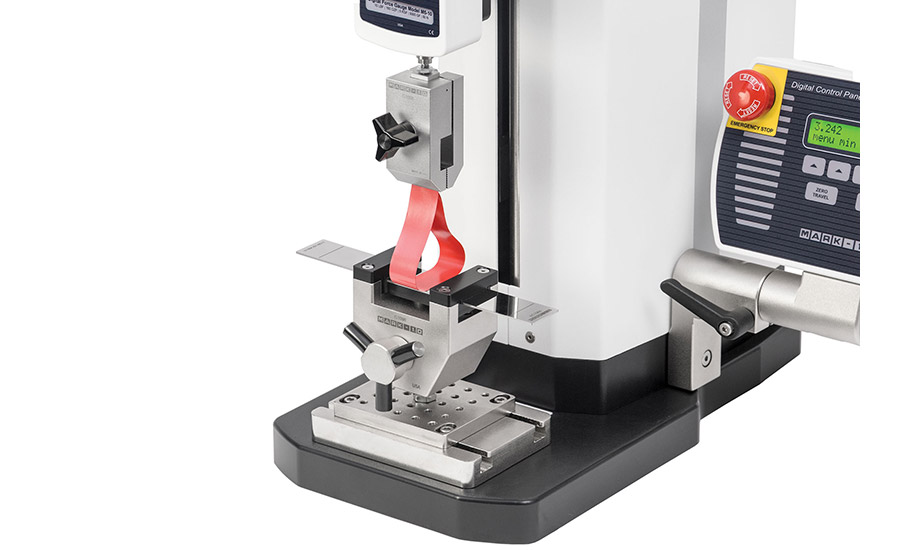
In a loop tack test, a loop with the adhesive side out is lowered to a surface and then pulled up at the loose ends to measure the maximum force.
Example Applications
Adhesive manufacturers conduct force measurements in different ways, depending on the product in question and the end-use application. The ubiquitous T-peel test measures the separation force of adhesive labels against their backing. The expectation is that the bond strength between the label and the backing is sufficient to prevent premature separation while still being easy enough to remove. In addition, removal force should be consistent from batch to batch to prevent downstream issues with label application on packaging lines.
To test, a length of the roll is cut and then separated just enough to allow grips to secure the two loose ends. The sample is pulled apart, and the force is measured. The maximum force may be considered most important by some users, while others require a graph of force vs. distance or force vs. time.
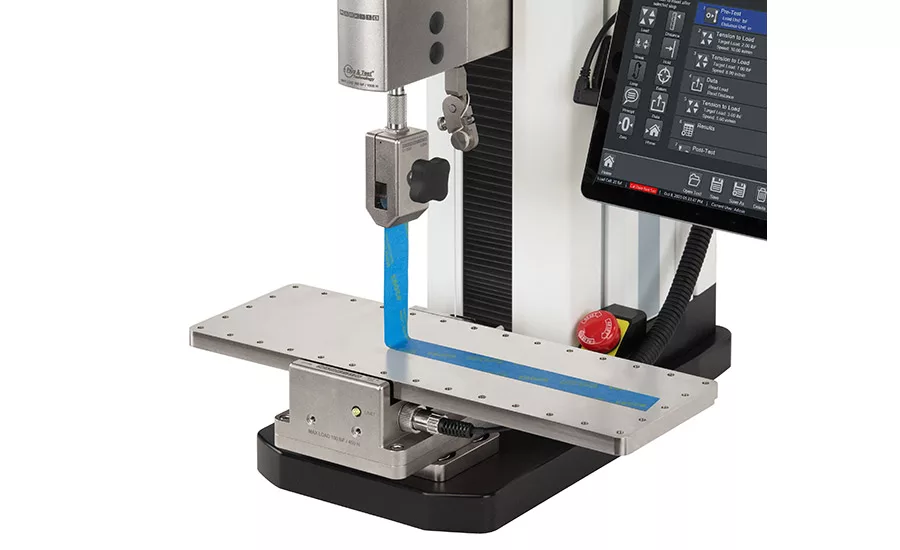
A 90° peel test can be used to simulate real-world applications. Here, tape may be peeled at a consistent 90° or other angle via specialized fixtures. Tape is applied to the surface of the fixture, and the loose end is then secured by a grip. As the grip pulls upward, the fixture moves horizontally, maintaining the desired angle for the duration of the test.
Another type of peel testing is the loop tack test. This approach involves forming a loop with the adhesive side out, lowering the loop to a surface, and then pulling up at the loose ends to measure the maximum force.
In these applications, the average force may be interesting to many companies to ensure that the adhesive is applied evenly to a given length of tape. Unevenly applied adhesive could cause issues with insufficient or excessive adhesive strength.
Coefficient of friction testing is often used for coatings applications. Coatings are an important part of many products, from packaging materials to bearings to tile flooring. Whether to protect the item or to provide the desired sliding resistance or tactile feel, the frictional properties of coatings should be quantified to ensure manufacturing consistency.
In coefficient of friction (COF) testing of films and paper, a sample is wrapped around a sled of a given weight (usually 200 g). Another piece of the same material is clamped to a surface. As the wrapped sled is pulled across the clamped material, the ratio of the downward force to the resistive force is calculated as the COF. COF testers calculate both the static COF (maximum force) and dynamic COF (average force over the course of the test).
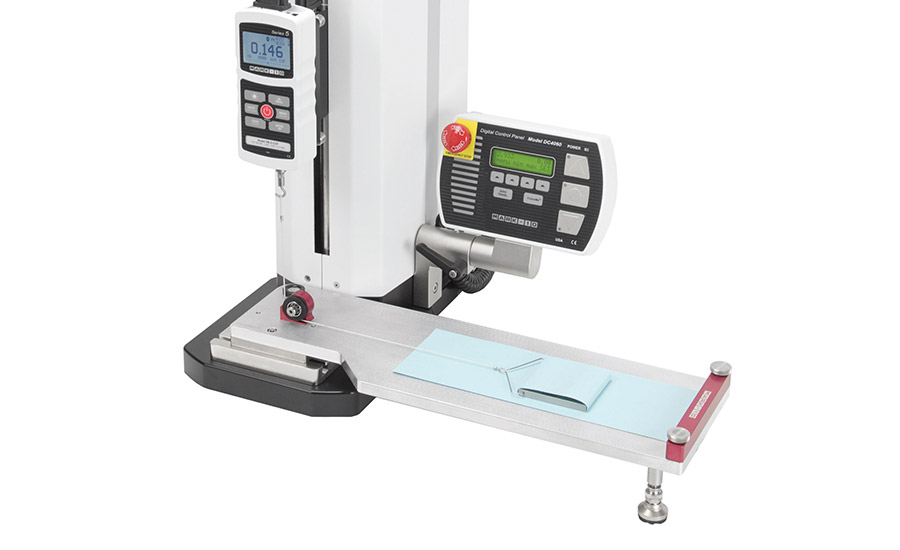
Coefficient of friction (COF) testers calculate both the static COF (maximum force) and dynamic COF (average force over the course of the test).
Test Equipment
The above application examples touch upon the physical motions and measurements that are required to perform the test. An equipment selection can be made after defining the test objective, estimating the expected maximum force, determining the sample size, and estimating how much the sample will deform or deflect. Force measurement equipment generally consists of a test frame of suitable force capacity (motorized or manually driven), a force sensor of suitable force capacity, grips and fixtures, and data collection software.
Test Frame
A test frame uses an actuator to produce compression and tension forces. Its speed can be regulated to ensure that tests are being performed repeatably and according to the test method.
Test frames are available in a range of force capacities. For longer or wider samples, single- and double-column extensions increase the working height and depth. Some test frames feature modular designs that allow for custom mounting to the edge of a workbench or to other surfaces.
Force Sensor
Force sensors (also referred to as load cells) measure tension and compression forces. They are offered in many force capacities, typically from as low as 50 gF (gram-force) full scale to thousands of lbF (pound-force). In the U.S., the most common unit of measurement is lbF, while N (Newtons), kN (Kilinewtons), and kgF (kilogram-force) prevail in other countries. Force measurement systems have selectable units of measurement to accommodate local preferences.
Choosing an appropriate capacity is one of the most important considerations in selecting a sensor. As a general rule, a sensor should be used at no less than approximately 5-10% of its range. For example, an application requiring 8 lbF is best served by a 10 lbF-capacity model. A 1,000 lbF-capacity sensor would yield lower accuracy and coarser data resolution.
Grips and Fixtures
The above application examples highlight three grip and fixture types commonly used in the adhesives and sealants industry. Globally, there are many more examples of force measurement applications.
Fortunately, force measurement manufacturers have developed an extensive library of generalized and application-specific grips and fixtures. In cases where a standard solution is not available, manufacturers have fabricated their own. The advent of 3D printing has made custom fixturing much easier, especially in lower force applications.
Software
Recent innovations in force measurement software have increased testing efficiency and sophistication. Traditional force measurement equipment, such as test stands, force gauges, and standalone software, offer universality for many uses, but extracting, presenting, and analyzing data can be more challenging.
Newer force measurement systems integrate the force sensor and software into one system, governed by a single software application. Such applications display the basics (force, distance, and time) while also providing a user interface to design the test, analyze results, export data, and generate a report. For complex applications requiring cyclical testing or custom combinations of push and pull sequences, multi-step scripting allows the user to customize a test without any programming knowledge.
Results are displayed on a graph. It may be considered important for average force tests and dynamic COF testing to visualize problematic areas of the sample. For maximum force tests, the results table may be of more use. Pass/fail indicators and tabulated results make it easy to determine the status of a run or batch and to generate a report or data export.
Looking Forward
The universality of today’s force measurement technology allows adhesives manufacturers to stay ahead of rapidly changing global market disruptions and dynamic customer needs. By accurately and repeatably testing products according to proven test methods and procedures, manufacturers can be more confident in the quality and performance of their products.
For additional information, contact the author at (631) 842-9200 or mf@mark-10.com, or visit www.mark-10.com.
Note: Photos courtesy of Mark-10 Corporation.
Looking for a reprint of this article?
From high-res PDFs to custom plaques, order your copy today!