Equipping the Concrete Industry with Corrosion-Inhibiting Sealers
Whether protecting new, existing, or repaired concrete from deterioration, sealers/water repellents can play an important role in durability for the construction industry.

The past 20 years have seen the increasing use of concrete sealers in the construction industry. Sealers are applied to concrete primarily to keep water and water-soluble compounds from entering the concrete through the surface pores.
As more is understood about alkali-silica reactions (ASR) and alkali aggregate reactions (AAR), sealers have been found to be a cost-effective way of mitigating those issues. They are also used to protect reinforcing steel from corrosion within concrete. For those involved in concrete design and maintenance, it is important to be aware of this enhanced concrete water-repellent technology and be equipped with best practices to ensure effective application.
Understanding the Options
Concrete sealers come with a variety of different features. The most basic function is to protect against the ingress of moisture, carbonation, and other potentially damaging elements. Others add stain resistance or corrosion inhibition.
Inhibiting corrosion is especially needed in applications where there is exposure to sea air with elevated humidity and chloride levels or in northern climates where there is a need for deicers. As cities, counties, and states that experience harsh winters are switching to liquid deicing brines instead of granular ones, more chlorides are entering concrete surfaces at a faster rate than ever. This trend is accelerating damage due to freeze-thaw cycles and the corrosion of reinforcing steel, leading to the heightened need for sealers with corrosion inhibitors.
In recognition of the importance of corrosion inhibitors that can be applied to existing concrete surfaces, the International Concrete Repair Institute recently published Guideline No. 510.2-2019, “Guide for Use of Penetrating Surface Applied Corrosion Inhibitors for Corrosion Mitigation of Reinforced Concrete Structures.” It is a valuable handbook for anyone who wants to explore deeper into the various types of corrosion-inhibiting surface treatments available and how to apply them to concrete.
Migrating Corrosion-Inhibiting Sealers
Among the best water repellents for corrosion protection are those with migrating corrosion inhibitors. These chemistries are designed to migrate through the concrete pores to the level of the reinforcement and form a molecular corrosion-inhibiting layer on the metal surface to help slow the corrosion rate. While some corrosion-inhibiting sealers react with the concrete to form pore-blocking compounds that impede the ingress of contaminants, the best migrating corrosion-inhibitor water repellents continue to protect at the rebar level even when cracking occurs.
Depending on the project budget or other parameters, the engineer may choose from migrating corrosion inhibitors with either 40% silane or 100% silane and full breathability. Some migrating corrosion-inhibitor sealers offer stain resistance or non-etching features as well.
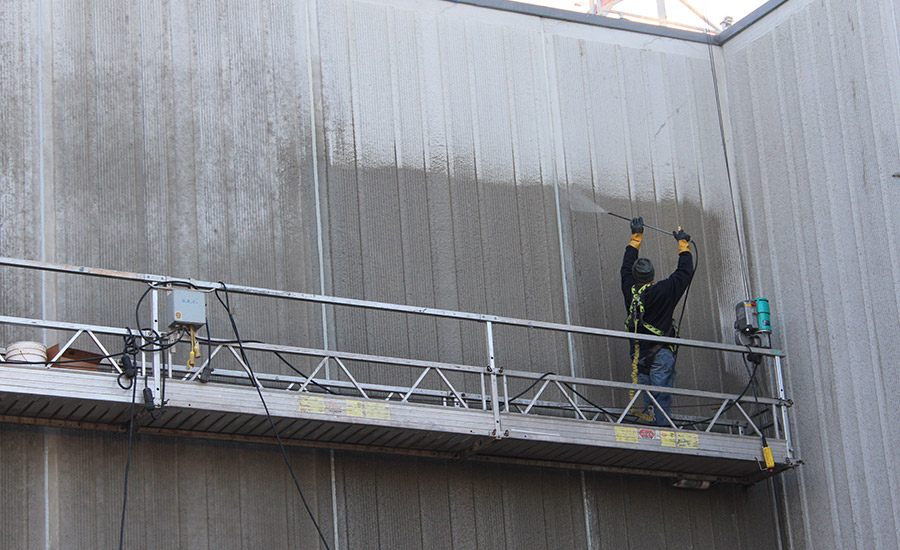
Routine maintenance application of a 100% silane water repellent with migrating corrosion inhibitors to a prefab concrete building.
Potential Applications
The possible applications where migrating corrosion-inhibiting water repellents can prove beneficial are endless: parking garages, bridges, water and wastewater treatment facilities, concrete grain silos, manufacturing plants, or just about any structure that contains reinforced concrete steel. These sealers can be used to enhance new or existing structures as part of a routine maintenance plan, or they can be used to fortify concrete repairs.
To evaluate their benefit for concrete repairs, two migrating corrosion-inhibitor sealers were studied by Tourney Consulting Group according to the U.S. Bureau of Reclamation M-82 (M0820000.714) “Standard Protocol to Evaluate the Performance of Corrosion Mitigation Technologies in Concrete Repairs.” The M-82 testing found that these two sealers were able to mitigate preexisting corrosion effectively at a statistically significant rate and were able to do so while starting from a higher combined microcell corrosion current value than typically required under the M-82 protocol.1,2
Practical Advantages of a Two-in-One Sealer
One example of the practical benefits of migrating corrosion-inhibiting water repellents for concrete repairs is the case of several residential halls at the University of Wisconsin. Built in 1970, the cast-in-place concrete residential towers were experiencing concrete spalling in 2015, as well as rust jacking in areas of inadequate concrete cover.
Instead of simply applying a standard 40% solids silane water repellent after repairs, as would have normally been done to inhibit moisture ingress, the project owner and engineer decided to use a water repellent with migrating corrosion inhibitors. They were pleased with the fact that it provided dual protection against moisture ingress and rebar corrosion with the use of one product. They were also happy with the sealer’s non-etching feature, which was critical for use around the recently replaced windows of all three towers.3
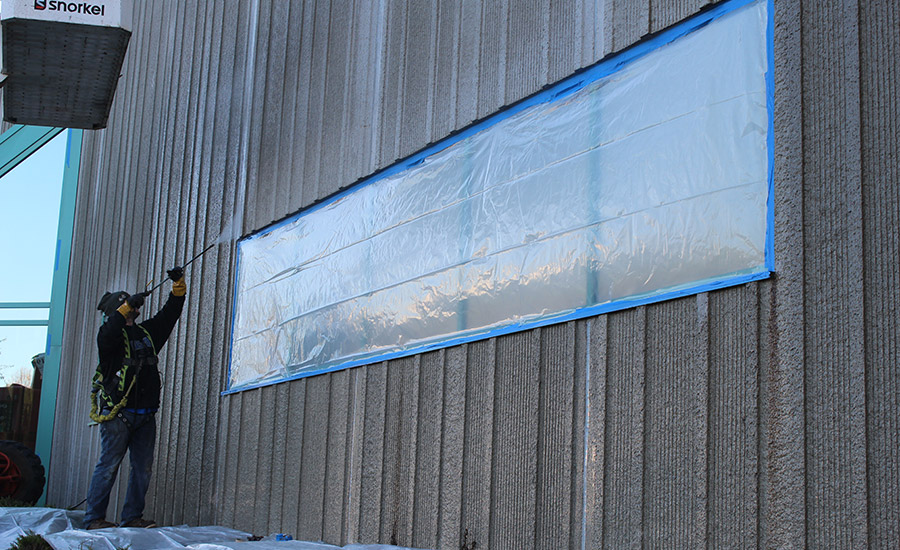
Some sealers require the masking of windows, while others have a non-etching feature that eliminates this step.
Ensuring Successful Application
As important as it is to choose a good sealer to mitigate current and future corrosion, proper application is also integral to the success of the product. One of the most basic but important steps is to ensure that concrete is sound, free of contaminants, and sufficiently dry before application.
Another important factor is to follow the manufacturer’s recommendations for using the right tools, application techniques, and coverage rates. The applicator should also evaluate how the ambient temperature, humidity, and potential for rain might affect application and whether it would be wise to postpone until better conditions are present.
After treatment, one of the simplest ways to confirm successful application is to spray the surface with water and do a quick visual check to make sure the concrete is not absorbing water but rather causing it to bead on the surface. Use of RILEM tubes is another common way to verify effectiveness. Sometimes “destructive” methods are used, such as taking a concrete core to detect penetration of the sealer to a desired depth. When properly treated, sound and non-defective concrete can typically be guaranteed protection for 7-10 years with the use of a migrating corrosion-inhibiting water repellent.
Equipped with New Tools for Enhanced Durability
Whether protecting new, existing, or repaired concrete from deterioration, sealers can play an important role in durability for the construction industry. The availability of water repellents with corrosion inhibitors and stain resistance amplifies their usefulness, and proper application promotes maximum effectiveness. With this knowledge in mind, individuals in the construction industry can move ahead equipped with better tools for extending the service life of concrete structures in corrosive environments.
For more information, email jholmquist@cortecvci.com or visit www.cortecmci.com.
Note: Opening image courtesy of georgeclerk via Gettyimages.com. Other images courtesy of Cortec Corp.
References
- Cortec Corp., “Three Cortec® MCI® Products Mitigate Ongoing Corrosion,” January 18, 2016, Saint Paul, Minn., www.cortecvci.com/whats_new/announcements/M-82%20MCI%20Testing%20PR.pdf.
- Tourney Consulting Group, “Re: USBR M-82 Evaluation of Surface Treatments, TCG Project # 14104,” August 31, 2015, Kalamazoo, Mich.
- Cortec Corp., “Restoration of UW Milwaukee Student Residence Halls,” Case History #590, April 2018, Saint Paul, Minn., www.corteccasehistories.com/?s2member_file_download=access-s2member-level1/ch590.pdf.
Looking for a reprint of this article?
From high-res PDFs to custom plaques, order your copy today!