Adhesives Mag logo
search
cart
facebook twitter linkedin youtube
  • Sign In
  • Create Account
  • Sign Out
  • My Account
Adhesives Mag logo
  • NEW PRODUCTS
  • NEWS
    • Adhesives & Sealants Headlines
    • Mergers/Acquisitions
    • Market Trends
    • TOP 20
  • TOPICS
    • Finished Adhesives and Sealants
    • Pressure-Sensitive Adhesives (PSAs)
    • Coatings
    • Raw Materials and Chemicals
    • Materials Handling/Processing
    • Meter/Mix/Dispense
    • Curing
    • Testing/Quality Control
    • Packaging of Adhesives & Sealants
    • Converting/Packaging
    • Composites
    • Sustainability
  • EVENTS
    • MAX
    • ASI Academy
    • Events Calendar
  • COLUMNS
    • European Perspectives
    • Strategic Solutions
    • Supply Chain Strategies
    • Tape Talk
  • MULTIMEDIA
    • Videos
    • Podcasts
    • Webinars
    • eBooks
  • EXPLORE
    • Adhesives in Action
    • Blog
    • ASI Store
    • Industry Links
    • Market Research
    • Classifieds
  • DIRECTORIES
    • Buyers' Guide
    • Global Adhesives & Sealants Directory
    • Raw Materials, Chemicals, Polymers and Additives Handbook
    • Equipment Handbook
    • Distributor Directory
  • EMAGAZINE
    • EMAGAZINE
    • ARCHIVE ISSUES
    • ADVERTISE
      • Custom Content & Marketing Services
    • CONTACT
  • SIGN UP!
Adhesives and Sealants TopicsSustainabilityRaw Materials and Chemicals

Striving for Sustainability

European Bio-Economy Experiencing Growth

The bio-economy in Europe is robust, as sales in bio-based industries are on the rise.

forest figure
January 19, 2022

The bio-based industries continue their ascent in the European bio-economy, marking a total contribution of €780 billion (approximately $874.9 billion). This figure is an increase of 4% compared to 2017 and more than 20% compared to 2008, which is the earliest data taken into account in this series of reports by nova-Institute. The first report of the series was commissioned by the Biobased Industries Consortium (BIC) in 2017. Since then, the report has been updated on an annual basis; this latest version covers the period from 2008 to 2018.


Sales Figures

The primary sectors (agriculture, forestry, and fisheries), as well as food, beverage, tobacco, and paper and paper products, can be considered fully bio-based and are thus fully accounted for in the bio-economy. For other manufacturing sectors (e.g., chemicals, pharmaceuticals, and textiles), the bio-based shares were estimated and included in the report’s assessment.

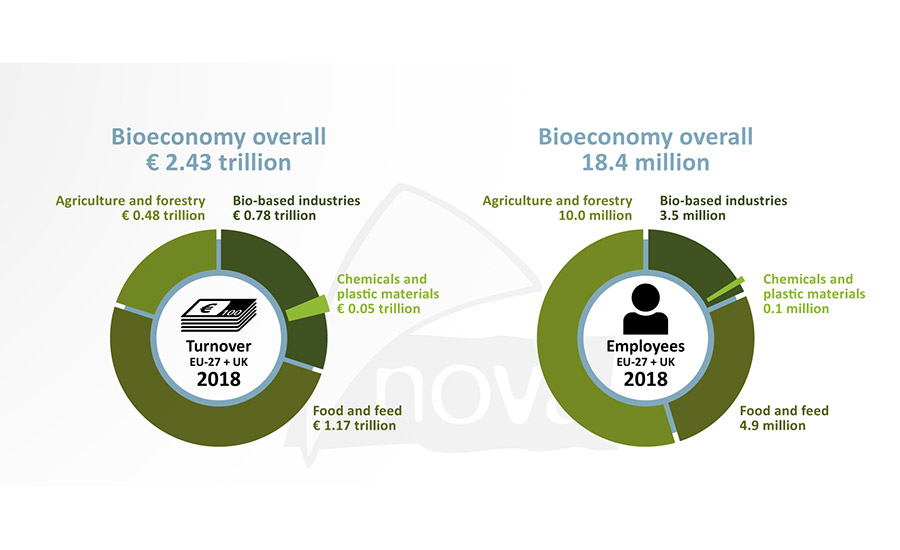
Figures for the bio-based chemical industry (including plastics) reveal a turnover of around €54 billion (~ $60.6 billion) with the bio-based share relatively stable at around 15%, an increase of 7.5% compared to 2008. An analysis of the 2018 Eurostat data shows that the turnover of the total bio-economy, including food and beverages and the primary sectors of agriculture and forestry, amounts to just over €2.4 trillion (~ $2.2 trillion) in the EU-27 and the UK. This represents an increase of around 25% since 2008.

The food and beverage sector accounts for about half of those sales, and the bio-based industries (e.g., chemicals and plastics, pharmaceuticals, paper and paper products, forest-based industries, textiles, biofuels, and bioenergy) account for roughly 30%. Almost another 20% was generated by the primary sectors of agriculture and forestry.
nova

Figure 1. European bio-economy sales and employees, 2018. (Image courtesy of nova-Institute GmbH.)


Employment Data

In contrast to the rising sales figures, employment in the European bio-economy declined slightly, from 18.5 million people in 2017 to a total of 18.4 million in 2018. This reduction is largely due to efficiency increases in production. The primary biomass production, mainly agriculture, provides a majority of the entire employment (54%) but comparatively low sales (20%).

The data also demonstrate clear differences between groups of member states. For example, the Central and Eastern European countries of Poland, Romania, and Bulgaria are more represented in the lower value-added sectors of the bio-based economy, which create many jobs. This indicates a strong agricultural sector that tends to be labor intensive compared to the high value-added sectors.

In comparison, Western and Northern European countries generate much higher turnover relative to employment, indicating a larger share of refining and value-added industries. The countries with the highest turnover-to-employment ratios are Finland, Belgium, and Sweden.


The full report is available free of charge at https://renewable-carbon.eu/publications.

Note: Opening image courtesy of metamorworks via iStock/Getty Images Plus.

KEYWORDS: bio-based materials general business sustainable manufacturing

Share This Story

Looking for a reprint of this article?
From high-res PDFs to custom plaques, order your copy today!

Recommended Content

JOIN TODAY
to unlock your recommendations.

Already have an account? Sign In

  • mouse in hole

    Using Foam Sealants for Pest Prevention

    According to the National Pest Management Association,...
    Finished Adhesives and Sealants
    By: Kevin Corcoran
  • linked network nodes

    Using the Power of AI for Adhesive and Sealant Formulation

    With the help of software solutions, adhesive formulators...
    Raw Materials and Chemicals
    By: Karen Parker
  • top20-hero.jpg

    2024 ASI Top 20: Leading Global Manufacturers of Adhesives and Sealants

    ASI's annual ranking of the top 20 global adhesive and...
    Pressure-Sensitive Adhesives (PSAs)
Manage My Account
  • eMagazine Issues
  • Newsletters
  • Online Registration
  • Manage My Preferences
  • Subscription Customer Service

More Videos

Popular Stories

henkel

FTC Sues to Block Henkel-Liquid Nails Acquisition, Citing Antitrust Concerns

news on internet screen

Henkel Posts Positive Organic Growth for Third Quarter, Driven by Adhesives Technologies Business

2025 CASE eBook

The 2025 PCI/ASI CASE eBook

ASI Top 20 website

Events

January 15, 2026

From Data Silos to AI Success: Lessons from Collano’s Journey

In this webinar, Raphael Schaller, CTO of Collano, shares how his team envisioned their data to make it usable for AI-driven materials discovery. He reflects on what he would do differently if starting over, and how adopting the Citrine Platform has accelerated learning, collaboration, and innovation across the organization.

January 1, 2030

Webinar Sponsorship Information

For webinar sponsorship information, visit www.bnpevents.com/webinars or email webinars@bnpmedia.com.

View All Submit An Event

Products

Structural Adhesives: Properties, Characterization and Applications

Structural Adhesives: Properties, Characterization and Applications

See More Products

ASI CASE EBOOK

ASI webinar

Related Articles

  • UPM new bio-based MEG BioPura.

    UPM Selects Brenntag as Sole European Distributor of its New Bio-based MEG

    See More
  • Image of hands holding green globe

    Eastman Highlights Circular Economy Growth and Innovation at Deep Dive Event

    See More
  • graph trending up

    U.S. Chemical Industry Growth Predicted to Outpace U.S. Economy

    See More

Related Products

See More Products
  • biobased wood.jpg

    Bio-based Wood Adhesives: Preparation, Characterization, and Testing

See More Products
×

Keep the info flowing with our newsletters!

Get the latest industry updates tailored your way.

JOIN TODAY!
  • RESOURCES
    • Advertise
    • Contact Us
    • Directories
    • Manufacturing Division
    • Store
    • Want More
  • SIGN UP TODAY
    • Create Account
    • eMagazine
    • Newsletters
    • Customer Service
    • Manage Preferences
  • SERVICES
    • Marketing Services
    • Reprints
    • Market Research
    • List Rental
    • Survey & Sample
  • STAY CONNECTED
    • LinkedIn
    • Facebook
    • Youtube
    • X (Twitter)
  • PRIVACY
    • PRIVACY POLICY
    • TERMS & CONDITIONS
    • DO NOT SELL MY PERSONAL INFORMATION
    • PRIVACY REQUEST
    • ACCESSIBILITY

Copyright ©2025. All Rights Reserved BNP Media.

Design, CMS, Hosting & Web Development :: ePublishing