Kaneka aims to achieve more than $200 million in sales by 2025 in high-performance composites in aerospace by fully utilizing Kaneka's global R&D resources.
Kaneka Aerospace LLC and Henkel Corp. have finalized the transfer of commercial rights, technologies and patents of benzoxazine-based high-performance composites business from Henkel to Kaneka Aerospace.
In collaboration with MIT and the National Research Council of Canada, a team of researchers from the Composites Research Network and the Department of Biology have been studying the development and application of bio-sourced composites.
A caution flag is being given by the University of British Columbia’s Okanagan School of Engineering to manufacturers who incorporate fibers such as flax, hemp, cellulose nanofiber, and kenaf in a drive for greener solutions.
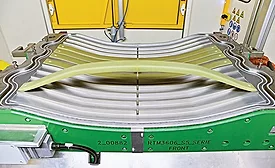
The project will be looking at developing faster, more sustainable, and cost-effective materials and manufacturing solutions for large aerospace and automotive composite structures.
An advanced composites technologies firm is launching a $10 million, four-year research and development project, the MAXIM project, backed by the UK Aerospace Technology Institute (ATI).
Researchers in Switzerland are showing promising results for tannins extracted from native tree bark becoming a renewable alternative in producing adhesives and composite materials.
As vehicle manufacturers worldwide look to reduce weight from their cars and trucks in order to boost fuel economy and reduce emissions, they must set aside the mindset that has dictated traditional material and process choices and instead consider new and emerging technologies. This includes selecting adhesives and other joining options. Each car today contains, on average, 15 kg (~ 33 lbs) of adhesives,―and this amount will likely increase in the future.
Aerospace designers and manufacturers are forming partnerships with a variety of component fabricators along with universities and research groups to develop new designs.
The possibility of a new alumina-based metamaterial that can be used in industries like building construction and aerospace is being tested by a team of researchers.
In an effort to grow the composite manufacturing cluster in Rhode Island, a $125,000 federal grant was recently given by the U.S. Economic Development Administration (EDA) to the Rhode Island Marine Traders Association.
 RSS
RSS