Researchers Turn Residual Materials into Adhesives for Wood-Based Materials
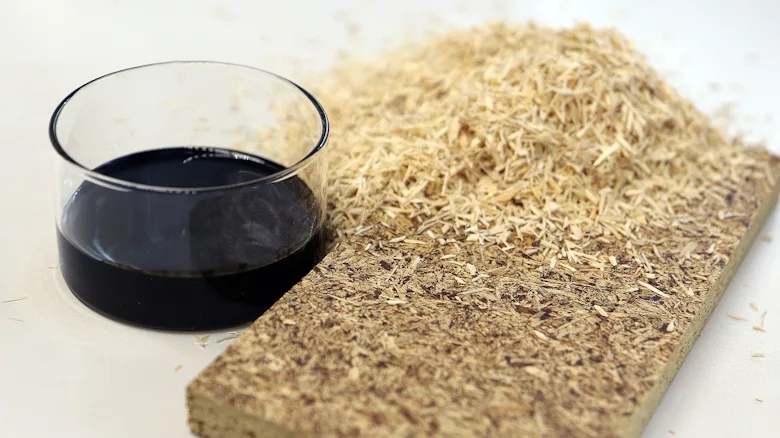
Researchers at the Fraunhofer WKI are developing biobased adhesives based on renewable raw materials and biogenic residues. In the LowEPanel research project, researchers are testing formaldehyde-free adhesives made from lignin and hydroxymethylfurfural (HMF) for the production of sustainable particle boards using regional wood residues. This enables the development of high-quality biobased materials, optimizing the value chain. Biobased adhesives are a key technology for the bonding of materials and the conservation of finite resources and represent a promising growth market. The research being conducted at the Fraunhofer WK is enabling particle boards that are more ecological and easier to recycle.
In the LowEPanel research project, scientists at the Fraunhofer WKI are working in collaboration with partners on the testing of adhesives derived from lignin and HMF. Lignin is a naturally occurring polymer found in the cell walls of plants and is a by-product of paper and bioethanol production, which makes it a valuable resource for the manufacture of bio-based materials. HMF has the potential to be used as a starting material for the synthesis of various chemical products, including adhesives. It is a chemical intermediate that is obtained through the dehydration of sugar. Through their investigations, the researchers are tapping into high-quality areas of application for residual materials and renewable raw resources.
Formaldehyde-Free Organic Binder
The researchers are using the formaldehyde-free organic binder, which is based on lignin and HMF, to produce particle boards for furniture and drywall construction. Particle boards are a sustainable and inexpensive building material. They are made from regionally available wood residues and recycled waste wood. The innovative adhesive does not release harmful formaldehyde and consists entirely of biogenic raw materials.
The research partners are testing whether the particle boards can be produced using alternative species of wood that will be available in greater quantities in the future as a result of forest restructuring. In the previous project, AdLigno, the Fraunhofer WKI successfully developed 100% bi-based and formaldehyde-free condensation resins on the basis of lignin and HMF on a laboratory scale.
“In our new 'LowEPanel' project, we are working with our partners on the further development and optimization of lignin-HMF resins for the production of particle boards.
The entire value chain is covered within the project: from raw-material suppliers, through material and process development, large-scale resin synthesis and dosing technology, and on to particle-board manufacturers,” said Dr. Steven Eschig, department head at the Fraunhofer WKI.
Learn more about research being conducted at Fraunhofer WKI at www.wki.fraunhofer.de/en.
Looking for a reprint of this article?
From high-res PDFs to custom plaques, order your copy today!

.webp?height=200&t=1704834340&width=200 "news-screens-GettyImages-165928833 (1).jpg")