Spray Coating for Adhesive Application in Advanced Manufacturing
Offering versatility and flexibility, spray coating is a popular choice across many manufacturing lines for adhesive deposition in high-throughput production.
In manufacturing, adhesive application must keep up with high-throughput production often while targeting large or complex components. To reliably achieve this, manufacturing lines rely on custom adhesive deposition systems, designed around a specific use case. Choosing the right deposition technique is essential to the success of these custom systems and, thanks to its versatility and flexibility, spray coating is a popular choice across many manufacturing lines.
Spray deposition is a scalable wet-coating technique that offers distinct advantages for industrial applications where reliable large-area throughput is paramount. The versatility of spray coating allows manufacturers to handle different adhesive depositions from low-viscosity cyanoacrylates to high-viscosity epoxies and even hot-melt adhesives with heated systems.
Different Types of Spray Coating
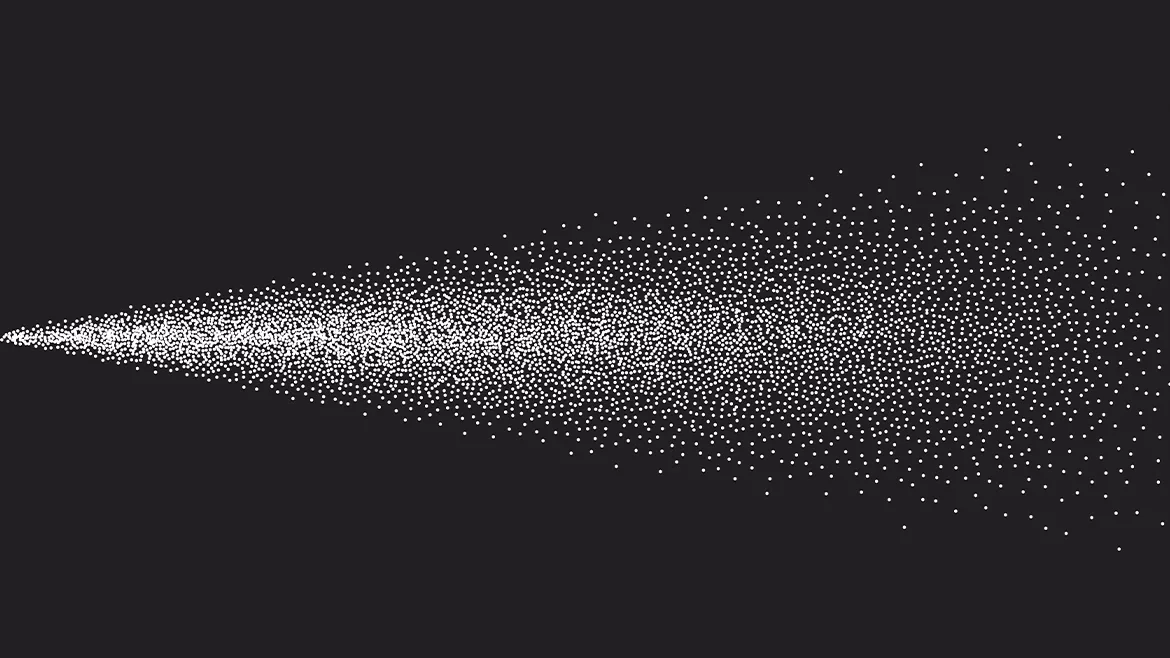
A spray coater atomizes liquid adhesive formulations into fine droplets, directing the spray toward the target substrate. There are three main types of spray formation: air-assisted, hydraulic, and ultrasonic.
Air-Assisted Spray Formation
Compressed air is mixed with the adhesive solution either within the nozzle or after exiting the nozzle. This mixing breaks the adhesive into droplets, the size of which can be controlled by the set gas pressure.
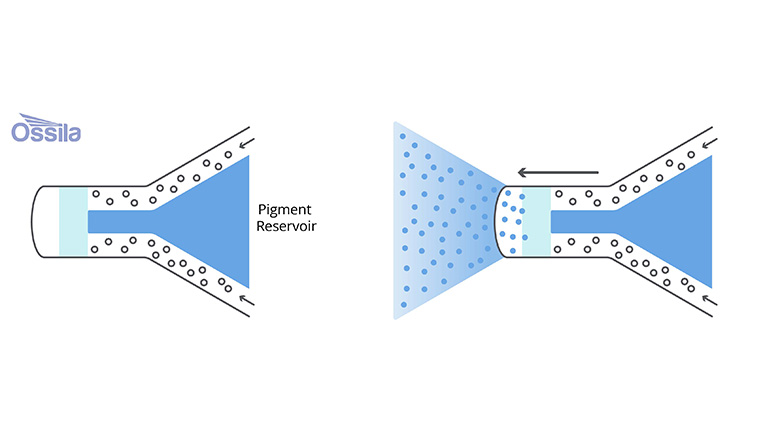
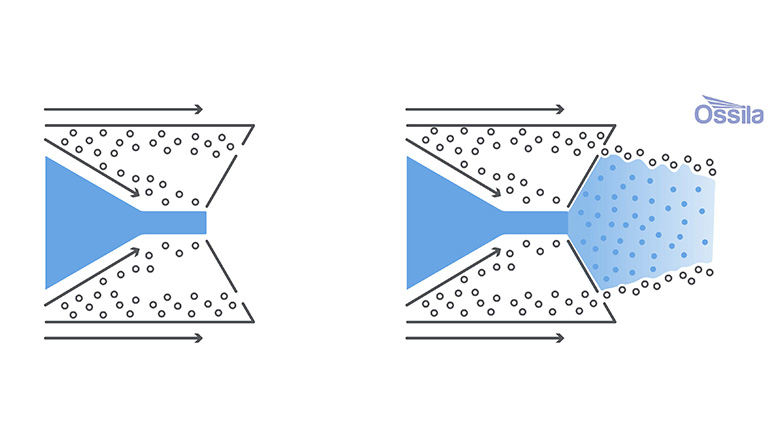
Air-assisted systems work particularly well with low- to medium-viscosity adhesives including cyanoacrylates, UV-cure acrylics, thin epoxies, and solvent-based contact adhesives. However, air-assisted spray formation can still be used to reduce the droplet size in high-viscosity adhesives, common in medical and electronic devices, for finer control.
The automotive industry finds these systems particularly suited for structural adhesives and sealants on body panels, where high throughput is essential. Medical device manufacturers can use air-assisted spray when applying biocompatible adhesives, provided they use filtered gas to prevent contamination.
Hydraulic Spray Formation
Hydraulic spray formation relies entirely on the mechanical energy of the pressurized solution itself. Using precisely engineered nozzles, the high-velocity flow atomizes the adhesive solution without any gas.
Medium- to high-viscosity formulations are best suited to hydraulic systems because the material itself provides sufficient momentum for atomization. The resulting droplet size is dependent on the chosen nozzle geometry and set fluid velocity.
On high-volume production lines, hydraulic systems are ideal for applying structural epoxies and polyurethane adhesives for a wide range of material bonding in automotive manufacturing and general assembly operations.
Ultrasonic Spray Formation
Beyond pressure-driven spray formation, ultrasonic systems use high-frequency vibrations on a piezoelectric or resonator-driven tip to generate controlled atomization. While air-assisted and hydraulic systems can deliver adhesives at rates measured in liters per minute, ultrasonic systems are limited to milliliters per minute. Manufacturers control droplet size precisely through adhesive viscosity and vibration frequency adjustments, optimal where precision matters more than speed.
Ultrasonic spray formation is superior for precise, low-volume adhesive application on microelectronics, flex circuits, and MEMS devices. While specialty assembly operations can use ultrasonic spray for micro-bonding applications requiring precise, small-scale adhesive deposition.
How Spray Coating Works for Adhesives
Spray coating is used to deposit a wide range of solutions and formulations. Alongside traditional coating parameters, successfully applying this technique to adhesives requires additional, specific attention to adhesive chemistry and curing mechanisms.
Viscosity Considerations
As with all spray-coated formulations, adhesive viscosity fundamentally determines which spray methods will be effective and what parameter adjustments will be required.
- Low-viscosity adhesives atomize easily with all spray methods but may require faster substrate movement or adjusted standoff distances to prevent running or pooling.
- Medium-viscosity adhesives represent the sweet spot for most spray systems and offer good control over layer thickness and coverage.
- High-viscosity adhesives require high-pressure hydraulic spray systems or heated air-assisted systems to achieve adequate atomization.
Curing Mechanisms
As the curing and drying process of adhesives is more complicated than other coating applications, the curing mechanism directly influences spray system design and production processes.
- UV-curable adhesives are well-suited to spray deposition. By remaining liquid during spraying and curing rapidly when exposed to UV light, manufacturers can tightly control the open time of the adhesive.
- Heat-cure formulations require thermal post-processing after spray application, which can easily be integrated into production lines.
- Moisture-cure adhesives, like certain polyurethanes and cyanoacrylates, begin curing immediately upon exposure to humidity. For spray coating to work with these formulations, careful environmental control or inert gas atomization is often required.
- Two-part reactive systems demand specialized spray equipment with dual material feeds, static mixing nozzles or separate spray streams, and frequent cleaning to prevent in-system curing.
The Importance of Optimizing Droplet Size
Droplet size is one of the key parameters for effective deposition. The optimal droplet size depends on adhesive open time, substrate wettability, and desired final thickness, and contributes to adhesive uniformity, adhesion, and drying.
Adhesion Performance
Proper droplet sizing ensures the adhesive wets the target substrate effectively before curing begins. Electronics applications demand good wetting on various substrates including metals, ceramics, and polymers with different surface energies. Medical device bonding requires optimal interfacial contact between adhesives and biocompatible materials such as titanium, stainless steel, and medical-grade polymers. Automotive structural bonding needs adequate wet-out on treated metal surfaces and composite materials that may have complex surface chemistries.
Coverage Uniformity
Tuning droplet size with viscosity enables the adhesive to form continuous layers with a uniform thickness. This is essential to adhesive performance, avoiding ineffective or uneven bonding and increased curing times.
The relationship between droplet size and layer quality depends on how quickly the adhesive droplets coalesce before curing begins. Smaller droplets coalesce rapidly and produce smoother films, but curing must be correctly timed to prevent trapped air, which can compromise adhesive integrity. Larger droplets maintain better flow characteristics and self-level more effectively but may require longer leveling time before curing, reducing production efficiency.
Drying and Curing Control
Droplet size influences both layer thickness and solvent evaporation rates, directly impacting cure times and manufacturing throughput. Smaller droplets are beneficial for high-speed electronics and automotive assembly lines where fast curing minimizes cycle time. Larger droplets work better for complex medical device assemblies requiring positioning time before fixation occurs.
Spray Pattern Optimization for Manufacturing Applications
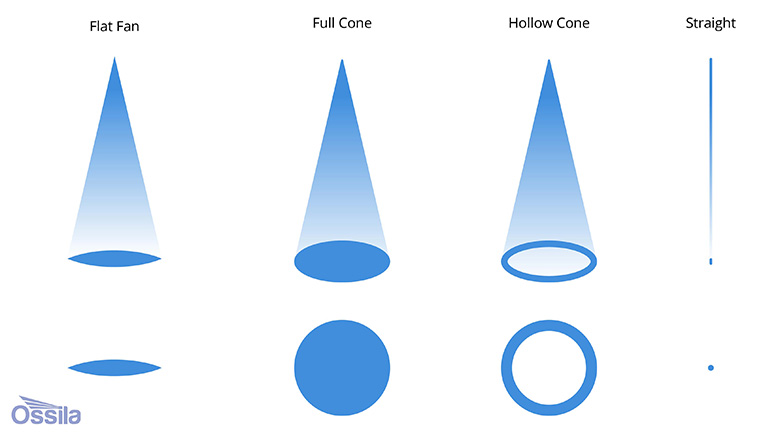
Once the optimal spray type and parameters have been identified, spray patterns can be customized to suit their target substrate shape, size, and complexity. Jet-shaping nozzles create specific patterns including full cone, hollow cone, flat fan, and straight jet configurations. Each pattern type serves different part geometries and production requirements across manufacturing sectors, with optimized spray patterns reducing adhesive wastage.
Electronics Manufacturing
- Flat fan patterns are ideal for coating rectangular PCBs and display panels because they deliver uniform coverage across linear surfaces.
- Hollow cone patterns work efficiently for coating cylindrical components like capacitors and sensors where radial symmetry matches the spray geometry.
Automotive Production
- Full cone patterns prove optimal for bonding curved body panels and interior trims because the radial spray distribution conforms naturally to contoured surfaces.
- Wide flat fan patterns cover large sheet metal areas for structural bonding with minimal overspray.
- Adjustable patterns accommodate varied part sizes on flexible assembly lines, reducing changeover time when switching between different vehicle models or components.
Medical Device Manufacturing
- Fine mist patterns create ultra-thin biocompatible coatings on implants where coating thickness must be tightly controlled to meet regulatory specifications.
- Controlled straight jets enable precise adhesive application on small diagnostic components without contaminating adjacent areas.
- Programmable patterns support complex geometries in surgical instruments where different surfaces require different coating densities.
Comparing Spray Coating
Understanding when spray coating offers advantages over other adhesive application techniques helps manufacturers select the optimal process for their specific process.
Dispensing
Dispensing systems deposit adhesives through a needle or nozzle in controlled beads or dots, applying precise volumes to specific locations with minimal waste. Dispensing is ideal for small bond areas, high-viscosity adhesives that resist atomization, and applications requiring thick adhesive layers in defined patterns. Electronics manufacturers use dispensing for underfill adhesives beneath flip chips and for precise dot patterns in component attachment.
Spray coating becomes advantageous when coverage area increases beyond what dispensing can efficiently handle: square feet or square meters per minute rather than square inches. On complex three-dimensional surfaces, spray coating is also preferred as it is easier to follow substrate contours.
Roller Coating
Roller coating transfers the adhesive solution from a rotating roller onto a substrate through contact. With excellent transfer efficiency, it works well for continuous web processing or flat substrates that can be passed beneath a roller.
For curved, uneven, or delicate surfaces, spray coating is better suited than roller coating. Selective coating can also be achieved without masking since the spray can be directed precisely or turned on and off rapidly. Changeover between different adhesives is faster with spray systems since rollers require thorough cleaning and may retain residual material. However, spray produces more waste and generally requires more sophisticated environmental controls for overspray capture.
When Spray Coating is the Optimal Choice
Spray coating has earned its place as a cornerstone adhesive application technique in advanced manufacturing, offering the adaptability manufacturers need to address diverse, component-specific production challenges. Its advantages become most apparent in scenarios where other methods fall short: large surface areas requiring high coverage rates of several square meters per minute, complex three-dimensional geometries demanding uniform coating across curves and contours, and porous or textured substrates where adhesive must penetrate surface irregularities.
As manufacturing continues to evolve toward greater complexity and higher production volumes, spray adhesive technology will remain critical for industries ranging from automotive structural bonding to medical device assembly.
Ossila was founded in 2009 by a team of scientists from the University of Sheffield who they set out to remove barriers to research by developing accessible, high-performance research tools. Today, Ossila, Sheffield, UK, manufactures and supplies a wide range of equipment and materials trusted by researchers. Learn more about Ossila at ossila.com.
Looking for a reprint of this article?
From high-res PDFs to custom plaques, order your copy today!