Adhesives Mag logo
search
cart
facebook twitter linkedin youtube
  • Sign In
  • Create Account
  • Sign Out
  • My Account
Adhesives Mag logo
  • NEW PRODUCTS
  • NEWS
    • Adhesives & Sealants Headlines
    • Mergers/Acquisitions
    • Market Trends
    • TOP 20
  • TOPICS
    • Finished Adhesives and Sealants
    • Pressure-Sensitive Adhesives (PSAs)
    • Coatings
    • Raw Materials and Chemicals
    • Materials Handling/Processing
    • Meter/Mix/Dispense
    • Curing
    • Testing/Quality Control
    • Packaging of Adhesives & Sealants
    • Converting/Packaging
    • Composites
    • Sustainability
  • EVENTS
    • MAX
    • ASI Academy
    • Events Calendar
  • COLUMNS
    • European Perspectives
    • Strategic Solutions
    • Supply Chain Strategies
    • Tape Talk
  • MULTIMEDIA
    • Videos
    • Podcasts
    • Webinars
    • eBooks
  • EXPLORE
    • Adhesives in Action
    • Blog
    • ASI Store
    • Industry Links
    • Market Research
    • Classifieds
  • DIRECTORIES
    • Buyers' Guide
    • Global Adhesives & Sealants Directory
    • Raw Materials, Chemicals, Polymers and Additives Handbook
    • Equipment Handbook
    • Distributor Directory
  • EMAGAZINE
    • EMAGAZINE
    • ARCHIVE ISSUES
    • ADVERTISE
      • Custom Content & Marketing Services
    • CONTACT
  • SIGN UP!

A Matter of Choice

July 1, 2004


When it comes to obtaining the desired performance properties of adhesive and sealant formulations, purchasing, modifying or adjusting process equipment is not always economically feasible. This is especially true when you consider the large and ever-growing variety of raw materials available. Therefore, it becomes imperative to properly select the most appropriate raw material to fit the current processing capabilities. This article will discuss how the proper selection of additives - particularly fillers, rheological control agents and reinforcing agents - can lead to their optimum dispersibility, enhanced performance, and formulation cost reductions in such processes.

Additives are generally used as a primary contribution to the existence of the end product, or they act as auxiliary or secondary functions. The range of additive substances used in the adhesives and sealants industry includes plasticizers, thickeners, fillers, curatives and emulsifiers. To optimize their influence in the formulation, additives must be homogeneously mixed or dispersed throughout the system. For powdered additives often used in large loading levels (such as calcium carbonate, silica, talc and mica), optimum dispersibility is even more important because of inherent particle agglomeration during the manufacturing process. To deal with these issues in light and heavy body formulations, e.g., low to high viscosity systems, these materials require medium- to high-shear energy dispersion equipment. The proper choice of equipment is dependent on the unfilled formulation viscosity and the required shear needed to achieve optimum homogeneity of the additive(s) in enabling its maximum effectiveness.

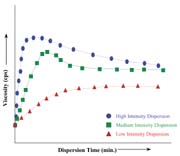
Figure 1. Common Additives for Adhesive and Sealant Formulations
In dispersing filler additives, four distinct stages are encountered: 1) ingestion - the introduction of filler agglomerates into the mixing zone where they are subdivided; 2) incorporation - agglomerate displacement of occupied air with fluid; 3) dispersion - the reduction of agglomerate size; and 4) distribution - uniform distribution of the agglomerated and/or primary particles. In most cases, total deagglomeration is not always achieved; however, the agglomerates can be reduced to a more effective size. The effectiveness of the process in reducing the agglomerate's size is dependent on its shear energy capability and on the shear forces needed to disperse the filler. If one of these requirements is not met, optimum dispersion of the filler is not achieved and will result in only marginal rheological performance properties.

Figure 2. Dispersion Effects on Viscosity
Dispersion of filler additives is dependent on many physical characteristics of the filler particle, of which size, shape, structure and interactions are among the most important. Examples of the most widely used filler additives are shown in Figure 1. The mobility of these particles in the fluid and their ability to form three-dimensional networks are also very much dependent on their loading concentration or volumetric fraction. Of course, higher loading concentration leads to increases in viscosity. However, optimum viscosity may not be realized if the filler additive is poorly dispersed, e.g., did not experience the fourth stage of dispersion. Figure 2 demonstrates a common trend of filler additives when they are dispersed at various shear energy intensities. As shown, low intensity dispersion results in a relatively low viscosity performance, regardless of dispersion time. This suggests that only a portion of the agglomerated particles experience size reduction. When sufficient shear energy is available, a significant reduction of agglomerate size occurs, as evidenced by increasing viscosity with time and the magnitude of the increase. Once the filler additive is optimally dispersed, it becomes homogeneously distributed in the system. With increasing intensity level, however, a drop in viscosity may occur as a result of over-dispersion. Over-dispersion usually occurs with low- to moderate-filler levels because of the reduced likelihood of particle-particle interactions leading to the development of particle networking.

Figure 3. Surface Area Performance Difference
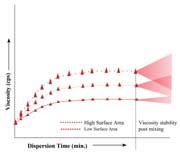
Most commercial filler additives are available in various particle sizes or surface areas. Selection and recommendation of the most appropriate material is based on the desired performance requirements of the formulation's applicability. Most research and development activities are generally focused on increased surface areas or modified surface chemistry to enhance the performance offering. Processing difficulties in developing a particle's discreteness are normally encountered in such pursuits because of their inherent tendency to agglomerate. Therefore, higher intensity dispersion energy is required in order for the particles to realize their performance potential. Figure 3 demonstrates the effects of low-energy intensity dispersion on fillers at various surface areas. Although an expected increase in viscosity is observed with increasing surface area, the shape of the curves are similar to the low-energy intensity curves shown earlier. Similar trends are observed with medium- and high-intensity dispersion conditions.

Figure 4. Filler Loading Level Effects
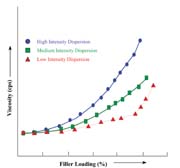
Figure 4 demonstrates the effects of filler additive loading levels on viscosity vs. dispersion intensity. As expected, trends of increasing viscosity with loading levels are observed. Lower loading levels result in marginal performance differences, while higher loading levels result in very significant differences in viscosity.

Figure 5. Combined Effects on Viscosity
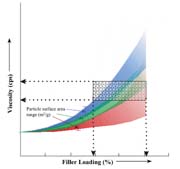
By combining the effects of surface area, loading level and dispersion intensity on viscosity, trends similar to those shown in Figure 5 can be constructed. What is shown is the effectiveness of surface area on viscosity compared to the filler enhancement effects on viscosity performance as a result of increased dispersion intensity. These trends show that intensity effects blend from one intensity level to the next and become more evident with increasing loading levels. This suggests that selecting a lower surface area filler can provide comparable viscosity performance value when properly dispersed. Using low-surface-area fillers can offer the added benefits of reduced incorporation and dispersion processing time, improved performance and shelf-life stability, and improved formulation economics. The performance box shown in Figure 5 suggests that when viscosity specifications are in place, a broader selection of products can be used to meet performance requirements. These requirements span a broader filler loading range and include wider surface area selection.

This article is based on a paper presented at the Spring 2004 Adhesive and Sealant Council Conference in Cleveland.

For more information, contact Material Apps LLC, 408 Shipwrighter Way, PO Box 1571, Lansdale, PA 19446; phone (215) 855-5902; fax (215) 855-5946; or visit http://www.materialapps.com .

Share This Story

Looking for a reprint of this article?
From high-res PDFs to custom plaques, order your copy today!

Recommended Content

JOIN TODAY
to unlock your recommendations.

Already have an account? Sign In

  • mouse in hole

    Using Foam Sealants for Pest Prevention

    According to the National Pest Management Association,...
    Adhesives and Sealants Topics
    By: Kevin Corcoran
  • linked network nodes

    Using the Power of AI for Adhesive and Sealant Formulation

    With the help of software solutions, adhesive formulators...
    Finished Adhesives and Sealants
    By: Karen Parker
  • top20-hero.jpg

    2024 ASI Top 20: Leading Global Manufacturers of Adhesives and Sealants

    ASI's annual ranking of the top 20 global adhesive and...
    Pressure-Sensitive Adhesives (PSAs)
Manage My Account
  • eMagazine Issues
  • Newsletters
  • Online Registration
  • Manage My Preferences
  • Subscription Customer Service

More Videos

Popular Stories

image of a graph representing markets

Sika Announces Acquisition of Gulf Seal in Saudi Arabia

Picture of two men and one woman in dark suits

Bodo Möller Chemie Makes Management Change for CASE Business Unit

news on internet screen

Henkel Posts Positive Organic Growth for Third Quarter, Driven by Adhesives Technologies Business

ASI Top 20 website

Events

January 1, 2030

Webinar Sponsorship Information

For webinar sponsorship information, visit www.bnpevents.com/webinars or email webinars@bnpmedia.com.

View All Submit An Event

Products

Structural Adhesives: Properties, Characterization and Applications

Structural Adhesives: Properties, Characterization and Applications

See More Products

ASI CASE EBOOK

Related Articles

  • A Clear Choice

    See More
  • There Is a "Best Choice"

    See More
  • A Plane Choice

    See More

Related Products

See More Products
  • social media

    Optimizing Social Media from a B2B Perspective

  • handbk-of-ad-and-surface-pr.gif

    Handbook of Adhesives and Surface Preparation

  • 9780080447087.jpg

    Volume 2: Handbook of Adhesives and Sealants, 1st Edition

See More Products
×

Keep the info flowing with our newsletters!

Get the latest industry updates tailored your way.

JOIN TODAY!
  • RESOURCES
    • Advertise
    • Contact Us
    • Directories
    • Manufacturing Division
    • Store
    • Want More
  • SIGN UP TODAY
    • Create Account
    • eMagazine
    • Newsletters
    • Customer Service
    • Manage Preferences
  • SERVICES
    • Marketing Services
    • Reprints
    • Market Research
    • List Rental
    • Survey & Sample
  • STAY CONNECTED
    • LinkedIn
    • Facebook
    • Youtube
    • X (Twitter)
  • PRIVACY
    • PRIVACY POLICY
    • TERMS & CONDITIONS
    • DO NOT SELL MY PERSONAL INFORMATION
    • PRIVACY REQUEST
    • ACCESSIBILITY

Copyright ©2025. All Rights Reserved BNP Media.

Design, CMS, Hosting & Web Development :: ePublishing