Adhesives Mag logo
search
cart
facebook twitter linkedin youtube
  • Sign In
  • Create Account
  • Sign Out
  • My Account
Adhesives Mag logo
  • NEW PRODUCTS
  • NEWS
    • Adhesives & Sealants Headlines
    • Mergers/Acquisitions
    • Market Trends
    • TOP 20
  • TOPICS
    • Finished Adhesives and Sealants
    • Pressure-Sensitive Adhesives (PSAs)
    • Coatings
    • Raw Materials and Chemicals
    • Materials Handling/Processing
    • Meter/Mix/Dispense
    • Curing
    • Testing/Quality Control
    • Packaging of Adhesives & Sealants
    • Converting/Packaging
    • Composites
    • Sustainability
  • EVENTS
    • MAX
    • ASI Academy
    • Events Calendar
  • COLUMNS
    • European Perspectives
    • Strategic Solutions
    • Supply Chain Strategies
    • Tape Talk
  • MULTIMEDIA
    • Videos
    • Podcasts
    • Webinars
    • eBooks
  • EXPLORE
    • Adhesives in Action
    • Blog
    • ASI Store
    • Industry Links
    • Market Research
    • Classifieds
  • DIRECTORIES
    • Buyers' Guide
    • Global Adhesives & Sealants Directory
    • Raw Materials, Chemicals, Polymers and Additives Handbook
    • Equipment Handbook
    • Distributor Directory
  • EMAGAZINE
    • EMAGAZINE
    • ARCHIVE ISSUES
    • ADVERTISE
      • Custom Content & Marketing Services
    • CONTACT
  • SIGN UP!

Pure Monomer Resins - Fine Tuning Adhesives Formulations for Demanding Applications

November 1, 2005
Pure monomer resins (PMRs) can provide formulators with the tools needed to fine-tune adhesives formulations to meet specific appplication requirements without affecting other key performance properties.

Packaging that includes a combination of rigid and flexible plastics requires an adhesive that can seal and restick to multiple types of plastic, even when exposed to meat juices. Photo courtesy of Arkema.
Today, many hot-melt adhesive formulators face daunting challenges - they must formulate precision adhesives that meet demanding application requirements without adversely affecting vital performance properties. Difficult adhesive applications often require formulations with high-temperature cohesion, adhesion at low temperatures, low color, FDA compliance and the desired adhesion/cohesion balance, while also meeting the narrow manufacturing viscosity windows of conversion processes. Such applications include automotive tapes and decals, frozen food labels and container closures, packaging for wet and/or greasy foods, microwaveable packaging, and nonwoven assembly.

A familiar example can be found at the deli counter of any supermarket. Ready-to-eat meats frequently come in resealable packaging that includes a combination of rigid and flexible plastics. This application requires an adhesive that can seal and re-stick to multiple types of plastic, even when exposed to meat juices. The adhesive must also be low color to meet consumer preference and comply with FDA regulations for direct contact with food. An application such as this requires a complex adhesive formulation.

Pure monomer resins (PMRs) are an ideal solution for such challenging applications. They can provide formulators with the tools needed to fine-tune adhesives formulations to meet specific application requirements without affecting other key performance properties.

Why Pure Monomer Resins?

PMRs occupy a unique space in the range of tackifying resins available to adhesives formulators. Made from purified aromatic starting materials, PMRs offer the best of both worlds: the compatibility and versatility of aromatic resins along with the clarity and stability of a hydrogenated aliphatic resin. This means that PMRs are compatible with various base polymers and provide low color, good thermal stability, and excellent resistance to weathering. In addition, their verifiable composition allows them to be compliant with FDA direct food contact regulations.
Broad Compatibility

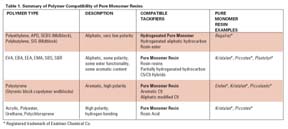
PMRs offer compatibility with a range of base polymers, such as polyethylene, ethylene vinyl acetate (EVA) copolymers, amorphous polyolefin (APO), styrene-ethylene-butylene-styrene (SEBS), styrene-isoprene-styrene (SIS), styrene-butadiene-styrene (SBS), styrene-butadiene rubber (SBR) and polychloroprene-based adhesives, as well as acrylics, some polyesters, and aromatic isocyanate-based urethanes (see Table 1). This allows broad flexibility in material selection when formulating adhesives for more demanding applications.

Low Color

PMRs have very low color, which helps to formulate a clear adhesive. This is a key property in any adhesives formulation used in food packaging, microwavable packaging and nonwoven applications where yellow- or brown-colored adhesive is visually unappealing to the consumer. PMRs also have good thermal stability, allowing the adhesive to be held at application temperature longer without excessive color or viscosity change.

Temperature Resistance

PMRs can also be used to improve the ability of an adhesive to maintain its cohesion at higher temperatures. All hot-melt adhesives have a characteristic temperature at which they soften to the point of failure when under stress. This is determined experimentally as the shear adhesion failure temperature (SAFT). Increased temperature resistance allows the formulation of adhesives with higher SAFT points without sacrificing tack and adhesion properties.

While there are many adhesives applications that do not require their use, PMRs are the optimum solution when compatibility, low-color, temperature resistance and application viscosity control are critical.
Pure Monomer Resin Applications

When all the families of PMRs are considered, they cover a range of properties. However, to select a specific PMR for a given application, it is important to understand what specific adhesive performance properties are required.

For example, the converting equipment used to apply adhesives often requires a narrow window of viscosity or application temperature to precisely control either the pattern or weight of the adhesive, or to avoid distortion of the substrate. To control costs and reduce the risk of product failure, it is crucial to select the right PMR to fine-tune the viscosity for a specific piece of equipment or to achieve better control of the overall manufacturing process and adhesive application.

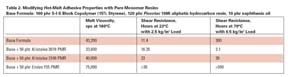
Adding a PMR with a high glass-transition temperature (Tg) - greater than 95°C - will increase temperature resistance, ambient temperature shear and melt viscosity (see Table 2). This enhances the ability of an adhesive to perform at higher temperatures, but it also increases the viscosity and application temperature. Meanwhile, adding a PMR with a lower Tg - 50-95°C -will decrease melt viscosity, SAFT and application temperature, but it will increase ambient temperature cohesion (see Table 2). This would be appropriate for applications where hitting a narrow application viscosity window is crucial without sacrificing room-temperature cohesion. Finally, adding a PMR with a Tg of less than 50°C will sharply decrease melt viscosity and reduce the required application temperature with some decrease in ambient temperature cohesion.

For adhesives applications that are used in food packaging, it is also important to make sure the PMR being considered is FDA compliant. PMRs have a range of FDA clearances, including some for applications in direct contact with food.

Conclusion

To meet the requirements of demanding adhesives applications such as automotive tape, various food packaging and nonwoven assembly, formulators need to fine-tune hot-melt adhesives - creating precision adhesives - without decreasing overall adhesive performance and effectiveness. In many cases, FDA compliance is also a requirement. PMRs are an ideal additive for formulators looking to achieve the right level of adhesion and cohesion, temperature stability and viscosity while maintaining clarity and performance.

With a clear understanding of application requirements, formulators can use PMRs to control specific performance properties, allowing them to formulate adhesives to meet the needs of these challenging applications.

Gary R. Robe is principal technical representative-Adhesives & Polymers, with Eastman Chemical Co. In 1991, he joined Eastman Chemical Co. in Kingsport, TN, as a technical representative for adhesives and coatings raw materials. In 1993, Robe began providing technical service for Latin America and by 1996 had developed sufficient fluency in Spanish to begin making technical presentations. He holds several patents for adhesives and coatings, has had journal articles published in four languages, and has made numerous presentations at industry meetings around the world.

For more information, contact Eastman Chemical Co., phone (423) 229-2000 or visit www.tackifier.com.

Share This Story

Looking for a reprint of this article?
From high-res PDFs to custom plaques, order your copy today!
Recommended Content

JOIN TODAY
to unlock your recommendations.

Already have an account? Sign In

  • mouse in hole

    Using Foam Sealants for Pest Prevention

    According to the National Pest Management Association,...
    Finished Adhesives and Sealants
    By: Kevin Corcoran
  • linked network nodes

    Using the Power of AI for Adhesive and Sealant Formulation

    With the help of software solutions, adhesive formulators...
    Adhesives and Sealants Topics
    By: Karen Parker
  • top20-hero.jpg

    2024 ASI Top 20: Leading Global Manufacturers of Adhesives and Sealants

    ASI's annual ranking of the top 20 global adhesive and...
    Pressure-Sensitive Adhesives (PSAs)
Manage My Account
  • eMagazine Issues
  • Newsletters
  • Online Registration
  • Manage My Preferences
  • Subscription Customer Service

More Videos

Popular Stories

Image of scrabble pieces with pictures of people

Avery Dennison Completes Acquisition of Flooring Business

Picture of a laboratory

Henkel Launches Packaging RecycLab in China

adhesives

The Invisible Strength of Polyurethane Adhesives

ASI Top 20 website

Events

January 1, 2030

Webinar Sponsorship Information

For webinar sponsorship information, visit www.bnpevents.com/webinars or email webinars@bnpmedia.com.

View All Submit An Event

Products

Structural Adhesives: Properties, Characterization and Applications

Structural Adhesives: Properties, Characterization and Applications

See More Products

ASI CASE EBOOK

Related Articles

  • Fine-Tuning Viscoelasticity of EB-Cured Adhesives to Optimize Performance

    See More
  • Low-Volatile Pure Monomer Resins

    Low-Volatile Pure Monomer Resins

    See More
  • Testing.jpg

    CRAY VALLEY: Hydrocarbon Resin for High Performance in Demanding Applications

    See More

Related Products

See More Products
  • pressure-sensitive-advesive.gif

    Pressure-Sensitive Adhesives and Applications

  • images.jpg

    Structural Adhesives: Properties, Characterization and Applications

  • adhesive-bonding-science.gif

    Adhesive Bonding: Science, Technology, and Applications

See More Products

Related Directories

  • Thermoset Resin Formulators Association

    The TRFA is the only organization dedicated to serving the needs and interests of all thermoset formulators and has a broader focus than just epoxy. Other chemistries that TRFA represents include polyester and vinyl ester composites, urethane, silicone, acrylic, and phenolics.
  • Epic Resins

    Fast turnaround times, rigorous product testing and cost-effective pricing give OEMs the ability to manufacture better-functioning and more reliable products at lower cost. For over 65 years, Epic Resins has formulated one- and two-component epoxy resin and polyurethane solutions. Our adhesive applications include brush manufacturing, panel bonding and general bonding.
×

Keep the info flowing with our newsletters!

Get the latest industry updates tailored your way.

JOIN TODAY!
  • RESOURCES
    • Advertise
    • Contact Us
    • Directories
    • Store
    • Want More
  • SIGN UP TODAY
    • Create Account
    • eMagazine
    • Newsletters
    • Customer Service
    • Manage Preferences
  • SERVICES
    • Marketing Services
    • Reprints
    • Market Research
    • List Rental
    • Survey & Sample
  • STAY CONNECTED
    • LinkedIn
    • Facebook
    • Youtube
    • X (Twitter)
  • PRIVACY
    • PRIVACY POLICY
    • TERMS & CONDITIONS
    • DO NOT SELL MY PERSONAL INFORMATION
    • PRIVACY REQUEST
    • ACCESSIBILITY

Copyright ©2025. All Rights Reserved BNP Media.

Design, CMS, Hosting & Web Development :: ePublishing