Lean Manufacturing: Minimizing Converting Costs with Moisture and Coat Weight Control
Converting process efficiency is often affected by variations in coat weight, inefficient moisture control, and thickness and/or temperature issues.
Producers focus on minimizing waste, reducing costs, increasing product quality, and maximizing plant efficiency. Wasted efforts are certainly a drain on resources, in addition to wasted product, creating the need to evaluate and implement lean manufacturing principles. Identifying the key areas in which the manufacturing process is not operating at its peak efficiency provides the framework for improvement.
Minimizing costs is a top priority for producers, and thoroughly evaluating methods of decreasing waste can reduce wasted efforts, wasted product, and wasted energy. Converting process efficiency is often affected by variations in coat weight, inefficient moisture control, and thickness and/or temperature issues. Moisture and thickness can play a key role in the final product’s quality and use.
Measurement and Control
Precise moisture levels in paper, pulp, tissue, corrugated liner, and other converting products are a crucial component to the manufacturing process. Out-of-tolerance moisture levels create wasted product, increased energy usage, downtime, and more. Processing lines can see improved product quality and increased productivity with proper moisture monitoring, creating substantial cost savings. Maintaining the ideal thickness and coat weight in the production line can mean the difference between a quality product or wasted effort and material.
Many basic properties of paper are greatly affected by moisture content. Paper dimensions, flatness, conductivity, strength, and fold are among the more significant properties influenced by moisture content. These properties can be critical to the proper performance of paper; providing effective control of paper moisture levels and moisture uniformity is essential for efficient printing and converting operations.
Moisture and coating technology provides a proactive path to avoid quality control issues. Installing sensors throughout the process ensures consistent and accurate measurement of 100% of the product with proactive, immediate adjustments to the line. Real-time results are recorded and displayed every second to operating personnel via PLC, providing full control of the line. In addition, some sensors can ensure that feedback loops have predictable and repeatable results, even at high operating speeds.*
With implemented moisture monitoring, processing, and manufacturing, plants can see large savings in little time. Producers are missing a large opportunity for increased efficiencies if there is no current method of moisture measurement in the production process.
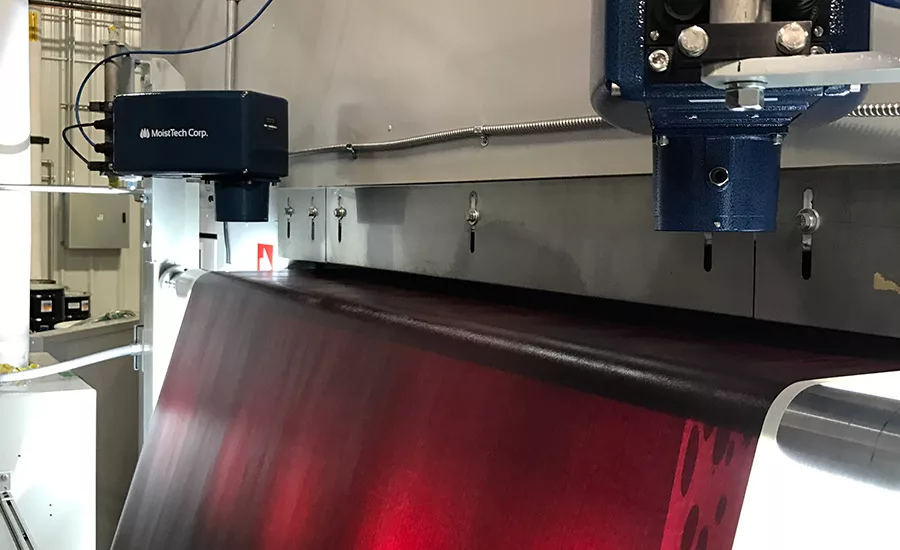
NIR moisture and coat weight sensors produce instant, non-contact readings of materials.
Near Infrared Sensor Technology
Various components are vital in the converting process and should be evaluated for optimal performance. Near-infrared (NIR) technology* provides an efficient, non-contact measurement of multiple constituents, immediately improving product quality and plant efficiency. These sensors provide continuous, reliable readings with a one-time calibration, maintenance-free, no-drift optical design, allowing for immediate process adjustments based on real-time data.
Multiple detection methods are available for the converting process, but not all technology is created equal. NIR technology differs from traditional methods, as it does not have to be in contact with the product, is non-destructive, and is insensitive to most material variations. NIR provides fast analysis of the chemical and physical information in the product by using an NIR light. Reflected into the product and back to the sensor, NIR light gives an accurate, repeatable measurement that is relied on for quality control.
Designed for effectiveness, the NIR moisture and coat weight sensor produces instant, non-contact readings of materials anywhere in the production process, reducing startup and down times. Final product quality is critical; by measuring moisture, coat weight, or thickness, the producer can ensure the quality of the product and sell it for maximum profit. NIR is useful in multiple converting applications, including but not limited to:
- Pressure-sensitive adhesives
- Hot melts
- Resins
- Films
- Hydrocarbon and water-based coatings
- Paper and pulp
- Corrugated materials
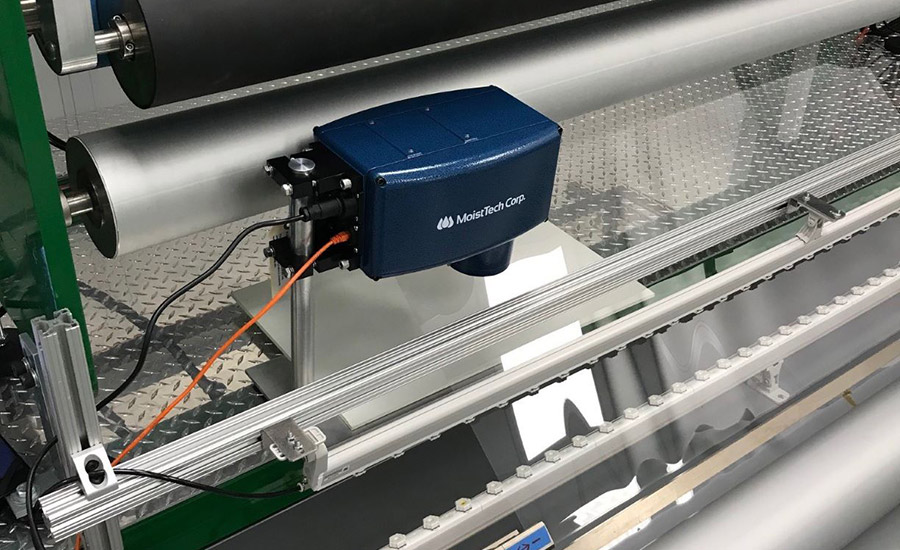
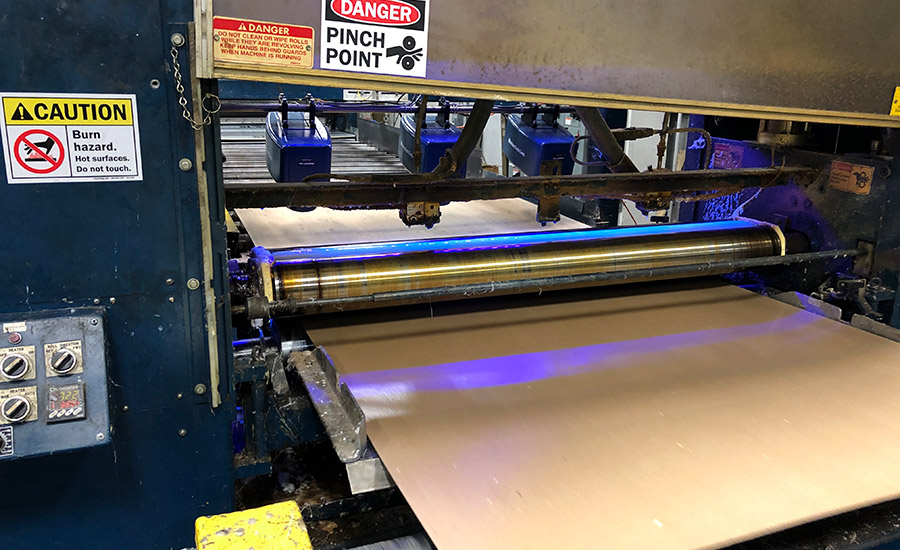
Measurement and control sensors can be installed in extreme production locations, including along webs.
Lean Operations
Maximizing automation and increasing reliability by reducing costs are major aspects for operation that can be easily achieved through proper moisture and coat weight monitoring. Moisture ranges outside of tolerance can unravel important facets of the production process. Each phase of manufacturing runs more efficiently with accurate moisture and coat weight measurements, providing increased profit margins.
If moisture is not properly regulated during the production process, the end quality becomes inferior and product waste occurs. Identifying and using the best methods can lessen common problems such as curl, warping, breakage, collapse, flute exposure, and reduced edge control and lay flat.
Uneven moisture stratification can cause shrinkage or expansion of cellulose fibers. Curled stock is an issue for printing and packaging, and coatings can also get thinner or thicker at the edges. Different moisture levels on the top and bottom side of corrugated board causes warp issues. Therefore, strict control of moisture helps enable operators to produce high-quality boards and boxes.
With the ability for installation in the most extreme production locations, including along webs, winders/unwinders, dryer entrances/exits, pipelines, pneumatic conveying, or in fluid-bed dryers, plant operators can take full advantage of implementing lean operating principles on measurement and control. Adjustments are made on the fly, producing instant measurements to improve performance, reliability, and consistency. Catching any out-of-tolerance readings as soon as possible helps avoid costly downtime and dramatically decreases the amount of wasted product.
Production efficiency improvements due to accurate real-time measurements provide the plant with energy savings and potential increased productivity with lower material losses. Delivering the highest quality product by utilizing NIR moisture detection systems ensures accuracy and repeatability. The sensors are insensitive to material variations such as particle size and material height/color, providing continuous reliable readings with zero maintenance, one-time calibration, non-contact, and a non-drift optical design.
For more information, call (941) 727-1800 or visit www.moisttech.com.
*IR3000 NIR sensors from MoistTech
Note: Images courtesy of Moist Tech.
Looking for a reprint of this article?
From high-res PDFs to custom plaques, order your copy today!