BioPreferred adhesives must use bio-based and renewable components instead of petroleum-based components.
Mactac recently announced its recognition as the first pressure-sensitive adhesive manufacturer to have products listed in the BioPreferred program established by the U.S. Department of Agriculture (USDA).
Ingevity’s bio-based tackifier products reportedly have broad compatibility with multiple polymers commonly used in rigid packaging, hygiene, tapes, labels, and construction adhesives.
Ingevity recently announced the appointment of Cambrian Solutions, a Maroon Group company, as distributor for its WestRez and Altatac rosin ester product lines in Canada.
In addition to a low carbon footprint, polylactic acid brings value to multiple applications through performance attributes such as a high modulus, excellent solvent and grease resistance, and food contact compliance.
In terms of mechanical recycling solutions, BASF has reportedly developed adhesives for flexible packaging that facilitate the separation of multi-layer structures.
At interpack 2020, which will be held in Düsseldorf on May 7-13, personnel from BASF and BTC Europe, BASF’s European distribution organization, will present a range of plastics, dispersions for adhesives, and resins and additives for printing inks and barrier coatings.
World Adhesive and Sealant Conference attendees will be able to listen to industry leaders share their thoughts on a broad range of topics influencing the industry.
The 2020 World Adhesive and Sealant Conference (WAC2020) will provide myriad opportunities for adhesives and sealants professionals to gather and learn about the latest products and technologies that the industry has to offer.
Tariffs, trade deals, and acquisitions—oh, my! In response to continued uncertainties resulting from ongoing political tensions and changing market dynamics, raw materials and chemicals suppliers are undertaking a number of strategic initiatives.
The global isocyanates market is witnessing consistent demand in the construction industry due to its reactive chemical properties and its usage in the production of adhesives, foams, and elastomers.
The global isocyanate market is projected to record an expansion rate of around 6% from 2019-2027.
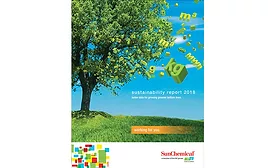
According to Sun Chemical, the 2018 report shows that it achieved its recent energy and water usage goals.
Sun Chemical recently released its 2018 Corporate Sustainability Report, which focuses on how the company’s commitment to sustainability has led to new products and services that help customers improve their eco-efficiency goals.