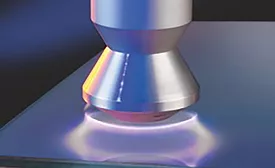
When traditional chemical adhesives fail to sufficiently bond dissimilar types of materials, engineers often turn to plasma treatments to solve complex adhesion problems
Whether bonding metal to plastic, silicon to glass, polymers to other polymers of different durometers, biological content to polymeric microtiter plates or even bonding to polytetrafluoroethylene (PTFE), plasma can be used to promote adhesion. Adhesion promotion can be achieved by increasing the surface free energy through several mechanisms, including precision cleaning, chemically or physically modifying the surface, increasing surface area by roughening, and primer coatings, according to Michael Barden of PVA TePla, a company that designs and manufactures plasma systems.
As a supplier, imagine knowing that almost any material was bondable. How much more productive would your work be if you could focus on such factors as environmental resistance, structural strength or cure speed?
Nordson MARCH, a Nordson® company, recently announced that recent studies have shown that plasma treatment of printed circuit boards (PCBs) prior to conformal coating improves the adhesion of the coatings.
Although five major bonding mechanisms are associated with adhesion promotion, two primary factors predominately influence the adhesion of any type of polymer to another substrate: chemical surface-to-surface interaction at the molecular level, and the wettability of the adhesive so as to enable surface spreading. Adhesion values can also be influenced by the matrix, or vehicle, that enables surface wet-out.