Ancient Adhesive Discovered on Neanderthal Tools
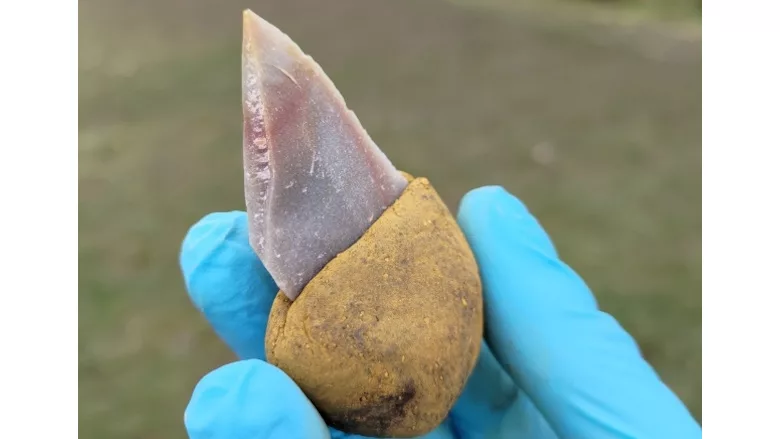
A stone tool glued into a handle made of liquid bitumen with the addition of 55 percent ochre. It is no longer sticky and can be handled easily. Image courtesy of Patrick Schmidt, University of Tübingen.
A team of scientists has discovered that Neanderthals created stone tools held together by a multi-component adhesive. Its findings, which are the earliest evidence of a complex adhesive in Europe, suggest these predecessors to modern humans had a higher level of cognition and cultural development than previously thought. The work, reported in the journal Science Advances, included researchers from New York University (NYU), the University of Tübingen, and the National Museums in Berlin.
“These astonishingly well-preserved tools showcase a technical solution broadly similar to examples of tools made by early modern humans in Africa, but the exact recipe reflects a Neanderthal ‘spin,’ which is the production of grips for handheld tools,” explained Radu Iovita, an associate professor at NYU’s Center for the Study of Human Origins.
A research team, led by Patrick Schmidt from the University of Tübingen’s Early Prehistory and Quaternary Ecology section and Ewa Dutkiewicz from the Museum of Prehistory and Early History at the National Museums in Berlin, re-examined previous finds from Le Moustier, an archaeological site in France that was discovered in the early 20th century.
The stone tools from Le Moustier — used by Neanderthals during the Middle Palaeolithic period of the Mousterian between 120,000 and 40,000 years ago — are kept in the collection of Berlin’s Museum of Prehistory and Early History and had not previously been examined in detail. The tools were rediscovered during an internal review of the collection and their scientific value was recognized.
“The items had been individually wrapped and untouched since the 1960s,” said Dutkiewicz. “As a result, the adhering remains of organic substances were very well preserved.”
The researchers discovered traces of a mixture of the naturally occurring earth pigment ochre and bitumen on several stone tools, such as scrapers, flakes, and blades. Bitumen can be produced from crude oil, but also occurs naturally in the soil.
“We were surprised that the ochre content was more than 50 percent,” said Schmidt. “This is because air-dried bitumen can be used unaltered as an adhesive but loses its adhesive properties when such large proportions of ochre are added.”
He and his team examined these materials in tensile tests—used to determine strength—and other measures. “It was different when we used liquid bitumen, which is not really suitable for gluing. If 55 percent ochre is added, a malleable mass is formed,” said Schmidt.
The mixture was just sticky enough for a stone tool to remain stuck in it, but without adhering to hands, making it suitable material for a handle. In fact, a microscopic examination of the use-wear traces on these stone tools revealed that the adhesives on the tools from Le Moustier were used in this way.
“The tools showed two kinds of microscopic wear: one is the typical polish on the sharp edges that is generally caused by working other materials,” explained Iovita, who conducted this analysis. “The other is a bright polish distributed all over the presumed hand-held part, but not elsewhere, which we interpreted as the results of abrasion from the ochre due to movement of the tool within the grip.”
The use of adhesives with several components, including various sticky substances such as tree resins and ochre, was previously known from early modern humans, Homo sapiens, in Africa but not from earlier Neanderthals in Europe. Overall, the development of adhesives and their use in the manufacture of tools is considered to be some of the best material evidence of the cultural evolution and cognitive abilities of early humans.
“Compound adhesives are considered to be among the first expressions of the modern cognitive processes that are still active today,” explained Schmidt.
In the Le Moustier region, ochre and bitumen had to be collected from distant locations, which meant a great deal of effort, planning, and a targeted approach, the authors note. “Taking into account the overall context of the finds, we assume that this adhesive material was made by Neanderthals,” concluded Dutkiewicz.
Schmidt added, “What our study shows is that early Homo sapiens in Africa and Neanderthals in Europe had similar thought patterns. Their adhesive technologies have the same significance for our understanding of human evolution.”
Story courtesy of NYU and the University of Tübingen, which contributed to the content.
Looking for a reprint of this article?
From high-res PDFs to custom plaques, order your copy today!