Bonding Technologies on the Rise
Among the factors driving growth in the adhesives and sealants industry are lightweighting, process optimization, and advanced materials.

A recent study by research firm Mordor Intelligence projects that the market for adhesives and sealants is estimated to reach $90.45 billion globally in 2026, with expectations that the market will grow to approximately $120.67 billion by 2031. These figures suggest a compound annual growth rate (CAGR) of 5.9% from 2026 to 2031. Industries driving demand for adhesives and sealants include construction, packaging, automotive, and aerospace. Among these industries, several employ structural bonding adhesives and assembly adhesives.
According to the study, the surge in lightweight, multi-material vehicle assemblies is boosting adhesives demand, accounting for 1.4% of the projected CAGR and impacting regions including North America, Europe, and Asia-Pacific. Additionally, the adoption of healthcare wearables is driving demand for medical-grade reactive hot-melt adhesives in Europe, Asia-Pacific, and North America. Demand is also coming from footwear, woodworking, and electronics, where each of these markets requires chemistries that balance speed, flexibility, and environmental profiles that meet customer needs.
Structural Adhesives and Aerospace Applications
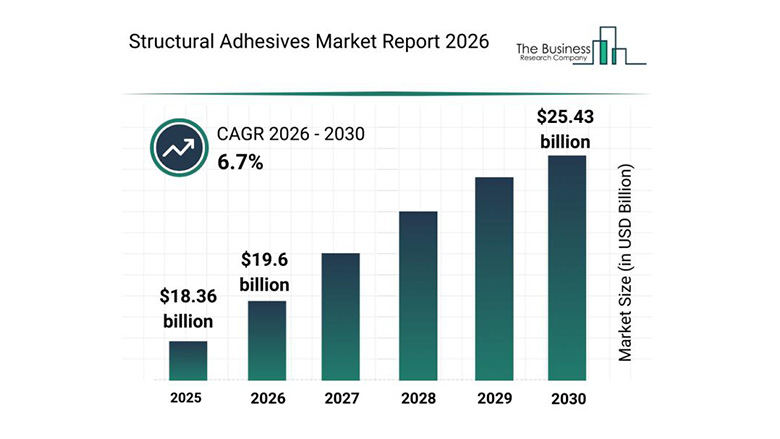
According to a report by The Business Research Co., the market for structural adhesives is expected to experience significant expansion in the coming years, reaching a projected value of $25.43 billion by 2030 and expanding at a compound annual growth rate (CAGR) of 6.7% during the forecast period. Growth in this market is largely fueled by increasing electric vehicle production, the rise of renewable energy projects, the adoption of lightweight materials, the use of advanced composites, and ongoing infrastructure upgrades.
Among the trends shaping the market are the broader application of lightweight vehicle frames, the substitution of mechanical fasteners with adhesives, rising demand in composite bonding, and growth within the wind energy and aerospace sectors. Innovations in high-strength adhesive formulations are expected to play a crucial role in the growing demand for structural adhesives.
In the aerospace segment, a recent study by Future Market Insights expects demand for these adhesives and sealants to grow at a CAGR of 5.1% from 2025 to 2035. Revenue is projected to increase from $1,070 million in 2025 to $1,760 million by 2035. Adhesives are estimated to account for 56.4% of that market, as they provide superior load distribution and enhanced fatigue resistance compared to mechanical fasteners. Additionally, adhesives enable the bonding of diverse materials, including metals, composites, and polymers. This diversity facilitates continued innovation in lightweight and structurally optimized assemblies, with formulations that withstand extreme temperature fluctuations, vibration, and chemical exposure. Adhesives are also increasingly being employed in both assembly and repair applications within the aerospace segment, improving efficiency, reducing weight, and extending component life.
The Rise of Adhesive Tapes
In the automotive segment, adhesive tapes are poised for notable expansion. The rise of electric vehicles and advancements in material technologies are helping drive this growth. According to a report from The Business Research Co., these developments are creating new demands and opportunities for adhesive tape solutions tailored to modern automotive applications.
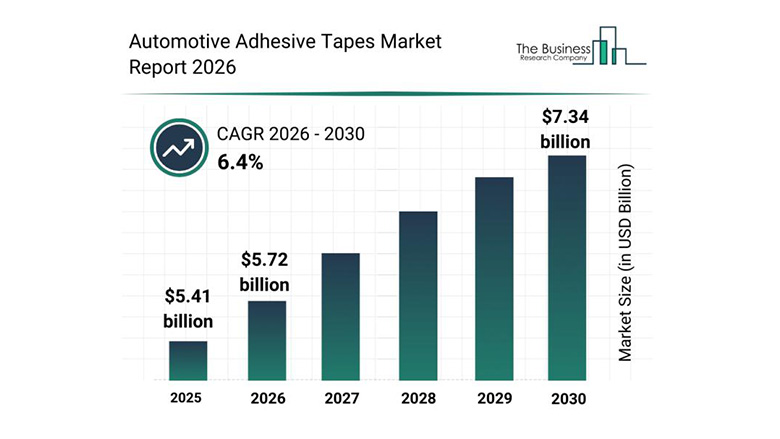
With these new technologies, the automotive adhesive tapes market is anticipated to reach a valuation of $7.34 billion by 2030. This increase corresponds to a CAGR of 6.4% during the forecast period. Factors driving this expansion include the surge in electric vehicle production, the adoption of advanced materials, the need for faster assembly processes, and a growing preference for sustainable adhesive products. Additionally, the integration of electronics into vehicles further propels demand. Upcoming trends are expected to center on lightweight bonding alternatives that replace traditional mechanical fasteners, expanded applications in electric vehicles and electronics, noise and vibration reduction, and the use of high-temperature-resistant tapes. Adhesive tapes will help to facilitate debonding, helping companies comply with upcoming right to repair and recycling regulations.
More broadly, the automotive adhesives segment is expected to grow, with one report predicting a market value of $13.6 billion by 2030, growing at a CAGR of 9.3% from 2024 to 2030. As noted earlier, advancements in adhesive formulations are driving adoption across both traditional and electric vehicle segments. Furthermore, escalating consumer demand for vehicle customization and cost-effective manufacturing is anticipated to support continued market growth.
For additional information about the two market reports cited in this article, visit thebusinessresearchcompany.com, futuremarketinsights.com, and mordorintelligence.com.
Looking for a reprint of this article?
From high-res PDFs to custom plaques, order your copy today!