Dual-Cure Adhesive Meets Demands of Advanced Medical Device Manufacturing
The one-component adhesive system offers optical clarity, chemical resistance, and compatibility with a wide range of sterilization methods.
The global medical devices market continues expansion as healthcare systems invest in advanced diagnostics, minimally invasive procedures, wearable monitoring technologies, and connected care platforms. According to a market study by Future Market Insights, the medical devices market was valued at approximately $678.9 billion in 2025 and is projected to reach nearly $1.29 trillion by 2036, growing at a 6% compound annual growth rate. Drivers of growth include: increasing demand for in vitro diagnostics, hospital modernization, aging populations, and the continued integration of AI-enabled healthcare technologies. EY’s Pulse of the MedTech Industry 2025 report noted that the medtech sector achieved its seventh consecutive year of revenue growth. According to the EY study, growth is driven by strong investment activity, expanding digital health capabilities, and increased focus on robotics, cardiovascular technologies, and diabetes care.
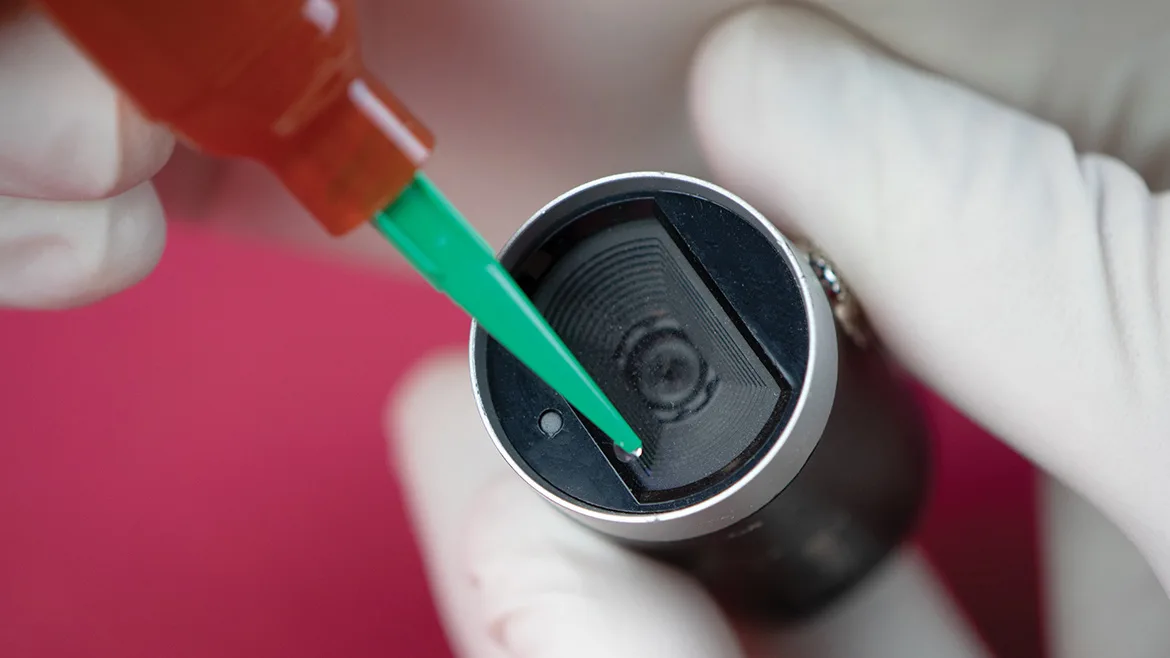
As the medical device market continues to grow, providers of this technology look to adhesive technologies to streamline production, ensure device safety and longevity, and meet regulatory requirements. Master Bond recently introduced a new one-component, dual-cure adhesive system developed for the assembly of medical devices.
Master Bond UV26DCMed is designed for reusable devices that require repeated sterilization, including steam autoclaving, ethylene oxide, and glutaraldehyde. The system also demonstrates compatibility with various hydrogen peroxide sterilization systems. It is bio-compatible and meets ISO 10993-5 requirements for non-cytotoxicity.
UV26DCMed utilizes UV light for rapid fixturing and heat to fully polymerize shadowed-out areas. The adhesive cures upon exposure to a UV light source (320–365 nm), followed by a secondary heat cure at 110–125 °C for 60–90 minutes. To optimize performance properties and ensure maximum chemical resistance, an additional post-cure at 120–150 °C for 1–2 hours is recommended.
The adhesive system provides optical clarity and maintains a low viscosity of 500–3,500 cps at 24 °C, which facilitates easy application and flow. Its high mechanical strength is demonstrated by a tensile strength of 6,000–8,000 psi and a tensile modulus exceeding 750,000 psi. The system is serviceable over a wide temperature range from -60 °F to +500 °F (-51 °C to +260 °C) and features a high glass transition temperature (Tg) of 160–170 °C. Electrically non-conductive with a volume resistivity greater than 1014 ohm-cm, it bonds effectively to metals, glass, plastics, and ceramics.
The one-component system is available for use in syringes, as well as ½-pint, pint, quart, and gallon containers. Its suitability for automated dispensing makes it ideal for high-speed manufacturing environments.
Learn more at masterbond.com.
Looking for a reprint of this article?
From high-res PDFs to custom plaques, order your copy today!